Could an earlier consular interview be possible? Applicants may request an expedited appointment for an emergency, humanitarian reason, or critical employment need, subject to the consulate’s criteria. A consular interview preparation lawyer in San Jose can help assess the request and prepare the supporting information, while also helping you get ready for the interview itself.
Preparing for a consular interview involves more than collecting paperwork. Required documents depend on the visa category, and clear, consistent answers matter when interview responses must match the application. A consular interview preparation lawyer in San Jose can help review forms and supporting documents, practice likely questions, assess an expedited appointment request, address inconsistencies, and prepare for a marriage-based immigrant visa interview. In marriage cases, that means paying close attention to relationship evidence and the details in the application so you can approach the interview with a clear plan.
Key Takeaways
- Learn how visa type and consulate procedures shape the documents and evidence to prepare for an interview.
- See how reviewing application details and practicing clear, truthful answers can help address inconsistencies.
- Understand when an expedited appointment request may be considered and what circumstances can support it.
- Explore why marriage-based cases call for careful preparation of relationship evidence and interview responses.
- Find out how legal preparation can help organize the case and tailor interview practice to its specific issues.
Consular interview document review and practice questions with an immigration lawyer
For an immigrant visa, required forms and evidence depend on the visa category. Consular processing also involves the embassy or consulate handling the case, where interview procedures and document requirements can differ. An immigration lawyer can review the application alongside the case history, flag missing or inconsistent details, and tailor interview practice to the applicant’s actual record.
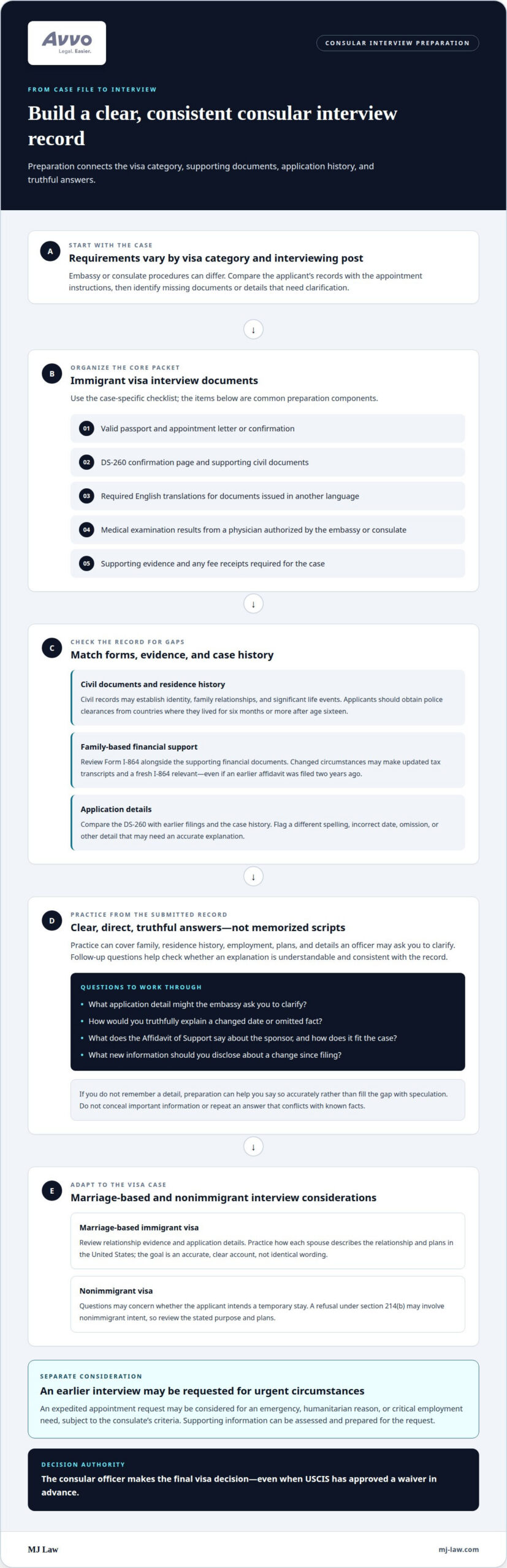
For an immigrant visa interview, preparation commonly includes organizing these core items:
- A valid passport and the appointment letter or confirmation.
- The DS-260 confirmation page and supporting civil documents.
- Required English translations for documents issued in another language.
- Medical examination results prepared through a physician authorized by the embassy or consulate.
- Supporting evidence and any fee receipts required for the case.
The checklist depends on the visa type and interviewing post. A lawyer can compare the applicant’s records with the appointment instructions, then flag missing documents or evidence that needs clarification. This helps keep the interview packet organized and consistent with the application already submitted.
Civil documents establish important details in a case. Depending on the application, they may include records about identity, family relationships, and significant life events. Immigrant visa applicants should also obtain police clearances from countries where they lived for six months or more after age sixteen. A lawyer can map the applicant’s residence history against this requirement and identify gaps that need attention.
Family-based cases also require careful review of Form I-864, the Affidavit of Support submitted by the U.S. family member. The lawyer can assess whether the financial-support documents align with the information in the form and whether changed circumstances call for updated materials. For example, a change in the petitioner’s situation may make updated tax transcripts and a fresh I-864 relevant, even if an earlier affidavit was filed two years ago.
Interview practice should be based on the submitted forms and evidence, not memorized scripts. A lawyer can ask about the applicant’s family, residence history, employment, and plans, then compare the answers with the record. Practice helps uncover unclear dates or discrepancies in advance, so the applicant can explain them truthfully and directly. The U.S. Department of State states that a consular officer makes the final visa decision, even when USCIS has approved a waiver in advance.
When choosing an immigration lawyer in San Jose, look for a practice focused on immigration law with experience in consular processing and the relevant visa category. Ask how the lawyer will review your forms, tailor interview practice, and identify document gaps. Clear answers will help you understand what the preparation involves.
Preparing with a lawyer to answer questions and explain inconsistencies
A consular officer may compare interview answers with the forms and supporting evidence. If an answer differs from the application or introduces new information, the officer may deny it. Lawyer-led preparation focuses on understanding the record and giving truthful, direct answers, not memorizing a script designed to secure approval.
The lawyer can review the DS-260 alongside earlier filings and identify details that may prompt follow-up questions. A different spelling, an incorrect date, or an omission can have an ordinary explanation, but the applicant should understand the discrepancy before speaking with the officer. Preparation connects the explanation to the relevant record, rather than relying on a guess under pressure.
For a marriage-based case, practice can focus on how each spouse describes the relationship and plans in the United States. If one spouse recalls a milestone differently from a date in the application, a lawyer can identify the discrepancy and help the applicant explain what happened accurately. The goal is a clear account, not identical wording from both spouses.
A focused practice session can work through questions such as:
- What detail in the submitted application might the embassy ask you to clarify?
- How would you explain a changed date or an omitted fact truthfully?
- What does the Affidavit of Support say about the sponsor, and how does that fit the case?
- What new information should you disclose if the officer asks about a change since filing?
A lawyer can then ask follow-up questions, as an officer might, to check whether an answer is understandable and consistent with the record. If the applicant does not remember a detail, preparation can address how to say so accurately rather than fill the gap with speculation.
In a nonimmigrant visa case, questions may also concern whether the applicant intends a temporary stay. A refusal under section 214(b) may involve nonimmigrant intent. Reviewing the application’s stated purpose and the applicant’s plans helps keep responses accurate and focused on the question asked.
Preparation also includes distinguishing an honest correction from a misleading answer. The lawyer can help identify whether a form contains an error, whether an explanation needs supporting context, and which facts require a clear response. An applicant should not conceal important information or repeat an answer that conflicts with known facts. For a discussion about interview preparation, bring the questions or discrepancies causing concern.
5. Marriage-based green card interviews
A marriage-based immigrant visa interview tests whether the application and the couple’s accounts fit together. The U.S. citizen or lawful permanent resident petitioner files Form I-130, and the applicant completes Form DS-260 during consular processing. The interview then gives the consular officer an opportunity to ask about the marriage and the applicant’s plans.
Family members typically attend their consular interview together at the same consulate. A U.S. consular immigrant visa interview typically lasts five to fifteen minutes. Even a short meeting can cover important facts, so preparation should focus on accurate, consistent answers rather than rehearsed speeches.
For a marriage-based case, interview practice can connect the couple’s history with the submitted visa application. A lawyer can ask each spouse about the relationship timeline, current marital status, and plans after the applicant arrives in the United States. Their answers do not need to use identical wording, but both spouses should understand the key facts in the petition and supporting evidence.
- How did the relationship develop, and what milestones appear in the couple’s records?
- What is each spouse’s current employment, and how does that match the application?
- Where do the spouses plan to live after the immigrant arrives?
- Has any important detail changed since the petition or visa application was filed?
These examples cover likely topics, not a script for every embassy interview. An officer may ask about employment, marital status, or plans after arrival. A lawyer can tailor practice to the couple’s filing and flag details that need a clear explanation, such as a changed address or a date remembered differently.
Relationship evidence should support a coherent account, not replace one. During preparation, a lawyer can connect documents to relevant events and help the couple explain what a record shows. For example, if a document lists an earlier address, the couple can be ready to explain when they moved and why the older information appears.
Honesty is essential. Providing false information or concealing important facts at a consular interview may result in permanent exclusion from the United States. If the applicant cannot recall a detail, answering truthfully is safer than guessing. The takeaway: understand the petition, know the evidence, and answer the officer’s questions directly. A marriage-based green card interview calls for clear, truthful communication, not memorized answers.
4. Which San Jose immigration attorneys offer consular interview preparation services?
Look for an immigration attorney whose practice includes family immigration and consular processing. That combination matters when a relative’s immigrant visa interview follows a U.S. family petition. Preparation should connect the filed petition, the applicant’s records, and likely interview questions, rather than treating the appointment as a separate task.
A practical review starts with the case’s actual forms. For a family-based immigrant visa, the attorney can compare Form I-130, the DS-260, civil documents, and the Affidavit of Support. The review can identify details that need clarification, such as a difference between a residence date in one record and the timeline described elsewhere. This gives the preparation a specific focus.
Interview preparation should account for the embassy or consulate handling the case. Each post may have its own procedures and requirements, so follow the applicant’s appointment instructions. A lawyer can help arrange documents in a usable order and identify which records support the answers the applicant may need to give.
Look for preparation that covers both evidence and communication. A focused session can use the submitted forms to practice questions about family relationships, residence history, employment, and plans after arrival. If an answer differs from the application, an attorney can help the applicant understand the discrepancy and explain it truthfully. Memorized responses cannot replace an accurate account.
A useful way to assess interview preparation is to consider whether it follows clear, case-specific steps:
- Review the visa category and submitted forms, including the DS-260.
- Identify missing records or inconsistencies across the petition and supporting evidence.
- Tailor practice questions to the applicant’s own history and documents.
- Explain how to respond directly if the officer asks about a changed fact.
For example, if the applicant’s employment changed after filing, preparation can address how that change relates to the information already submitted. If a marriage-based case includes a date discrepancy, an attorney can help organize the relevant context without coaching either spouse to change an answer.
For applicants in San Jose and the San Francisco area, these details help distinguish interview preparation from general immigration assistance. A good fit is an attorney who can explain how the application, supporting evidence, and interview practice work together for the specific visa case. Preparation should help applicants present their own facts clearly, while the consular officer makes the final visa decision.
How can a lawyer help me prepare for a marriage-based immigrant visa interview abroad?
A lawyer can connect your marriage petition, submitted forms, and interview preparation into one focused review. In a marriage-based consular case, the U.S. family petitioner files Form I-130, and the immigrant applicant completes Form DS-260. Reviewing those records together helps identify details that need clarification before the embassy appointment.
Preparation starts with the interview instructions for the specific embassy or consulate. The lawyer can organize the case documents and identify items that need attention, including the appointment letter, passport, civil documents, and DS-260 confirmation page. Required English translations and supporting evidence also belong in the case-specific packet. The post’s instructions guide which records apply.
A lawyer can also help coordinate preparation around other interview requirements. Consular-processing applicants need a medical examination from a physician authorized by the U.S. embassy or consulate before the interview. Applicants should also bring two compliant photos. These items can be included in the preparation plan, alongside a review of any gaps in the documents provided.
Practice should reflect the couple’s actual history. A lawyer can ask about how the relationship developed, important milestones, each spouse’s employment, and plans after arrival in the United States. If the application lists an earlier address or a date that one spouse remembers differently, the lawyer can help clarify the timeline using the couple’s records. The aim is truthful, direct answers, not identical scripts.
Practical preparation also covers the appointment itself. Applicants should arrive early and dress professionally. A lawyer can explain the interview sequence and help the applicant practice listening to the full question before responding. For example, if an officer asks about a change since filing, the applicant can address that specific point rather than offer unrelated details.
An attorney does not represent an applicant inside a consular interview. Unlike some interviews at USCIS offices in the United States, applicants cannot bring an attorney to represent them at a consular interview. Advance preparation is therefore useful: the lawyer can review forms and practice questions beforehand, while the applicant answers the officer personally.
If a marriage-based immigrant visa interview is approaching, schedule a preparation discussion to address the case documents, likely questions, and any details that need a clear explanation.
MJ Law
MJ Law helps people navigate complex immigration matters, including family-based cases involving consular processing. If your marriage-based green card interview is approaching, legal support can help you review case documents, identify details that need explanation, and prepare for questions about your application and relationship.
Consider working with an attorney if your records contain inconsistencies, your circumstances have changed, or you want preparation tailored to your case. The aim is to understand the evidence and answer accurately, not memorize a script or expect a particular decision.
For a conversation about your case, contact MJ Law.
Take the next step with a clear preparation plan
Interview preparation should reflect the details of your case, not a generic checklist. Speaking with a consular interview preparation lawyer in San Jose can help you identify what needs attention, whether that means organizing supporting evidence, addressing a discrepancy, or practicing how to explain your history clearly. For a marriage-based case, focused legal guidance can keep preparation aligned with the petition and documents already submitted.
MJ Law provides family immigration services for people navigating immigration matters involving relatives. If an interview is approaching or a question in your application concerns you, discussing your circumstances with the firm can clarify a practical next step. Legal preparation supports clear, truthful communication, while the consular officer makes the visa decision.
Contact MJ Law to discuss your interview and move forward with a more focused preparation plan.
Frequently Asked Questions
How long does consular processing take?
Consular processing time depends on the visa category, visa availability, and case progress through USCIS, the National Visa Center, and the embassy or consulate. Family-based cases that require an immigrant visa number can involve a wait tracked in the Visa Bulletin, which is published monthly. Missing documents or further review can also cause delays. The case’s current stage helps explain which factors affect its progress.
Can my family interview together?
Family members typically attend their consular interview together at the same consulate. Each applicant should still be ready to answer questions about their own application and circumstances. For example, a parent and child may share an appointment, but the questions can differ according to each person’s case. Follow the appointment instructions for the specific post, since its procedures determine how the group should attend and what each applicant must bring.
What if my visa is refused?
Start by identifying the refusal basis and any instructions the consular officer provided. A refusal under section 221(g) can involve a request for additional information or further case review. For a travel visa refusal, applicants may reapply, but they cannot appeal the decision. A new application should address the circumstances behind the refusal and accurately disclose relevant changes rather than simply repeat the earlier filing.
What is administrative processing under section 221(g)?
Section 221(g) can apply when a visa decision is delayed while the applicant provides additional information or the case receives further review. It is not necessarily a final refusal. Read the instructions given with the decision and respond to any document request as directed. For example, if the officer requests a missing record, provide the requested item in the required manner and keep a copy for your records.
What does a consular interview preparation lawyer in San Jose help with?
A lawyer can assess how the submitted application, supporting records, and interview answers fit together. Preparation may include identifying an inconsistency, organizing a response to a document request, or assessing whether an expedited appointment request addresses an emergency, humanitarian reason, or critical employment need. Each consulate sets its own expedited-appointment criteria. The lawyer helps prepare the case, while the consular officer makes the visa decision.
What documents should I bring to a U.S. consular visa interview?
Bring the documents listed in the specific embassy or consulate instructions for your visa category. An immigrant visa applicant’s packet commonly includes a passport, appointment letter, DS-260 confirmation page, civil documents, required translations, and supporting evidence. The medical examination report and two compliant photos may also be required. Keep documents organized so you can provide the requested record promptly, and follow the post’s directions about originals and copies.
What questions are commonly asked at immigrant visa consular interviews?
Questions often cover family relationships, employment history, marital status, and plans after arriving in the United States. A family-based applicant may be asked about the petitioner or the purpose of the move. Exact questions depend on the visa classification and the application. Answer the question asked, provide truthful information, and clearly explain if a detail has changed since filing.
What are the current U.S. consular interview rules and procedures?
Consular interviews follow federal regulations and Department of State procedures for assessing eligibility under the visa classification. The embassy or consulate handling the case sets its own appointment instructions and document procedures. Applicants should follow the instructions for their specific post and application type. An attorney cannot represent an applicant inside the consular interview, so preparation takes place beforehand and the applicant answers the officer directly.