
An H-1B plan and a green card plan can work together. H-1B status is dual intent, so pursuing permanent residency doesn’t by itself conflict with maintaining H-1B status. A tech worker permanent residency attorney in Silicon Valley can help coordinate the work visa and employment-based green card process, including PERM labor certification and Form I-140.
It’s understandable to want clear guidance on how the steps fit together, what evidence is needed, and how worksite details may affect a petition or a request for evidence (RFE). This article explains how a tech worker permanent residency attorney in Silicon Valley can help shape a green card plan, develop supporting evidence, and respond to worksite-related questions, so you can prepare for the decisions ahead.
Key Takeaways
- H-1B status and a green card plan can work alongside each other, but the steps need to be coordinated.
- Learn how PERM and Form I-140 fit into an employer-sponsored permanent residency plan.
- See how organized evidence and clear petition drafting can address questions about a tech role or worksite.
- Understand what to look for in legal support for a tech worker’s employment-based immigration process.
- Explore how MJ Law’s employment-based visa services can support workers planning for permanent residency.
1. Do H-1B lawyers handle green cards too?
Yes. Immigration attorneys can coordinate H-1B matters with employment-based green card planning. In the United States, employment-based immigrant visas provide a pathway to lawful permanent residency. Their preference categories have different eligibility criteria and evidence requirements, so the right route depends on the worker’s qualifications and employer’s plans.
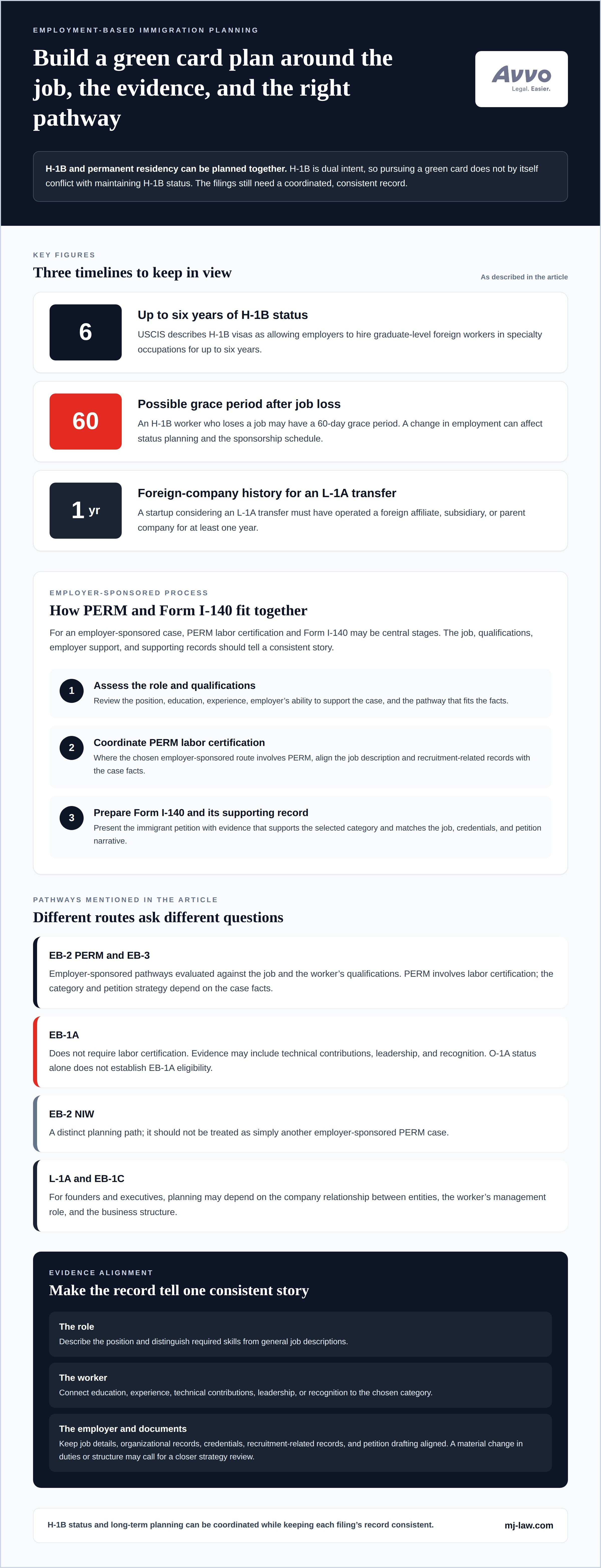
H-1B status is dual intent, meaning pursuing a green card does not by itself conflict with maintaining H-1B status. U.S. Citizenship and Immigration Services describes H-1B visas as allowing employers to hire graduate-level foreign workers in specialty occupations for up to six years. The H-1B petition is employer-filed, while the employee supplies details about education, duties, and immigration history. Coordinating those records can help keep temporary work authorization and longer-term planning aligned.
The employer’s role matters because the H-1B employer is the petitioner, not the worker. Under 8 CFR 1.2 and 292.1, an attorney in good standing with any U.S. state bar may represent an H-1B applicant and employer. Representation must still account for who the client is and whose interests the attorney serves. For example, a company may need advice about its petition, while an employee needs guidance about personal status and future immigration options.
Startup structures call for particular attention. A founder may hold equity, direct product work, and perform a specialized technical role. The petition must clearly explain the employer, the position, and the working relationship. Immigration counsel can review organizational records alongside job information, rather than treating the company chart and employee’s duties as unrelated details. That alignment matters when the same employer later supports an employment-based green card process.
Employment-based pathways include labor-certification-based sponsorship and categories with different criteria. PERM may be one step in an employer-sponsored process; other routes rely on different qualifications and supporting documentation. A technology professional’s role, credentials, and career record help determine which pathway merits evaluation. A worker with evidence of extraordinary ability, for example, may face different questions from an employee whose case depends on a specific employer and position.
Timing also deserves prompt attention. According to U.S. Citizenship and Immigration Services, an H-1B worker who loses a job may have a 60-day grace period, identified as 1B. A change in employment can therefore affect the schedule for addressing status and future sponsorship. Legal support can connect that immediate issue with the broader green card plan, including whether the existing employer remains involved and what records the next filing requires.
3. Planning a green card through PERM and Form I-140
A green card plan should connect the worker’s role, qualifications, and employer’s needs to a suitable employment-based category. For an employer-sponsored case, PERM labor certification and Form I-140 may form central stages. PERM concerns the labor-certification process, while Form I-140 is the immigrant petition. A lawyer can coordinate the sequence, assess the available records, and identify gaps before filings are prepared.
Planning starts with the job itself. Counsel reviews the position, the worker’s education and experience, and the employer’s ability to support the proposed case. For a specialized software role, the analysis should distinguish required skills from general job descriptions and match those requirements to credible evidence. The employer and employee also need a consistent account of the position across immigration filings. A material shift in duties or organizational structure may call for a closer review of the strategy and supporting documents.
EB-2 PERM and EB-3 are employer-sponsored pathways that can be evaluated alongside the job and the worker’s qualifications. The PERM route involves labor certification; the category and petition strategy depend on the case’s facts. Form I-140 then presents the immigrant petition and its supporting record. A well-managed process keeps the job description, recruitment-related records, credentials, and petition narrative aligned rather than treating each document as a separate task.
Some workers may have other options to assess. The EB-1A green card does not require labor certification, and an O-1A history may help frame a record of extraordinary ability. However, holding O-1A status alone does not establish eligibility for EB-1A. A lawyer can review evidence such as technical contributions, leadership, and recognition, then determine how the record relates to the intended category. EB-2 NIW planning also follows a distinct path, so it should not be treated as simply another employer-sponsored PERM case.
For founders and executives, L-1A and EB-1C planning can intersect when a qualifying company structure and leadership role are involved. A startup considering an L-1A transfer must have operated a foreign affiliate, subsidiary, or parent company for at least one year. That requirement makes corporate history relevant to immigration planning. Counsel can examine the relationship between entities, the worker’s management role, and whether the long-term green card strategy fits the business structure.
In California, planning early gives counsel time to compare pathways before a filing deadline or workplace change narrows options. A focused discussion can map the PERM and I-140 sequence against possible EB-1A, NIW, or EB-1C considerations. To discuss how these routes may fit your circumstances, schedule a green card planning conversation.
4. Evidence development and petition drafting
A strong petition connects the requested immigration benefit to a clear, documented record. For a Form I-140 filing, the attorney organizes evidence around the selected employment-based category and the facts supporting eligibility. The goal is not to submit every available document. It is to make each exhibit relevant, understandable, and consistent with the petition’s explanation.
Evidence development starts by identifying what the case needs to establish. Counsel can compare the worker’s education, employment history, role, and achievements with the category’s criteria. For example, a senior software engineer’s project summaries may describe technical impact, but the record is stronger when responsibilities, outcomes, and supporting documents fit together. The attorney identifies gaps and determines which records best explain the work.
For employer-sponsored cases, companies and employees contribute different parts of the record. The employer may provide information about the position, business operations, and organizational structure. The worker may provide credentials, prior employment details, and project evidence. Counsel can reconcile those materials so the job description, résumé, and supporting letters use consistent terms for the role and its responsibilities.
Worksite details deserve careful attention when they raise questions about where duties take place or how the position is structured. The petition should describe the arrangement clearly and match the supporting records. If an RFE asks about a worksite or job detail, the response should address that specific issue, connect evidence directly to it, and avoid unexplained inconsistencies. A focused response is easier to assess than an unfocused stack of documents.
Drafting also calls for a deliberate exhibit sequence. Counsel can label documents, group related records, and explain why each item matters. A technical publication, for instance, may need context about the worker’s contribution, not just a copy of the publication. Letters can explain specialized work, while project records can provide concrete examples. The attorney’s written argument then links those exhibits to the petition’s criteria without overstating what they prove.
Timing depends on the evidence collection stage, the case type, and the employer’s ability to provide records. Traditional immigration law firms may take 4 weeks to 3 months to prepare an O-1A petition after evidence collection is complete. That example shows why preparation and drafting are separate parts of a timeline. An attorney can track missing materials and review documents as they arrive, rather than waiting until filing preparation begins.
Before submission, a final review can compare names, dates, job titles, and descriptions across the petition and exhibits. If a worker’s responsibilities changed during a project, the attorney can clarify the sequence and keep the explanation consistent. This review helps present a coherent record and prepares the case team to address follow-up questions with relevant evidence.
4. Silicon Valley immigration attorneys specializing in tech worker permanent residency
For a technology worker, legal support should reflect the actual job and company structure, not rely on a generic petition template. A software engineer, product manager, and machine-learning researcher may have different duties and evidence. An attorney familiar with Silicon Valley employment can help translate technical work into clear descriptions that immigration officials can assess in the context of the petition.
The first step is understanding the worker’s role in context. Counsel can review the job description, reporting relationships, and projects, then compare them with the immigration category being pursued. For example, a senior engineer’s role may combine hands-on development with technical leadership. A precise description should distinguish those responsibilities and explain how the position fits the employer’s operations.
Company structure also affects how the facts are presented. In a startup, a founder may hold an ownership interest while performing technical or managerial duties. A growing company may reorganize teams or update job titles as products develop. Counsel can trace those changes through organizational records and employment documents, helping the petition explain who directs the work and how the position has evolved.
Worksite information requires the same care. A technology employee may work from a company office, a client location, or remotely. The legal team can assemble a clear account of the work location, duties, and relevant business relationships. If USCIS issues an RFE about a worksite, a focused response can address the precise concern and connect it to supporting records.
Category selection should follow the evidence, not a preferred label. An attorney can assess whether the case depends on employer sponsorship, evidence of extraordinary ability, or another employment-based pathway. A technical publication, product contribution, or leadership role may be relevant, but each item needs context. Counsel can identify what a document demonstrates and avoid presenting ordinary job duties as proof of a different claim.
Strong coordination matters when the worker and employer provide separate records. The employee may provide education and career documents, while the company provides position and organizational information. Counsel can compare dates, titles, duties, and project descriptions across those materials. For instance, a résumé and employer letter should explain a promotion consistently, even if the worker’s responsibilities changed during product development.
A useful process assigns responsibilities early. The attorney identifies needed records, explains how they support the petition, drafts the legal narrative, and organizes exhibits for review. The worker can clarify technical terms, while the employer can explain business operations and reporting lines. This collaborative approach helps keep the filing coherent and prepares the team to address questions while maintaining focus on the permanent residency strategy.
What a permanent residency attorney for tech workers in Silicon Valley should provide
For a technology worker, effective legal support begins with a clear assessment of the current status, employment, and permanent residency objective. An attorney should identify whether the matter involves H-1B continuity, PERM labor certification, Form I-140, or another employment-based category. That initial review connects the immediate filing to the longer-term plan and clarifies which employer records and personal documents the case will need.
Look for a process that clearly explains the worker’s and employer’s responsibilities. In an employer-sponsored case, company representatives may provide job and organizational information, while the employee supplies education and career records. The attorney can coordinate those materials, flag inconsistencies in titles or duties, and explain how each item supports the petition. For example, a software engineer’s résumé and employer letter should describe the role consistently.
A careful legal strategy should also account for company changes. A startup may revise reporting lines, move a product team, or update a worker’s responsibilities during the filing process. Counsel should consider how those developments relate to the petition and supporting evidence. If a worksite-related RFE arrives, the response should address the specific question with relevant records and a focused explanation.
Clear communication matters throughout drafting and review. The attorney should explain the filing sequence, identify what information remains outstanding, and share the reasoning behind the proposed category. For instance, a worker whose case relies on employer sponsorship should understand how the job description connects to PERM and Form I-140. A worker with a record of extraordinary ability may need a different evidence strategy.
Ask for a defined approach to document review and petition preparation. A reliable workflow organizes records by purpose, checks that dates and job details align, and gives the worker and employer a chance to resolve factual questions before filing. For a technical project, counsel should help explain the worker’s specific contribution, rather than simply attach product materials without context. That distinction can make the evidence easier to follow.
Support should extend beyond preparing the initial filing. An attorney can explain how an RFE will be handled, what documents may address the issue, and how the response fits the case record. The discussion should also cover how employment changes could affect the strategy, rather than treating each petition as an isolated task. A tech worker permanent residency attorney in Silicon Valley should connect legal analysis with the realities of the role and company.
Before moving forward, establish who will coordinate employer information, review drafts, and communicate filing updates. A focused meeting can clarify those steps and help determine whether the proposed approach fits your employment-based goal. Schedule a conversation about your immigration strategy.
MJ Law
MJ Law can help technology professionals connect H-1B matters with longer-term employment-based immigration planning. Its employment-based visa services can support workers and employers assessing a green card pathway, preparing petition evidence, or responding to worksite-related questions. The process starts by understanding the employment situation and immigration goal, then identifying the legal issues and records relevant to the case.
Consider reaching out when you’re planning a transition from temporary work status, preparing an employer-sponsored petition, or addressing an immigration request. A conversation can help clarify the next steps and the information needed to assess your matter. Contact MJ Law to discuss your employment-based immigration needs.
Make your next immigration decision with a clear plan
Your next career move can affect both your employment and your long-term immigration strategy. Before changing roles, company structure, or worksite, consider how the decision fits your residency goals. A tech worker permanent residency attorney in Silicon Valley can help frame the legal questions, coordinate relevant records, and clarify next steps with you and your employer.
MJ Law provides Employment-Based Visas, alongside Family Immigration Services and Business and Investor Visas. If you’re considering an employer-supported green card plan or need guidance on how a work visa fits your broader goals, contact MJ Law to discuss a practical direction for your case.
Contact MJ Law about your case to discuss your immigration needs. A considered plan can help you approach the next stage with greater clarity and confidence.
Frequently Asked Questions
Do H-1B lawyers handle green cards too?
Yes, an immigration attorney may assist with both H-1B matters and employment-based green card planning. The work can involve coordinating the employee’s status questions with the employer’s sponsorship plans. For example, if a company is considering permanent residency support after an H-1B filing, counsel can assess how the proposed job and records fit the longer-term case. Confirming who the attorney represents helps clarify responsibilities.
What are the EB-2 NIW eligibility requirements for technology professionals?
Eligibility depends on the EB-2 NIW category’s criteria and the evidence supporting the technology professional’s case. An attorney can assess the worker’s specialized background, proposed work, and relevant career record, then identify what the evidence establishes and where it needs context. A worker should not assume that a strong technical résumé alone answers every eligibility question. The legal analysis should distinguish this pathway from an employer’s PERM-based plan.
What are the EB-1A green card requirements for tech workers?
EB-1A is an employment-based green card category associated with extraordinary ability, and it does not require labor certification. A technology worker’s case therefore needs an evidence strategy tailored to that category, rather than simply relying on job duties or an employer’s sponsorship. Counsel can assess the worker’s record against the applicable criteria and organize supporting materials so the petition explains the significance of each item clearly.
What are the PERM labor certification and employer-sponsored green card steps for tech workers?
The process generally links the employer’s PERM labor-certification stage with a later Form I-140 immigrant petition. Counsel first reviews the position and employer information, then coordinates records and prepares the relevant filings in sequence. For a technology role, the job description and employment records should consistently describe the position. Changes to duties or company structure during preparation may affect what needs review before submission.
How long does EB-2 or EB-3 green card processing take for Silicon Valley applicants?
Processing depends on the case’s stages and how quickly the employer can provide complete, consistent information. PERM preparation and Form I-140 are distinct parts of an employer-sponsored plan, and each requires its own documentation and processing. Silicon Valley or San Jose location alone does not set an individual case timeline. Counsel can map the sequence and explain which pending steps affect the overall schedule.
Common risks and denial reasons in tech worker green card applications
Risks include gaps or inconsistencies in the evidence, a mismatch between job requirements and the worker’s qualifications, and unclear descriptions of duties, worksite, or organizational structure. Evidence that does not address the selected category’s criteria may also weaken the petition or prompt an RFE.