
A USCIS denial may leave an administrative route to challenge the decision, but the right filing depends on the decision and the grounds for review. Form I-290B, titled Notice of Appeal or Motion, is used to appeal certain decisions to the Administrative Appeals Office or to ask the USCIS office that issued the latest decision to reopen or reconsider it. People seeking a Form I-290B notice of appeal lawyer in San Jose need to distinguish these options before addressing the deadline.
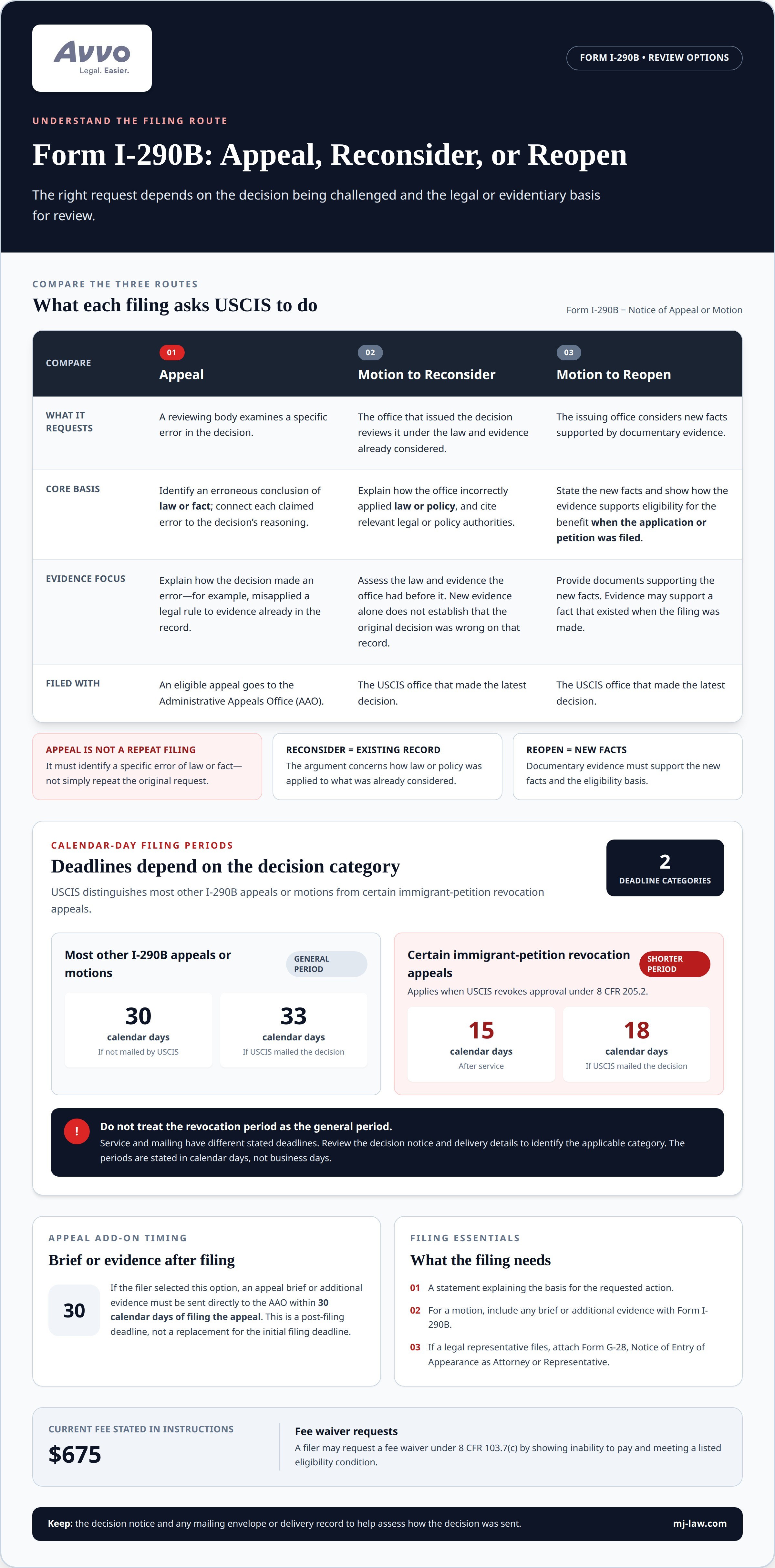
Timing is critical. USCIS states that most other Form I-290B appeals or motions must be filed within 30 calendar days, or 33 calendar days when USCIS mailed the decision. Appeals of certain revocations have shorter deadlines: 15 calendar days after service, or 18 calendar days if the decision was mailed.
This article explains what Form I-290B can address, how appeals differ from motions, which decisions may qualify, and how the filing deadlines apply. It also outlines the role of legal representation in assessing the decision, identifying the appropriate basis for review, and preparing a complete filing.
Key Takeaways
- Form I-290B can be used to appeal certain decisions or ask the issuing USCIS office to reopen or reconsider them; the appropriate route depends on the decision and the argument.
- For other Form I-290B appeals or motions, U.S. Citizenship and Immigration Services sets a deadline of 30 calendar days, or 33 calendar days if USCIS mailed the decision.
- An appeal must identify an error of law or fact, while a motion must meet the requirements for reopening or reconsideration and include its supporting basis.
- Eligibility depends on the type of immigration decision. Some matters, including I-130 family petition appeals, generally follow a different review route.
- Legal representation can help assess the decision, filing route, deadline, and supporting evidence. MJ Law’s immigration practice includes family, employment-based, business and investor, and entertainment and artist visas.
What Is the Purpose of Form I-290B?
Form I-290B, titled Notice of Appeal or Motion, is a filing used to challenge certain USCIS decisions. It lets an eligible filer request an appeal or ask the USCIS office that made the latest decision to reopen or reconsider it. The appropriate option depends on the decision and the legal or evidentiary basis for review.
An appeal asks a reviewing body to examine a specific error in a decision. It must identify an erroneous conclusion of law or fact, not simply repeat the original request. For example, an argument might explain how the decision misapplied a legal rule to evidence already in the record. The filing should connect each claimed error to the decision’s reasoning.
A motion to reconsider asks the office that issued the decision to review it under the law and evidence it already considered. The motion must explain how the office incorrectly applied law or policy and cite relevant legal or policy authorities. New evidence alone does not show that the original decision was wrong based on the record then available.
A motion to reopen asks the issuing office to consider new facts supported by documentary evidence. The evidence must show eligibility for the requested immigration benefit when the application or petition was filed. For example, a document supporting a fact that existed at filing may help explain the request to reopen. The motion should state the new facts and show how the evidence supports them.
A brief is a written explanation of the arguments supporting an appeal or motion. Supporting evidence consists of documents submitted to establish facts relevant to that argument. For a motion, any brief or additional evidence must be filed with Form I-290B. The form must also include a statement explaining the basis for the requested action. A legal representative filing the form must attach Form G-28, Notice of Entry of Appearance as Attorney or Representative.
The current Form I-290B filing fee stated in the instructions is $675. A filer may request a fee waiver under 8 CFR 103.7(c) by showing inability to pay and meeting a listed eligibility condition.
Before hiring a San Jose lawyer, ask which review route fits the decision, what specific error or new fact supports it, and what evidence is needed. Ask how the lawyer will assess the record, deadline, and filing requirements.
Common problems include an incomplete form or missing required documents, which may lead to rejection, dismissal, or denial. After filing, USCIS may require an interview or biometrics; the office that issued a denial or revocation has 45 days to review an appeal and decide whether to approve it. That review period is not a complete estimate of the time needed for every case.
Appeal and motion filing deadlines
A filing deadline is the time allowed to submit Form I-290B after a decision. For other Form I-290B appeals or motions, the filing deadline is 30 calendar days, or 33 calendar days if USCIS mailed the decision, according to U.S. Citizenship and Immigration Services. A Form I-290B notice of appeal lawyer in San Jose can assess which period applies to the decision and filing type.
A revocation appeal has a shorter deadline when USCIS revokes approval of an immigrant petition under 8 CFR 205.2. U.S. Citizenship and Immigration Services says Form I-290B must be filed within 15 calendar days after service of the unfavorable decision, or within 18 calendar days if USCIS mailed it. The revocation category matters, so the ordinary deadline should not be assumed.
Service refers to USCIS providing the unfavorable decision, while a mailed decision reaches the recipient through the mail. These distinctions matter because the stated periods differ. For example, a mailed revocation decision falls under the 18-calendar-day period, not the 15-calendar-day period after service. The decision notice and its delivery details help identify which timing rule applies.
Calendar days include weekends and holidays in ordinary usage, so counting only weekdays can mislead. The filing rules state calendar-day periods, not business-day periods. A Form I-290B notice of appeal lawyer in San Jose can review the decision date, whether USCIS mailed or served the notice, and the applicable category before preparing the filing.
Keep the decision notice and any mailing envelope or delivery record with the case documents. These materials can help establish how the decision was sent and support an accurate deadline assessment. If the notice concerns revocation, identify the immigrant petition and the action stated. For another appeal or motion, distinguish the 30-calendar-day period from the 33-calendar-day mailed-decision period.
An appeal brief or additional evidence submitted after the initial filing follows a separate timing point. If the filer selected that option, the brief or evidence must be sent directly to the Administrative Appeals Office within 30 calendar days of filing the appeal. This is a post-filing deadline, not a replacement for the initial Form I-290B deadline.
Deadlines also shape preparation. The argument, supporting documents, completed form, and required attachments need to be assembled within the applicable period. Waiting to determine whether USCIS mailed or served a decision can leave less preparation time. A deadline-focused review can map the relevant dates and filing route; schedule a filing deadline review.
Eligible Form I-290B appeals and motions
Eligibility means the decision and filer qualify for the review route requested. Form I-290B generally permits an appeal or a motion, but not both on one form. The decision notice, the person’s role, and the requested action help determine whether this form fits. A filing must include a statement explaining its basis. A Form I-290B notice of appeal lawyer in San Jose can assess these factors together.
An appeal is a request to review a particular USCIS decision through an administrative appeal route. Some denials or revocations of Form I-140 immigrant petitions may be appealed to the Administrative Appeals Office. The petitioner or another appropriate party with standing may file. The appeal needs to identify a specific erroneous conclusion of law or fact, rather than merely disagree with the outcome.
A motion asks the USCIS office that issued the latest decision to reopen or reconsider it. Motions may address decisions by a field office, service center, or the Administrative Appeals Office. The right option depends on the reason for review: a motion to reopen relies on new facts, while reconsideration challenges how the original decision applied law or policy.
A motion to reopen asks the issuing office to examine new facts supported by documentary evidence. Those facts and documents must show eligibility for the immigration benefit when the application or petition was filed. A motion to reconsider asks the office to reassess its decision using the record available at that time. It must explain the alleged error in applying law or policy and cite relevant authority.
The appeal-or-motion statement explains why the requested review is warranted. For an appeal, it should connect the alleged legal or factual error to the decision. For reopening, it should identify the new facts and supporting documents. For reconsideration, it should cite relevant legal or policy authority and explain the claimed error. A general request to revisit a denial does not establish these distinct grounds.
Some decisions follow different routes. Appeals of Form I-130 family petition decisions generally go to the Board of Immigration Appeals, rather than through the usual Form I-290B appeal route. Some Form I-485 adjustment denials may allow a motion but not an Administrative Appeals Office appeal. Working with a Form I-290B notice of appeal lawyer in San Jose can help identify which route fits the decision and the filer’s role.
The 2009 Form I-290B instructions state that a visa petition beneficiary, or the beneficiary’s attorney or representative, may not file an appeal or motion. The petitioner’s standing and the specific decision remain central eligibility issues. A legal review should identify the decision-maker, the immigration benefit involved, the filer’s role, and whether the requested action is an appeal, reopening, or reconsideration.
Form I-290B purpose and eligibility
Form I-290B is USCIS’s Notice of Appeal or Motion for challenging certain agency decisions. The form provides a route for administrative review, but eligibility depends on the decision, the requested action, and the filer’s role. Its appeal and motion procedures operate under 8 C.F.R. § 103.3 and § 103.5.
An appeal asks a designated reviewing body to examine an unfavorable decision. For a Form I-290B appeal, the filing must identify a specific erroneous conclusion of law or fact. It is not enough to express disagreement with USCIS’s conclusion. The written statement should connect the claimed error to the reasoning and evidence discussed in the decision.
A motion asks the office that issued the latest decision to reopen or reconsider it. A motion to reopen relies on new facts and documentary evidence showing eligibility when the application or petition was filed. A motion to reconsider argues that the decision incorrectly applied law or policy, based on the record available when USCIS decided the case. The two requests require different kinds of support.
The decision type helps identify whether Form I-290B is an available route. Some denials or revocations of Form I-140 immigrant petitions may be appealed to the Administrative Appeals Office by the petitioner or another appropriate party with standing. By contrast, some Form I-485 adjustment denials may permit a motion but not an AAO appeal. The decision notice and underlying benefit therefore matter.
Some immigration decisions use a different administrative path. Appeals involving Form I-130 family petitions generally go to the Board of Immigration Appeals, rather than through the usual AAO appeal route. Form I-290B concerns certain immigration-law decisions in proceedings the Board of Immigration Appeals cannot review. Identifying the decision-maker helps distinguish these routes before filing.
Eligibility also depends on who may bring the challenge. The petitioner or another party with standing may be eligible for some Form I-140 appeals, while the beneficiary’s role may not provide the same filing right. The 2009 Form I-290B instructions state that a visa petition beneficiary, or the beneficiary’s attorney or representative, may not file an appeal or motion. The decision and the filer’s legal role must be considered together.
A practical eligibility review starts with the notice, identifies the agency office and benefit involved, then matches the requested remedy to the record. For example, an alleged legal error in an existing decision points toward reconsideration, while newly documented facts may support reopening. If the route is an appeal, the filing must explain the specific legal or factual error. This focused analysis helps avoid a mismatch between the requested review and the decision being challenged.
Immigration court, BIA, labor, and consular decisions
An immigration court decision is a ruling made in immigration court proceedings, not simply a USCIS decision. Form I-290B concerns certain immigration-law decisions in proceedings the Board of Immigration Appeals cannot review. That distinction matters because the form is not a universal route for challenging every immigration-related outcome. Start by identifying the agency or tribunal named on the decision.
The Board of Immigration Appeals, or BIA, reviews certain immigration decisions through its own process. A case that falls within BIA review does not automatically use the usual Administrative Appeals Office route on Form I-290B. For example, appeals involving Form I-130 family petitions generally follow a BIA route. The decision type and reviewing body determine which procedure applies.
Immigration court and BIA decisions should be distinguished from USCIS administrative decisions before selecting a form. A notice issued by a USCIS field office or service center may involve a different review path from a ruling in immigration court. The practical first step is to match the notice’s issuing body, the benefit involved, and the review instructions. A familiar immigration subject alone does not establish Form I-290B eligibility.
Labor decisions concern matters handled through labor-related processes, while consular decisions arise from consular processing. Those labels do not, by themselves, establish that Form I-290B applies. The key question is whether the challenged action is a decision eligible for this USCIS appeal or motion process. A petition connected to employment, for instance, should not be confused with a labor-agency determination simply because both involve work.
Consular processing also requires attention to who made the decision and what action is being challenged. A consular outcome is not interchangeable with a USCIS denial, even when both relate to the same immigration goal. Form I-290B addresses specified administrative decisions; it should not be treated as a general appeal form for every stage of an immigration matter. The notice and its issuing authority provide the starting point for route analysis.
For a case involving multiple decisions, organize the record by decision rather than by the overall immigration story. Separate a USCIS petition decision from any later court, BIA, labor, or consular action. Then identify the decision-maker and the review route stated for that action. This prevents arguments about one agency’s decision from being directed to another body and clarifies which record and grounds relate to the requested review.
A legal review can map each notice to the correct administrative route and identify whether Form I-290B fits the specific USCIS decision. For help assessing an immigration decision and its review path, schedule a case review.
MJ Law
MJ Law helps people assess immigration decisions and understand whether an appeal or motion may fit their circumstances. The review can focus on the decision, available record, stated reasons, and applicable deadline. This helps clarify whether the issue concerns a family petition, employment-based matter, or another immigration benefit.
Turn to legal counsel when you need help identifying the appropriate review route, organizing supporting documents, or developing arguments tied to the decision. MJ Law’s immigration practice includes Family Immigration Services, Business and Investor Visas, Employment-Based Visas, and Entertainment and Artist Visas. This experience can help frame the immigration matter connected to the decision.
For a considered discussion of your immigration decision, contact MJ Law.
Take the Next Step With a Clear Filing Strategy
The next step is to connect the decision notice with your immigration goal and the record USCIS reviewed. A Form I-290B notice of appeal lawyer in San Jose can assess the decision’s reasoning, identify the central issue, and determine which review route fits the matter. That focused assessment can also clarify what information and documents may be needed to prepare the case.
Before moving forward, consider what you need resolved: whether the decision can be challenged, which arguments the record supports, and how the filing should address the agency’s stated reasons. MJ Law can discuss how an immigration decision relates to a family, business, or employment matter and what legal support may be appropriate.
For a thoughtful review of your situation, contact MJ Law about Form I-290B. A clear understanding of the available path can help you approach the next stage with greater confidence.
Frequently Asked Questions
What evidence should you provide to a San Jose lawyer for a Form I-290B filing?
Provide the complete USCIS decision notice and documents relevant to the original petition or application. Include evidence that addresses the decision’s specific findings, such as records supporting a disputed fact or documents showing eligibility when you filed. For a motion to reopen, organize evidence of the new facts separately. This lets counsel compare the decision’s reasoning with the record and assess what supports the requested review.
What is Form I-290B and what decisions can it appeal or reopen?
Form I-290B is USCIS’s Notice of Appeal or Motion for certain administrative decisions. Depending on the decision, an eligible filer may seek review by the Administrative Appeals Office or ask the USCIS office that issued the latest decision to reopen or reconsider it. Some I-140 decisions may qualify for an appeal, while some I-485 denials may allow a motion. The decision notice and filer’s role help determine eligibility.
How does a San Jose lawyer calculate the deadline to file Form I-290B?
A lawyer identifies the decision category, the date USCIS served or mailed the notice, and the deadline rule that applies. The notice and mailing envelope can help establish how USCIS sent the decision. For example, an appeal of a petition revocation has a different filing period from other Form I-290B matters. Provide counsel with the full notice and delivery materials promptly so the applicable deadline can be assessed.
What documents and evidence should you provide to a lawyer for a Form I-290B filing?
Along with the decision notice, provide copies of the original application or petition, USCIS correspondence, prior responses, and supporting documents. Include any new evidence relevant to a motion to reopen, and identify which records relate to each issue in the decision. If another representative handled the matter, prior filings can help counsel understand the case history and avoid overlooking an argument or document already in the record.
How do a motion to reopen, a motion to reconsider, and an appeal differ on Form I-290B?
An appeal asks an administrative reviewer to examine an identified error in the decision. A motion to reopen presents new facts supported by documents, while a motion to reconsider argues that the office applied law or policy incorrectly based on the existing record. For example, newly available evidence may support reopening; a cited legal authority may support reconsideration. Form I-290B generally calls for choosing one route on the form.
How can I find an experienced immigration lawyer in San Jose for an I-290B case?
Look for counsel who can explain how they will assess the decision notice, filing eligibility, deadline, and supporting record. Ask how they distinguish an appeal from reopening or reconsideration, and what documents they need to evaluate your case. A useful discussion should address the specific USCIS decision, not immigration appeals in general. MJ Law handles immigration matters, including family, business and investor, and employment-based cases.
How does a San Jose lawyer file Form I-290B and track the case?
A lawyer typically reviews the decision and record, prepares the form and supporting statement, and assembles the required attachments. If representing you, the lawyer must include Form G-28, Notice of Entry of Appearance as Attorney or Representative. After filing, keep copies of the submission and delivery records together. Counsel can use later USCIS notices to identify requests for an interview, biometrics, or additional action and explain the next response.