
A motion to reopen does not necessarily put the effects of a USCIS decision on hold. If removal is a concern, a pending motion alone does not stop it. A San Francisco attorney handling a motion to reopen a USCIS petition can help assess what the filing may address and what risks remain while it is pending.
It’s understandable to hope that asking USCIS to revisit a decision will put everything on hold. But a motion to reopen and a request to pause a decision’s effects are different. The grounds also matter: reopening generally relies on new facts supported by evidence, while reconsideration challenges how USCIS applied the law or policy.
This article explains how reopening differs from reconsideration and an appeal, what may happen if USCIS grants a motion, and how USCIS procedures compare with immigration court options. Deadlines, the decision being challenged, and the evidence submitted can all shape the path forward.
Key Takeaways
- Learn how new facts support reopening, while reconsideration challenges the reasoning behind a decision.
- Understand why filing a motion does not automatically pause the consequences of a USCIS decision.
- See how immigration court deadlines and procedures differ from USCIS motion rules.
- Identify which factors can help determine whether a motion, appeal, or new petition fits the situation.
- Find out what a grant of a motion means for the case and what may still need to happen next.
What is the difference between reopening, reconsidering, and appealing?
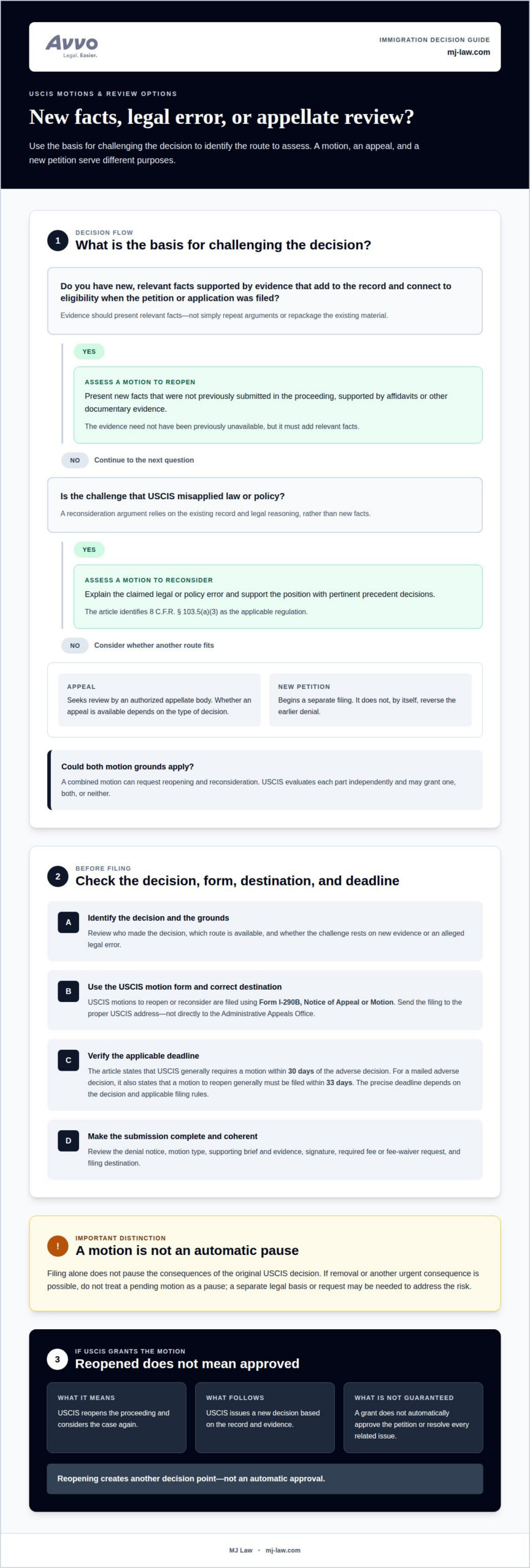
These options challenge an unfavorable decision in different ways: reopening presents new facts, reconsideration identifies an error, and an appeal seeks review by an authorized appellate body. The right route depends on the decision, available evidence, and grounds for challenge. A motion to reopen a USCIS petition with an attorney in San Francisco starts by identifying which grounds the record can support.
New Evidence and Changed Circumstances
A motion to reopen asks USCIS to consider new facts supported by evidence, including relevant circumstances that help establish eligibility. New documents may support a different result, while repeating arguments or resubmitting the same material may not address the denial. The evidence must connect to eligibility when the underlying petition or application was filed. An attorney handling a motion to reopen a USCIS petition in San Francisco can assess that connection.
New Facts and Documentary Evidence
A motion to reopen must present facts that were not previously submitted in the proceeding, supported by affidavits or other documentary evidence. For example, records clarifying a qualifying relationship may support a family petition if they establish eligibility at filing. The evidence need not have been previously unavailable, but it must add relevant facts rather than simply repackage the existing record.
A motion to reconsider takes a different approach. Under 8 C.F.R. § 103.5(a)(3), it states why the decision misapplied law or policy and supports that position with pertinent precedent decisions. It relies on the record and legal reasoning, rather than new facts. A combined motion can request both forms of review, but USCIS evaluates each part independently and may grant one, both, or neither.
For a mailed adverse decision, a motion to reopen a USCIS petition denial generally must be filed within 33 days, according to U.S. Citizenship and Immigration Services. USCIS motions to reopen or reconsider are filed using Form I-290B, Notice of Appeal or Motion, according to U.S. Citizenship and Immigration Services. The filing goes to the proper USCIS address, not directly to the Administrative Appeals Office.
An appeal asks an authorized appellate body to review a decision under the applicable process. Whether an appeal is available depends on the type of decision; a motion is not interchangeable with an appeal. Before selecting a route, the representative identifies the decision-maker, the deadline, and whether the argument relies on new evidence or an alleged legal error. Those distinctions shape what the filing must explain.
- Reopen: Present new, relevant facts and supporting evidence.
- Reconsider: Explain the legal or policy error and cite pertinent precedent.
- Appeal: Seek review through the applicable appellate process.
What happens if the motion is granted?
If USCIS grants a motion, it reopens the proceeding, but does not automatically approve the petition or settle every related issue. USCIS considers the case again and issues a new decision. The outcome depends on the record, the evidence presented, and whether the petitioner establishes eligibility. Reopening creates another decision point, not an automatic approval.
Filing alone does not pause the consequences of the original decision. If removal or another urgent consequence is possible, do not treat a pending motion as a pause. A separate legal basis or request may be needed to address that risk. The motion asks USCIS to revisit the case; it does not guarantee that related actions will stop.
Refiling a petition and moving to reopen serve different purposes. A motion asks USCIS to review the earlier proceeding based on its grounds and supporting record. A new petition begins a separate filing, with eligibility assessed under that petition’s requirements. A new filing does not, by itself, reverse the earlier denial. An attorney can assess whether new facts belong in a reopening request or support a separate petition.
Start by identifying which agency issued the decision, who has authority over the case, and where that agency requires the filing. For a USCIS motion, filing at the correct USCIS address matters; the motion is not filed directly with the Administrative Appeals Office. The correct destination depends on the case and applicable filing instructions, so do not assume that a filing location from another case applies.
Preparing Form I-290B involves more than completing its fields. The attorney reviews the denial notice, identifies the requested type of motion, and connects each legal argument to the relevant record. For reopening, the filing must present new facts and supporting evidence; for reconsideration, it must explain the claimed error. The supporting brief and evidence should accompany the motion, so the submission presents a coherent argument from the outset.
Filing requirements also include the required fee or a fee-waiver request. The attorney checks the applicable instructions, payment or waiver materials, signature, evidence, and destination before submission. U.S. Citizenship and Immigration Services generally requires a motion within 30 days of the adverse decision; the precise deadline depends on the decision and applicable filing rules. A strict deadline makes prompt review of the notice important.
For a focused review of the decision, evidence, and filing route, you can schedule a case review.
Immigration court motions to reopen
An immigration court motion to reopen challenges a removal order in the immigration court system, not a USCIS petition decision. The correct forum depends on which agency entered the order and whether the Board of Immigration Appeals has taken jurisdiction. The record, filing deadline, and reason for reopening all shape the request.
A motion to reopen an immigration court case must be received within 90 days of the final removal order, according to the Electronic Code of Federal Regulations. For an in absentia removal order based on exceptional circumstances, a motion may be filed within 180 days of the order, according to the Electronic Code of Federal Regulations. A motion based on lack of proper notice or custody may be filed at any time.
Usually, a respondent may file only one motion to reopen. If an immigration judge entered the removal order and no appeal followed, the immigration court generally retains jurisdiction. If the person appealed the removal order to the Board of Immigration Appeals, the Board has jurisdiction over the motion, which must be filed there. A motion filed while a Board appeal remains pending is treated as a motion to remand.
Court and USCIS records serve different roles. USCIS records concern petitions and applications decided by that agency. Immigration court records document proceedings before an immigration judge, including hearing notices, orders, and evidence submitted in court. An attorney compares the actual order and procedural history before selecting the forum. A USCIS denial is not challenged by filing a motion with the immigration court.
For a missed hearing, the reason for absence matters. A motion may challenge an in absentia order based on lack of proper notice or custody, while an exceptional-circumstances filing has the 180-day period. Evidence should support the specific ground, such as documents addressing the notice or circumstances surrounding the missed hearing. A motion to reopen based on ineffective assistance of counsel also has procedural requirements established in Matter of Lozada.
When looking for a San Francisco immigration attorney for a motion to reopen, seek counsel who handles removal proceedings and can distinguish immigration court motions from USCIS filings. Ask how the attorney will identify the court with jurisdiction, evaluate the order, and organize supporting evidence. For a USCIS motion, clarify who issued the decision, what grounds support reopening, and what deadline applies. You can request the attorney’s bar number and ask about their experience with USCIS motions and immigration court proceedings.
These records and filing routes matter because a reopened court case and a reopened USCIS proceeding are not the same outcome. When an immigration judge or the Board reopens a case, the existing removal order is vacated. That action returns the case to proceedings; it does not decide the underlying immigration claim.
Choosing between a motion, appeal, or new petition
The right path depends on what went wrong, who issued the decision, and what has changed since filing. A motion addresses the existing record or presents new facts; an appeal asks an authorized body to review a decision; a new petition starts a separate application. These options are not interchangeable, and choosing one does not automatically preserve the others.
Consider a family petition denied because USCIS overlooked evidence already submitted. A motion to reconsider may fit if the decision applied law or policy incorrectly to that record. If newly documented facts show that eligibility existed when the petition was filed, a motion to reopen may address that evidence. The distinction matters: new arguments alone do not turn reconsideration into reopening.
A new petition may make more sense when current facts support eligibility but the prior record did not. For example, a family relationship or qualifying circumstance may have changed after the original application. The new filing must establish eligibility under its own requirements. It does not erase the earlier denial or automatically resolve consequences tied to that decision.
Appeals follow a separate route. If an immigration judge denies a motion to reopen, a person may appeal to the Board of Immigration Appeals within 30 days. The Board must receive the appeal within that period; mailing it by the deadline isn’t enough. USCIS decisions follow their own administrative review rules, so an immigration court appeal isn’t the route for every USCIS denial.
If a motion is denied, the next option depends on the decision-maker and the reason for denial. An immigration judge’s denial may be appealed to the Board within 30 days; for a USCIS denial, counsel assesses whether an appeal, another motion, or a new petition is available. The denial notice and case record guide that assessment.
A focused review compares the original application, denial notice, evidence, and later developments. The attorney identifies whether the proposed argument challenges a legal error, adds relevant new facts, or establishes eligibility through a separate filing. If removal is involved, the review also considers which order is in force and whether the selected filing changes its effect. Filing a motion or appeal does not automatically pause removal.
Before preparing a filing, counsel checks the deadline, the proper decision-maker, and the remedy sought. A motion should directly address its legal basis; an appeal should identify the claimed error for review; a new petition should present evidence of its own eligibility requirements. This comparison helps avoid asking one process to achieve what another is designed to do.
USCIS motions to reopen based on new facts
A USCIS motion to reopen focuses on new facts that support eligibility for the petition or application under review. Under 8 C.F.R. § 103.5(a)(2), it must state those facts and explain what the reopened proceeding should consider. The central question is whether the evidence changes how USCIS can assess eligibility, not simply whether the denial feels unfair.
A motion to reopen a USCIS petition denial generally must be filed within 30 days of the adverse decision, according to U.S. Citizenship and Immigration Services. For a mailed decision, the applicable filing period may include additional time under the governing rules. Because the notice date and delivery method can matter, counsel reviews the actual decision and filing instructions before calculating the deadline.
New facts must not have been presented earlier in the proceeding. The supporting evidence should show eligibility when the original petition or application was filed. For example, in a marriage-based case, newly submitted records may document a qualifying relationship that already existed at filing. Later changes alone may not establish earlier eligibility, though they may affect whether another application offers a better route.
The evidence need not have been previously unavailable. The key question is whether the motion presents relevant facts USCIS did not previously receive. Affidavits, official records, or other documentary materials can support those facts. Counsel connects each item to a specific issue in the denial, then explains how the record supports eligibility. Repeating an old argument or resubmitting the same documents does not add the required factual basis.
The petitioner’s role also matters. A USCIS motion generally must be filed by a party with legal standing, typically the petitioner rather than the beneficiary. Counsel identifies who filed the original petition, who received the denial, and who has authority to seek relief. This helps prevent a filing from being prepared in the wrong person’s name or sent to an agency without jurisdiction.
A denial for a missed response may require a focused assessment. The motion can explain why the requested evidence wasn’t material to eligibility, supported by the petition record and the notice requesting evidence. If the deadline has passed, USCIS may accept a late Form I-290B when the applicant shows the delay was reasonable and uncontrollable. The explanation and supporting documents must address the reason for delay directly.
A new-facts motion is strongest when its evidence answers the denial’s specific concerns and establishes eligibility at the original filing date. For a focused assessment of the notice, record, and possible filing, schedule a motion review.
MJ Law
MJ Law helps individuals and families understand how an immigration denial affects their broader case and what options may follow. When a denied petition involves family immigration, an employment-based visa, a business or investor visa, or an entertainment and artist visa, the next step is to assess the decision, supporting record, and available path together.
Legal guidance can help distinguish a motion from a new filing, identify the relevant deadline, and explain how a denial affects an immigration plan. MJ Law can review the matter in the context of its underlying immigration goals and explain the considerations involved in moving forward.
Contact MJ Law to discuss your immigration matter.
Move Forward With a Clear Immigration Strategy
Your next step is to connect the denied petition to your broader immigration plans. A San Francisco attorney handling motions to reopen USCIS petitions can help assess how the denial, available evidence, and future applications relate to your goals. If you are considering a motion to reopen a USCIS petition, attorney guidance in San Francisco can clarify which questions to resolve before choosing a path.
MJ Law works with family immigration, business and investor visas, and employment-based visas. Its immigration practice can put a petition denial in the context of the broader case and the options under consideration.
Bring the denial notice and relevant case documents to a discussion. That context can help clarify the issues and possible next steps. Contact MJ Law about your options and move forward with a clearer plan.
Frequently Asked Questions
Can I be deported while my motion is pending?
Yes. Filing a USCIS motion does not automatically stop removal or pause the consequences of the decision. A pending motion and a stay of removal are separate matters, so do not treat the filing receipt as protection from enforcement. If a removal order or reporting requirement applies, an attorney can assess the order’s status and whether a separate stay request or other relief is relevant.
How long do I have to reopen an in absentia order?
For an in absentia removal order based on exceptional circumstances, a motion may be filed within 180 days of the order. A motion based on lack of proper notice or custody may be filed at any time. These grounds require different factual support, so the hearing notice, address history, custody information, and explanation for missing the hearing can matter when determining which basis applies.
Strategic Choice: Should You File an I-290B or Refile the Underlying Petition?
Use Form I-290B to ask USCIS to revisit an existing decision when a motion ground fits; refiling starts a separate petition. For example, if the original record omitted relevant evidence of eligibility at filing, a motion may address the old decision. If eligibility rests on later circumstances, a new petition may be more appropriate. A new filing does not erase the prior denial or automatically pause its consequences.
What does it cost to file?
The total cost can include the government filing fee and the attorney’s professional fee. A motion must include the required filing fee or a fee-waiver request. The professional fee depends on the case and is provided after a quote request; relevant factors include the record’s complexity, the evidence to organize, and the legal analysis required. Do not assume a specific service price without a quote.
What is a motion to reopen in an immigration case, and how does it differ from a motion to reconsider?
A motion to reopen asks the decision-maker to consider new facts supported by evidence, while a motion to reconsider argues that the prior decision applied law or policy incorrectly. For example, a newly documented fact may support reopening; a legal argument based on the existing record may support reconsideration. The grounds determine what the filing must explain and which supporting materials belong with it.
Can USCIS reopen a denied or revoked immigration petition, and what rules apply?
USCIS may review an adverse decision through a motion when the filing meets the applicable procedural rules and presents a valid basis. A motion to reopen relies on new facts, while reconsideration addresses an alleged error in applying law or policy. The decision notice, petitioner’s standing, deadline, and supporting record help determine which motion applies. Filing a motion does not guarantee reopening or approval.
What deadline and filing process will an attorney assess for a motion to reopen a USCIS decision?
An attorney reviews the decision date, mailing details, and applicable deadline, then identifies who has standing and where the filing must go. The motion generally must be filed within 30 days of the adverse decision; U.S. Citizenship and Immigration Services states a mailed decision generally carries a 33-day period. The attorney also assembles Form I-290B, the supporting brief and evidence, and the required fee or waiver request.
What evidence can an attorney use to support a USCIS motion to reopen?
Evidence can include affidavits and documentary records presenting relevant facts not previously submitted and supporting eligibility when the original petition or application was filed. For example, records establishing a qualifying family relationship may matter in a family petition; employment documents may relate to an employment-based filing. The attorney ties each item to the denial’s stated concern instead of relying on unrelated documents or repeating the old record.