
A family visa can affect more than one person’s plans. You may not need the same level of legal support for every immigration matter, but help from a bilingual immigration lawyer in San Jose, CA may be useful when a family petition, marriage-based case, or work-related immigration issue involves complex facts or important decisions.
It’s reasonable to want clear answers before choosing an immigration path. This article explains when a bilingual immigration lawyer in San Jose, CA, may help, how family-based options such as marriage and fiancé visas differ, and what work and business immigration services can address. It also outlines what to expect when working with a lawyer and how to reach MJ Law in San Jose, so you can understand the available support and decide on a practical next step.
Key Takeaways
- Learn when immigration legal support may help clarify a family, naturalization, or work-related case.
- Understand how marriage, fiancé, and family petitions differ, and which eligibility details can shape the next steps.
- Get practical details for reaching the San Jose office, including nearby transit and local landmarks.
- Find out what to review when assessing an immigration lawyer’s California license and disciplinary history.
- See how family immigration support connects with employment-based and business visa services.
Do I Really Need An Immigration Lawyer?
Not every application requires the same level of legal help. A straightforward filing may be manageable, but an attorney can help assess your options when your history includes a prior refusal, an immigration violation, a complicated family relationship, or several possible visa categories. The key question is whether the facts and potential consequences make careful case planning valuable.
Employment cases can involve H-1B, TN, O, P, or L visa categories. The right option depends on the worker’s situation, the role, and the employer’s plans. A lawyer can help organize the case, identify what information the application needs, and address how a change in employment plans may affect the immigration strategy. The same careful review can matter when an employer is considering an employment-based green card.
Investor and treaty trader cases require a different analysis from employee petitions. A lawyer can assess the proposed business activity and your goals before identifying an appropriate route. For students, tourists, and business visitors, legal guidance may be useful when a planned visit overlaps with longer-term immigration plans or a prior application raises questions. Each category has a different purpose, so clarifying the intended stay is an important first step.
Humanitarian situations also call for a fact-specific review. VAWA allows abused individuals, including men, to apply for adjustment of status without filing with their abusive family member. U visas, asylum, and immigration waivers may also be relevant in certain circumstances, but each involves distinct eligibility issues and supporting facts. An attorney can help assess which path fits your circumstances and explain what evidence may matter.
Naturalization is another point where legal advice may help, especially when a permanent resident has questions about eligibility or past immigration history. According to U.S. Citizenship and Immigration Services, basic U.S. naturalization requirements include being at least 18 years old when applying and having lawful permanent residency for the required time. U.S. Citizenship and Immigration Services also states that applicants generally must have held permanent resident status for three to five years before applying for citizenship.
What risks should you consider when choosing an immigration lawyer, and how can you avoid scams? Be cautious of anyone promising a guaranteed result or asking you to sign documents you don’t understand. Confirm that the person is an attorney, request clear written terms, and keep copies of filings and payment records.
Legal help can be especially useful when one decision affects a family member, employer, or future green card application. A focused review can clarify available routes, potential concerns, and the next step before you file.
Family petitions, marriage visas, and fiancé visas
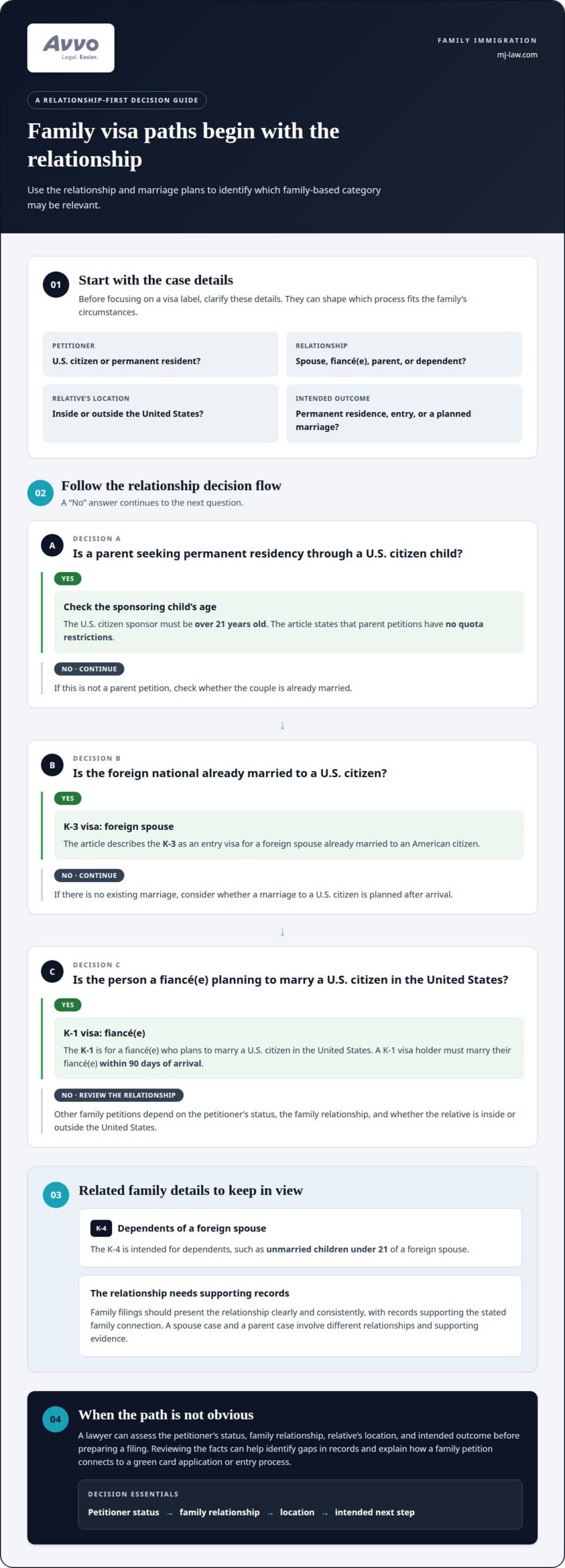
Family-based immigration starts with identifying the relationship and your intended outcome. A U.S. citizen or permanent resident may seek an eligible family-based petition, while a marriage case may involve a spouse seeking permanent residence. The appropriate process depends on the petitioner’s status, the family relationship, and whether the relative is inside or outside the United States. An immigration attorney can assess these details before preparing a filing.
For a parent seeking permanent residency through a U.S. citizen child, age matters: according to U.S. Citizenship and Immigration Services, the sponsoring citizen must be over 21 years old. Parent petitions have no quota restrictions, according to the information available for this topic. A lawyer can review the family relationship and supporting records, then explain how the petition fits the family’s circumstances.
Marriage immigration may involve a spouse already married to a U.S. citizen or a couple planning to marry after arrival. A K-3 visa is an entry visa for a foreign spouse already married to an American citizen. A K-1 visa is for a fiancé(e) who plans to marry a U.S. citizen in the United States. According to U.S. Citizenship and Immigration Services, a K-1 visa holder must marry their fiancé(e) within 90 days of arrival.
That timeline makes the couple’s plans a central part of choosing a route. A K-1 petition concerns a planned marriage, while a marriage-based petition concerns an existing marriage. The K-4 visa is intended for dependents, such as unmarried children under 21 of a foreign spouse. An experienced immigration attorney can help distinguish these categories and organize a petition around the actual relationship and intended next steps.
Family petitions require more than choosing a visa label. The filing needs to present the relationship clearly and consistently, with records supporting the stated family connection. For example, a spouse case and a parent case involve different relationships and supporting evidence. A law firm can review the facts, identify gaps, and explain how a family petition connects to a green card application or entry process.
Before a family makes plans around travel or marriage, it can be useful to discuss the case with an attorney. A family immigration appointment can help clarify which petition or visa category fits the relationship, what information the case requires, and which decisions should come first.
Office location, parking, and public transportation
Planning a San Jose office visit starts with distinguishing the meeting location from any court venue. The office is described as a half-block from public transportation, which may help visitors arriving without a car. It is also listed 1.2 miles by road from San Jose Mineta International Airport. These reference points can help orient a trip through the Santa Clara Valley.
Nearby landmarks offer additional context for route planning. The office is stated to be 0.5 miles from O’Nel Field and 2.4 miles from Montague Park. Those distances refer to the listed office and named landmarks, not necessarily to a particular travel route. Use the destination address on your appointment details when entering directions, since a landmark alone may not lead to the correct entrance.
Public transportation is a practical option to consider: the office is described as a half-block from transit. Before setting out, identify your transit stop and the walking route to the office. If you are traveling with a family member, coordinating the route and arrival time can make the visit easier. The office’s proximity to transit is useful context, but it does not identify a specific line or stop.
Parking details are not part of the location facts provided here, so this section does not name a lot, street-parking option, or parking rate. If you plan to drive, use the office address supplied with your appointment as your destination. Allow time to locate the entrance and park before your scheduled meeting. For a visit concerning citizenship or another immigration matter, bringing the requested case documents can help keep the discussion focused.
San Jose court locations should be treated separately from the office location. A meeting at an immigration law office does not identify where a court appearance will take place. For a scheduled hearing, use the venue printed on the official hearing notice rather than relying on nearby landmarks such as Montague Park or O’Nel Field. This distinction matters when a case involves both office appointments and court proceedings.
For office contact, the listed telephone number for the San Jose immigration team is 408-359-4388. Use it to coordinate practical visit details and avoid assuming that the airport distance or a nearby landmark gives the full route. A concise arrival plan can include the appointment destination, chosen transport method, and any case materials requested. These steps support a smoother visit while the legal team focuses on helping with the immigration matter.
San Jose immigration legal services
Immigration representation can address family petitions, permanent residency, citizenship, and employment-based matters. The right scope depends on your current status, immigration history, and immediate goal. For example, someone seeking a family-based green card needs a different plan from a worker pursuing an employment visa. An immigration law firm can assess how each issue fits into your broader immigration plans.
Family immigration services may involve a relative’s petition, a marriage-based green card, or questions about permanent residency. A useful first discussion identifies the relationship, the intended outcome, and any prior filings or decisions. That context helps an attorney determine what work the case requires and which facts need careful review. Clear representation also gives families a point of contact for understanding case steps and legal terms.
San Jose residents may also encounter matters involving asylum, waivers, VAWA, U visas, DACA, temporary protected status, consular processing, or immigration appeals. These are distinct legal processes, not interchangeable options. For instance, a waiver question calls for a different analysis from a citizenship application. The category, relevant history, and available supporting information shape the legal review.
For Spanish- or Portuguese-speaking households, bilingual communication can help make legal discussions more precise. Important terms such as “petition,” “status,” and “permanent residency” should be explained in language the person understands. In a family case, clear communication can help relatives follow the same plan and understand what information the legal team needs. Language access should support informed decisions, not obscure the legal meaning.
What should you ask when comparing bilingual immigration lawyers in San Jose? Ask who will handle your case, how the lawyer explains options in your preferred language, and how the proposed representation addresses your specific immigration goal. You can also ask how the attorney will communicate case developments and clarify documents or decisions.
Where can San Jose residents find low-cost or nonprofit immigration legal help? Santa Clara County’s immigration legal-services webpage identifies local providers, but it doesn’t give legal advice. People needing legal guidance should consult an attorney. Whether a provider is accepting new clients can vary, so a local listing does not establish that a particular organization can take a case.
For any consultation, organize the central issue, relevant immigration documents, and questions about your status or goal. A focused conversation helps clarify whether the matter concerns a family petition, a green card, citizenship, or another path. It also gives you a clearer basis for understanding the proposed representation and deciding what to do next.
How can I assess a San Jose immigration lawyer’s California State Bar license and disciplinary history when choosing legal representation?
Start with the lawyer’s full name and the State Bar of California’s attorney search. Review the profile for a matching name, license status, and identifying details. If several results appear, compare each profile carefully instead of assuming the first match is correct. This basic check helps establish whether the person you are considering is listed as a California attorney.
Next, review the profile’s discipline information and any linked public records. Read the details, not just a label or summary. Note the dates, type of action, and whether the record describes a resolved matter or another status. A disciplinary entry requires context; it does not, by itself, explain how the lawyer would handle your immigration case today.
Keep the information current by checking the profile close to the time you choose representation. Save the attorney’s full name and profile details so you can compare them with the name on an engagement agreement. If the agreement identifies a different attorney, ask who will manage the case and communicate with you. Clear roles matter in a family petition, green card, or other immigration matter.
Licensing is only one part of choosing counsel. Ask how the lawyer’s experience relates to your specific issue, such as a marriage petition, a prior immigration decision, or a citizenship application. Find out who prepares filings, reviews supporting documents, and explains case developments. A precise answer should describe the work and communication process, not promise a particular result.
Also discuss how you will receive written information and raise questions. For example, ask how the attorney explains a filing decision or responds when new facts affect the plan. If you need Spanish or Portuguese communication, ask how the lawyer will make legal terms and next steps understandable. Your questions should help you judge whether the working relationship fits your needs.
Compare the written engagement terms with what you discussed. Confirm the responsible attorney, the work covered, and how the firm will communicate about the case. Keep copies of signed documents and correspondence. If a detail seems inconsistent, request an explanation before signing or sending original records. These steps create a clear record of the representation you agreed to receive.
A California license search can help confirm identity and review public discipline information, but it cannot assess every aspect of legal judgment or communication. Use it alongside direct questions about the lawyer’s role and experience with your immigration issue. To discuss your case and representation needs, schedule a legal consultation.
MJ Law: Family Immigration Services
MJ Law provides Family Immigration Services for people seeking guidance with family petitions and marriage-based immigration matters. Consider reaching out when you need help understanding which family immigration path fits your circumstances, preparing an application, or addressing questions about a pending case.
For needs beyond family matters, MJ Law also handles Business and Investor Visas, Employment-Based Visas, and Entertainment and Artist Visas. The right service depends on your immigration goal, such as pursuing a family-based process or addressing a work-related visa matter.
A focused conversation can help clarify your circumstances and the legal support that may be appropriate. Contact MJ Law to discuss your immigration needs.
Take the Next Step With a Clear Plan
Choosing a bilingual immigration lawyer in San Jose, CA, can help you discuss your goals in a language you understand and make informed decisions about representation. Before moving forward, identify the question you most need answered, such as which family immigration route fits your circumstances or what information a petition may require. A focused conversation can make the next decision easier.
MJ Law handles Family Immigration Services, Business and Investor Visas, and Employment-Based Visas. These services address different immigration goals, so the first step is explaining your situation and what you hope to accomplish. You can then discuss whether the firm’s work aligns with your needs and what the process would involve.
Immigration matters often connect to important family or professional plans. You don’t need to resolve every detail before beginning a conversation. Contact MJ Law about your case to discuss your circumstances and consider a practical path forward.
Frequently Asked Questions
How Can an Immigration Lawyer Help Determine What Employment Visa I Should Apply For?
An immigration lawyer can compare visa options against your role, qualifications, employer, and work plans. For example, MJ Law handles employment-based visas, including H-1B and L-1 matters. A lawyer can review the position and the employer’s circumstances, then explain which route may fit and what information the petition requires. This helps align the application strategy with the actual job rather than relying on a visa label alone.
What Immigration Cases Does Your Firm Handle?
MJ Law handles family immigration, marriage-based green cards, employment-based visas, business and investor visas, entertainment and artist visas, and U.S. citizenship and naturalization. These services address different goals, from joining a family member to pursuing work or investor immigration. For example, an employee’s visa matter calls for a different discussion from a spouse’s green card case. The firm can review which area best matches your circumstances.
Do you work with employers and professionals in Silicon Valley?
Yes. MJ Law works with businesses and individuals on immigration matters, including employment-based visas and business and investor visas. A Silicon Valley employer may need help with a foreign worker’s visa petition, while a professional may need guidance related to an employment opportunity. The discussion can focus on the role, the employer’s needs, and the immigration objective, clarifying which kind of representation is relevant.
How Can Your Lawyers Help Me Attain Citizenship?
MJ Law provides U.S. citizenship and naturalization services, including legal consultation and representation. A lawyer can review your immigration history and the information relevant to your application, help prepare and file the paperwork, and explain what to expect during the process. For example, someone with questions about an earlier immigration filing can raise those concerns before proceeding. The review helps identify issues that may need attention as you pursue citizenship.
How Can a Lawyer Help Me Start the Immigration Process for Myself or a Loved One?
A lawyer can begin by discussing who needs immigration assistance, the family or employment connection involved, and the result you are seeking. You can explain relevant events and provide available immigration records, such as prior notices or applications. The attorney can use that information to assess the matter, identify a suitable service area, and outline the work involved. This gives you a more informed starting point than selecting a form without context.
Which immigration lawyers in San Jose, CA offer bilingual services, and which languages do they speak?
MJ Law offers consultations in English and Spanish. Se Habla Español – Consultas de Inmigración Disponibles. A bilingual immigration lawyer in San Jose, CA, can help make legal discussions easier to follow when you prefer Spanish or English. During a consultation, explain which language you prefer for discussing your case so the conversation can address your questions clearly.
What immigration cases do bilingual San Jose law firms handle, such as family visas, green cards, asylum, deportation defense, and citizenship?
Immigration firms handle different case types, so their practice areas vary. MJ Law’s services include family immigration, marriage-based green cards, employment-based visas, business and investor visas, entertainment and artist visas, and citizenship and naturalization. These areas cover family, work, business, and citizenship goals. The best fit depends on your situation and the legal assistance you need.
What are the consultation fees and typical attorney costs for immigration cases in San Jose, CA?
Attorney fees depend on the case’s scope, complexity, and level of legal representation required; no typical cost applies to every immigration matter. MJ Law discusses fees after a quote request. Ask what legal work the proposed fee covers, such as preparing a petition or managing an application, and how the representation will address your specific case before deciding how to proceed.