
An L-1 extension isn’t automatic; it requires a new eligibility determination. An L-1 visa allows a qualifying organization to transfer an employee to the United States, and an L-1 visa extension attorney in San Jose can help present the business and employment evidence for continued eligibility. The stay limit depends on the visa category: according to the Office of the Federal Register, L-1A status is limited to a total stay of seven years, while L-1B status is limited to five years.
It’s understandable to focus on how much time remains on your current approval. But an extension also depends on whether the qualifying company relationship, U.S. business activity and employee’s role continue to meet L-1 requirements.
This article explains what L-1A and L-1B cover, how initial stays and extensions work, and what evidence can support a request. You’ll also learn how business circumstances shape the extension process and when experienced legal guidance can help organize the case.
Key Takeaways
- Understand how L-1A and L-1B categories differ and which details shape the petition.
- Learn how an employer’s Form I-129 filing fits into the L-1 process.
- See how time spent outside the United States may affect the stay calculation when properly documented.
- Recognize why a continuing qualifying company relationship, active business operations, and an eligible role matter for an extension.
- Find out how legal support can organize business records and employment evidence for an extension request.
What are the Different Types of L1 Visas and Their Requirements?
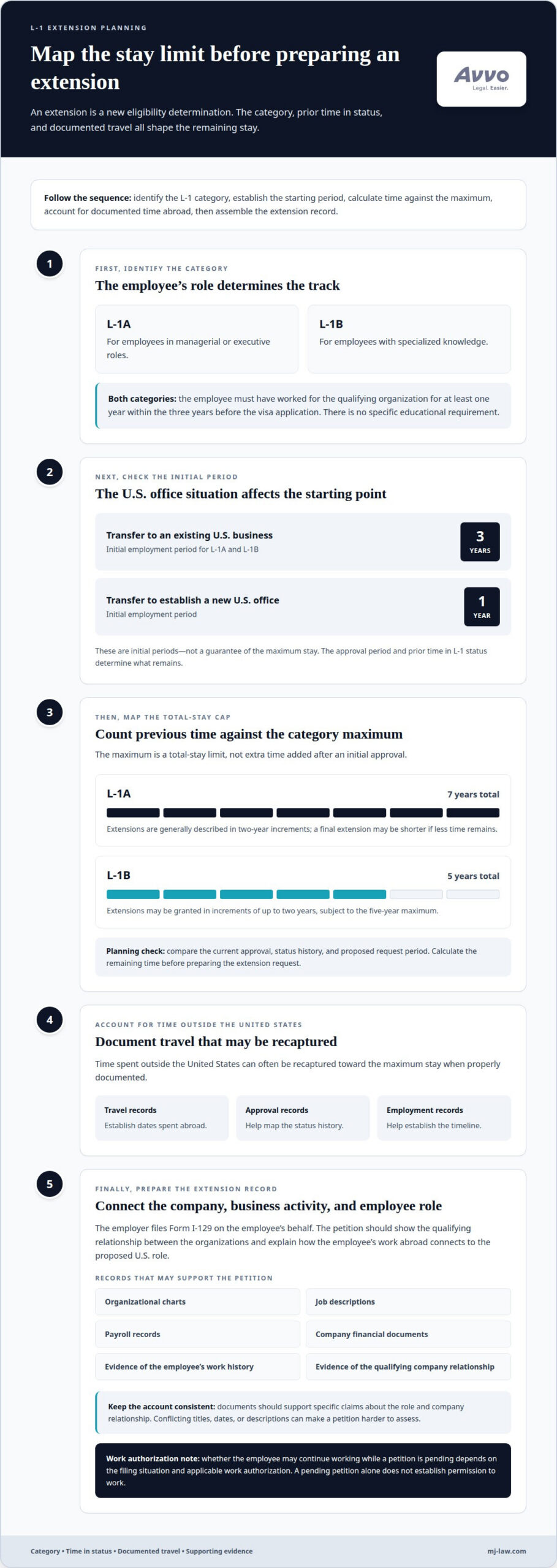
The L-1 category covers intracompany transfers to the United States. L-1A applies to employees in managerial or executive roles, while L-1B applies to employees with specialized knowledge. For either category, the employee must have worked for the qualifying organization for at least one year within the three years before the visa application. There’s no specific educational requirement.
The employer starts the petition by filing Form I-129 on the employee’s behalf. The application must connect the employee’s work abroad, proposed U.S. role, and qualifying relationship between the organizations. An immigration lawyer can assess whether the role and supporting records present a consistent account before filing.
Supporting documents should substantiate the petition’s claims. Depending on the case, useful records may include organizational charts, job descriptions, payroll records, company financial documents, and evidence of the employee’s work history. Each document should support a specific point, such as the employee’s role or the relationship between the companies. Conflicting titles, dates, or descriptions can make an already complex petition harder to assess.
Required documents vary with the petition’s circumstances, but the employer generally assembles Form I-129 and supporting evidence about the U.S. and foreign entities and the employee. A dependent applying for L-2 status has a separate application process. The employer’s petition should explain why the transfer fits the L-1 category, rather than relying on a job title alone.
A new-office petition needs evidence about the planned U.S. operation. An employee transferring to establish a new U.S. office may receive an initial employment period of one year. Business plans, information about the premises, hiring plans, and financial records can help explain how the office will operate and support the proposed position. The evidence should reflect the company’s actual plans.
Common problems include insufficient proof of the qualifying corporate relationship, unclear duties, inconsistent employment records, or weak evidence that the U.S. role fits L-1A or L-1B. A petition may also raise questions when the documents describe an intended business activity but don’t show how the proposed role connects to it. Careful review helps identify gaps and inconsistencies before submission.
Plan an extension around the employee’s current status end date and the circumstances of the petition. Whether the employee may continue working while the petition is pending depends on the filing situation and applicable work authorization. A pending petition alone does not establish permission to work.
USCIS filing fees depend on the petition requirements and processing option, including whether premium processing is requested. Premium processing has a separate fee, and the applicable amount depends on the specific filing.
L-1 visa validity periods and maximum stays
The category determines the maximum stay and the available extension time. The Office of the Federal Register sets the total limit at seven years for L-1A status and five years for L-1B status in the United States.
L-1A Maximum Stay and Extensions
An L-1A employee transferring to an existing U.S. business may receive an initial employment period of three years. An employee establishing a new U.S. office may receive one year initially. Extensions can continue the stay, but the total cannot exceed seven years. Review the approval history and time already spent in L-1A status before preparing an extension request.
L-1B Maximum Stay and Extensions
An L-1B employee transferring to an existing U.S. business may receive an initial stay of three years. An employee establishing a new U.S. office may receive one year initially. L-1B extensions may be granted in increments of up to two years, subject to the five-year maximum. The key planning step is to calculate the remaining time before the cap.
Initial periods and extension increments do not mean every employee receives the maximum time available. The approval period and previous stay determine how much time remains. For example, a new-office transfer may begin with one year, while an existing-office transfer may begin with three. This difference affects when the employer needs to prepare the next petition.
For L-1A, extensions are generally described in two-year increments, up to the seven-year limit. The maximum is a total-stay cap, not an extra period added after an initial approval. A final extension may be shorter when only part of the maximum remains. The employer and visa lawyer should account for prior L-1A time when organizing the visa process.
For L-1B, an extension may provide up to two years, but the five-year cap still controls. An extension cannot carry the employee beyond that total. A foreign employee who has used most of the available L-1B period needs a precise review of prior stay and any documented time outside the United States.
Time spent outside the United States can often be recaptured toward the maximum stay when properly documented. Travel records help establish the dates spent abroad, while approval and employment records help map the full status history. This calculation matters in either category, particularly when travel affects the time remaining.
Before an employer prepares an extension, it should compare the current approval, status history, and proposed request period. A review of your L-1 stay timeline can help clarify which dates and category limits shape the next filing.
Choosing and hiring an immigration lawyer
An L-1 extension involves the employer, the employee, and records about related businesses. Choose an immigration attorney whose review addresses those connected parts, not only the employee’s current visa. For example, the lawyer should understand the role, the company relationship, the approval history, and the evidence the employer can provide. These details help define the work before the petition is prepared.
Use the initial discussion to explain what has changed since the last approval. A new reporting structure, revised duties, changes in ownership records, or a shift in business activity may affect how the extension is presented. The attorney can identify which facts need clarification and explain how they relate to the petition. A clear discussion helps the employer and employee understand their respective roles in preparing the case.
Before hiring an attorney, establish the scope of representation in writing. It should describe the work covered, who will prepare and review the filing, how the attorney will communicate about document requests, and how new issues will be handled. The employer should know who coordinates business records, and the employee should know who addresses personal immigration history. Clarify responsibilities rather than relying on assumptions.
Assess the lawyer’s process by how specifically they discuss the case. A useful review connects each claimed qualification to supporting evidence. For instance, if the employee’s title changed, the analysis should consider whether the documented duties still support the L-1 category. If company records use different names for related entities, the attorney should identify that inconsistency and plan how to explain it.
- Case fit: Confirm the discussion centers on L-1 classification and extension work, rather than immigration law in general.
- Evidence review: Ask how the attorney will organize employer records, role descriptions, and prior approval documents.
- Communication: Establish how updates, document requests, and filing decisions will be handled.
- Scope: Clarify which employer and employee tasks are included in the legal work.
An immigration lawyer should also explain what the filing can and cannot address. An L-1 extension concerns continued temporary work status; citizenship is a separate immigration matter with different eligibility questions. Keeping those goals distinct helps maintain a focused case plan. If another immigration issue arises, the attorney can explain whether it affects the extension or requires separate analysis.
Choosing an attorney is a practical decision about fit, communication, and the work involved. Share the approval notice, current role information, and relevant company changes during the initial discussion. These materials give the attorney a grounded starting point and help define next steps without relying on assumptions.
Continuing qualifying corporate relationship and business activity
An extension case must show that the qualifying organization and U.S. business remain connected and active. Under 8 CFR §214.2(l), extensions typically depend on an ongoing qualifying corporate relationship, ongoing business activity, and an ongoing qualifying role. The employer’s records should tell a consistent story across those three points.
Start with the relationship between the foreign organization and the U.S. entity. Ownership records, organizational charts, formation documents, and records of company structure changes can help explain how the entities are connected. If names, ownership details, or reporting lines changed after the earlier approval, the petition’s explanation should match current records. Describe structural changes with a clear timeline instead of assuming older documents still explain the relationship.
Next, show that the U.S. business is operating in line with its stated activities. The employer may organize records such as contracts, invoices, financial statements, payroll summaries, and office documents to demonstrate what the business does. Documents that reflect actual operations make the company’s claimed activity easier to assess. For example, a business describing ongoing client work can support that description with relevant contracts and invoices.
The employee’s role must also continue to qualify. Compare current duties with the role described in the previous petition, then identify meaningful changes in responsibilities, supervision, or position in the organization. A new title alone may not explain what the individual does. An updated job description and organizational chart can show how the role fits the employer’s current structure and business activity.
Consistency matters across the entire record. If a financial document uses one entity name and a contract uses another, supporting records should explain the connection. If the U.S. office moved or the organization changed its reporting structure, include documents that make the sequence clear. Connect each claim to evidence rather than leaving USCIS to reconcile unexplained differences.
- Corporate connection: Organize records showing how the foreign and U.S. entities relate.
- Business activity: Match descriptions of current operations with dated business records.
- Qualifying role: Explain the employee’s current duties and place in the organization.
- Changed facts: Provide context for updated names, ownership, locations, or reporting lines.
Keep employee and company evidence separate. Documents about an individual’s dependent family members, including children, do not establish the employer’s corporate relationship or business activity. Separating these records keeps the extension presentation focused and helps identify gaps between the organization’s current evidence and the claims supporting the employee’s continued qualifying role.
Evidence for L-1 extensions and renewals
An L-1 extension is a new eligibility determination, not an automatic continuation of a prior approval. The filing should present current evidence, not rely solely on the earlier petition. A clear record connects the employee’s transfer, the employer’s operations, and the qualifying role. Organizing those materials around each point helps the decision-maker follow the case.
Begin with the prior approval and compare its claims with current circumstances. The employer can gather the approval notice, earlier petition materials, current role description, and updated organizational chart. If the employee now reports to a different manager, include an updated chart and explain the change. If duties have changed, describe the current work and specific responsibilities instead of repeating an outdated title.
Company evidence should establish the continuing relationship between the U.S. entity and its foreign parent or related organization. Records may include ownership documents, business registrations, and materials explaining how the entities operate together. Use entity names consistently throughout the filing. If a document uses a shortened name, provide context linking it to the correct organization.
Evidence of ongoing business activity should reflect the company’s actual operations. Contracts, invoices, payroll records, financial statements, and office records can help describe current activity. The employer’s evidence should match the petition’s description. For example, a petition describing active client work should include business records that correspond to that work.
Role evidence needs the same careful alignment. An updated job description can explain the employee’s current duties, decision-making responsibilities, and place within the organization. Supporting materials such as team charts or project records can add context. The goal is to show how the employee’s work fits the claimed L-1 category, not simply to repeat a job title from the previous filing.
Organize the evidence so each item supports a specific statement. A practical review can group materials by corporate relationship, business activity, and employee role, then compare dates, names, and descriptions across the records. For example, if a company document reflects a restructuring, the petition should explain how that change relates to the current employer and transfer.
Keep dependent-family documents separate from the employer’s eligibility evidence. A parent’s employment records and a child’s dependent-status paperwork serve different purposes. Likewise, a future green card plan is distinct from an L-1 extension filing. Keeping those matters separate helps the extension presentation stay focused on current L-1 eligibility.
For a structured review of the evidence and filing plan, schedule an L-1 extension consultation.
MJ Law
MJ Law helps employers and employees assess L-1 extension cases, organize supporting evidence, and prepare a clear filing strategy through its employment-based visa work. Turn to the firm when business changes, evolving job duties, or prior approval records raise questions about continued eligibility. A focused legal review can help connect the employee’s role with the company’s current operations and identify which records support the extension. It also gives the employer and employee a clearer understanding of their respective parts in the process. For guidance on your circumstances and next steps, contact MJ Law.
Plan Your Next Step With Clarity
An L-1 visa extension attorney in San Jose can help turn your employer’s changing business plans into a clear legal strategy. The next step is to consider how the extension fits your work plans and broader immigration goals, then identify the records and decisions needed to move forward. Each case depends on its own facts, including the employee’s role and the employer’s circumstances.
MJ Law’s practice includes Family Immigration Services, Business and Investor Visas, and Employment-Based Visas. If you’re weighing an extension alongside other immigration priorities, a focused discussion can help clarify which questions belong in the current filing and which require separate planning.
Contact MJ Law about your L-1 extension to discuss your circumstances and possible next steps. A thoughtful plan can help you approach the process with greater clarity.
Frequently Asked Questions
What is an L1 Visa?
An L-1 visa allows a qualifying organization to transfer an employee from a foreign office to a related U.S. operation. L-1A covers qualifying managerial or executive roles, while L-1B covers specialized-knowledge roles. For example, a company may transfer a manager to oversee a U.S. team or a specialist to apply company-specific knowledge. The employer files the petition for the employee, rather than the employee applying independently.
How Much Does an Immigration Lawyer Cost?
Legal fees depend on the work involved, the petition’s complexity, and the evidence that needs review. An extension with significant changes in company structure or job duties may require different preparation than a case with consistent records. The total may also include government filing costs and optional premium processing. Ask for a case-specific fee explanation that separates legal services from government charges before deciding how to proceed.
What About Dependents?
An L-1 holder’s spouse and children under age 21 may qualify for L-2 status, according to U.S. Citizenship and Immigration Services. L-2 dependents generally receive a period of stay tied to the L-1 holder’s stay. An L-2 spouse may work after obtaining an employment authorization document. Children in L-2 status cannot work, and after turning 21 they need to maintain a different status independently.
Which San Jose immigration attorneys handle L-1 visa extensions?
MJ Law handles employment-based immigration matters, including L-1 visas, in San Jose. An L-1 visa extension attorney in San Jose can review the employer’s filing strategy, current role, and supporting records. MJ Law offers consultations in English and Spanish. The employer and employee can use an initial discussion to clarify the circumstances, identify key changes since the prior approval, and understand what information is relevant to the extension.
What are the eligibility requirements for extending an L-1A visa?
An L-1A extension generally requires continued eligibility for the managerial or executive classification and a qualifying employer relationship. The employer’s current operations and the employee’s actual duties matter, not just the position title. For example, if the employee now manages a different team, updated reporting information can help explain the role. The extension request also needs to account for the employee’s prior time in L-1 status.
What are the eligibility requirements for extending an L-1B visa?
An L-1B extension generally depends on whether the employee continues to perform qualifying specialized-knowledge work for an eligible organization. The employer can explain how the employee’s knowledge is used in current U.S. operations, supported by role descriptions and relevant project information. If responsibilities changed after the earlier approval, the filing needs to describe the current work clearly. Prior L-1B time also affects how much stay remains.
How long can L-1A and L-1B visa holders stay in the United States?
The total stay limit is seven years for L-1A and five years for L-1B, according to the Office of the Federal Register. The actual time remaining depends on the employee’s prior stay and approved periods. For instance, travel outside the United States may affect the calculation when properly documented. Employers should use the approval history and travel records to plan around the applicable category limit.
What documents are required for an L-1 visa extension petition?
The employer typically prepares Form I-129 with documents supporting the company relationship, ongoing business activity, and the employee’s current role. Useful records can include the prior approval notice, updated organizational chart, job description, payroll information, and business records that reflect current operations. The exact evidence depends on the case. For example, a change in ownership may call for records explaining how the U.S. and foreign entities remain connected.