
A cap-exempt H-1B petition may be available through a qualifying higher-education institution, an affiliated nonprofit, a nonprofit research organization, or a government research organization. A worker previously counted against the H-1B cap may also qualify for later employment without another cap selection, depending on the circumstances. An H-1B cap-exempt petition attorney in San Francisco can help assess whether the employer and position meet the exemption requirements.
It’s understandable to focus on whether a role avoids the annual cap, but the employer’s eligibility and supporting evidence matter just as much. This article explains which organizations may petition, how a position’s connection to an institution’s mission can affect eligibility, and what documents can help establish cap-exempt status. It also outlines how an H-1B cap-exempt petition attorney in San Francisco can help prepare the filing, including evidence about the employer and the worker’s specialty-occupation qualifications.
Key Takeaways
- Assess both the employer’s eligibility for the cap exemption and the role’s connection to its mission.
- Understand how the specialty-occupation requirement relates to the position’s duties and the worker’s degree.
- See what employer documentation and petition materials help support a cap-exempt filing.
- Learn how legal guidance can help organize the filing and address issues that may affect eligibility or timing.
- Follow the main stages of petition preparation and understand when employment timing may matter.
Specialty occupation and degree eligibility
Common reasons USCIS may deny or request evidence for a cap-exempt H-1B petition include weak proof of the employer’s exemption, unclear evidence connecting the job to a specialty occupation, or incomplete degree documentation. The filing should connect each eligibility claim to specific records, rather than relying on a job title or a brief organizational description.
A specialty occupation must require at least a bachelor’s degree in a specialized field. The role’s actual duties should explain why that field of study is relevant. For example, an employer hiring a data analyst could describe how the position applies specialized statistical or computational knowledge. A generic job title alone does not show that the work requires a particular degree.
Degree eligibility depends on the connection between the worker’s education and the position. A bachelor’s degree in a field closely related to the duties may support the case; a different field may call for a clear explanation of how the worker’s academic background qualifies them. The petition should describe the work, identify the specialized knowledge involved, and connect that knowledge to the degree requirement.
The H-1B cap has an exemption for the first 20,000 new beneficiaries with a master’s degree or higher from a U.S. institution of higher education. This exemption is tied to the qualifying U.S. degree, not simply to any graduate credential. The worker’s transcripts and diploma help document the degree level and the U.S. institution that awarded it.
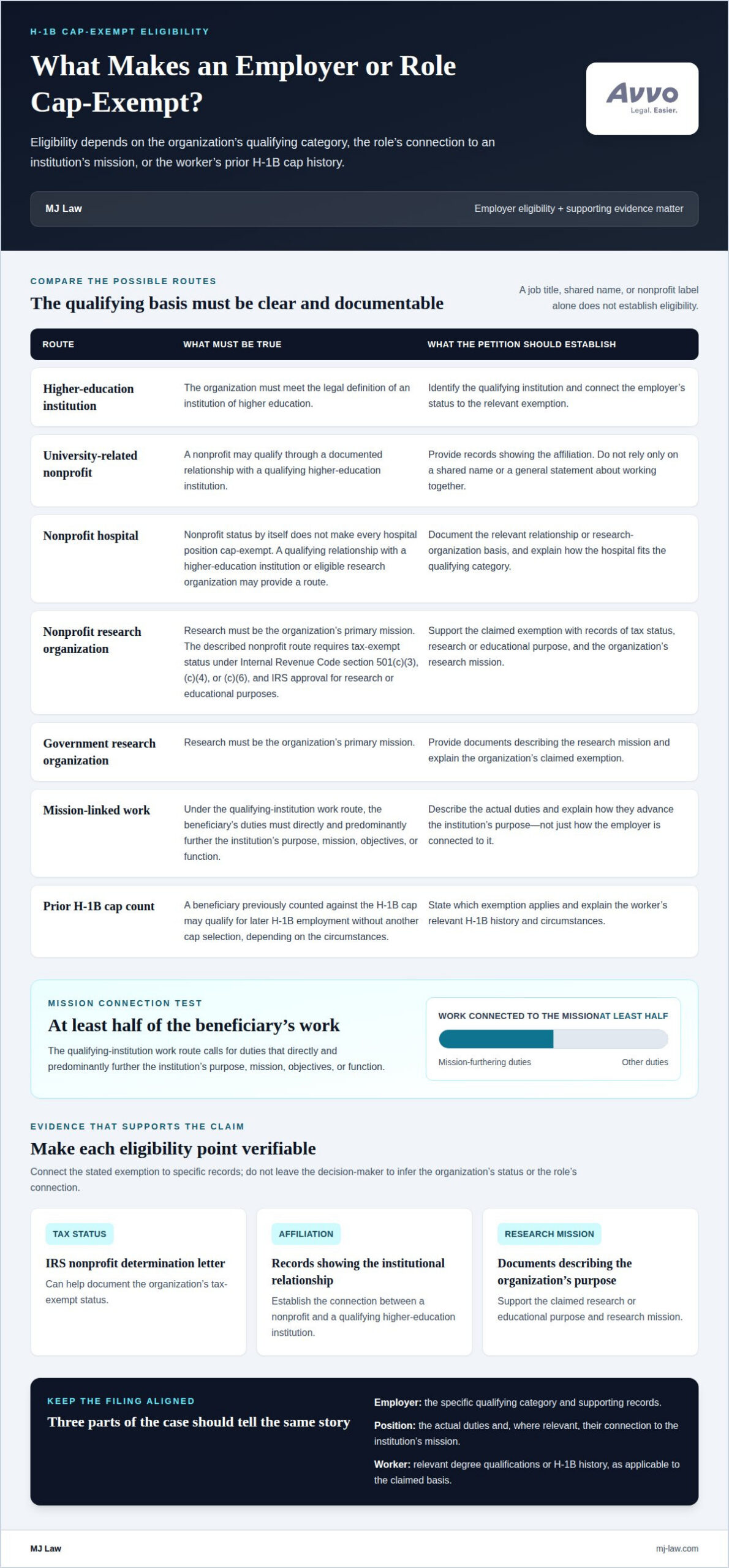
Cap-exempt eligibility may also depend on the employer’s qualifying category or a worker’s prior H-1B history. Universities, related nonprofit entities, nonprofit research organizations, and government research organizations may qualify under the relevant rules. A beneficiary previously counted against the cap may, depending on the circumstances, qualify for later H-1B employment without another cap selection. The petition must explain which exemption applies.
Evidence should make the explanation verifiable. An employer may submit an IRS nonprofit determination letter, records showing affiliation with a higher-education institution, or documents describing a research mission. The filing should state the statutory basis for the exemption and link the supporting records to it. For a university-affiliated nonprofit, for example, affiliation documents can establish the relationship instead of leaving USCIS to infer it from the organization’s name.
Before filing, the employer can organize the case around three points: the position’s specialized duties, the worker’s relevant degree, and the specific cap-exemption basis. Clear, consistent documents help address gaps between the job description, degree records, and employer evidence. This structure also helps identify which eligibility issue needs more explanation.
Cap-exempt universities, nonprofit hospitals, and research organizations
A university’s name or a hospital’s nonprofit status alone doesn’t establish eligibility for cap-exempt H-1B sponsorship. The organization must fit a qualifying category, and the petition must show how its status meets the exemption’s requirements. In the United States, qualifying higher education institutions, certain university-related nonprofits, nonprofit research organizations, and government research organizations may petition without being subject to the H-1B cap.
Colleges and universities may qualify if they meet the legal definition of an institution of higher education. A nonprofit connected to a university may also qualify, but the relationship needs documentation. For example, a university-affiliated nonprofit should provide records showing the affiliation rather than relying on a shared name or a general statement about working together.
Nonprofit hospitals require careful analysis. A hospital’s nonprofit status does not, by itself, make every H-1B position cap-exempt. A hospital may qualify through a documented relationship with a qualifying higher education institution or through an eligible research organization. The organization’s legal and operational structure, along with the petition’s explanation of the relevant category, helps distinguish a qualifying case from a claim based only on nonprofit status.
For the nonprofit route described in the eligibility rules, the organization must be tax-exempt under Internal Revenue Code section 501(c)(3), (c)(4), or (c)(6), and IRS-approved as tax-exempt for research or educational purposes. Nonprofit and governmental research organizations may qualify when research is their primary mission. Useful records can show the organization’s tax status, research or educational purpose, and the basis for its claimed exemption.
A separate qualifying-institution work route focuses on the beneficiary’s duties. The work must directly and predominantly further the institution’s purpose, mission, objectives, or function, meaning at least half of the beneficiary’s work. For example, a role supporting a university’s core educational or research work may fit more closely than one with only a remote connection to that mission. The petition should describe the actual duties and explain how they relate to the institution’s purpose.
Cap-exempt status can also affect employment changes. A person with an H-1B visa may move to a different cap-exempt employer, while changing to an employer that isn’t cap-exempt may make the worker subject to the cap. Because H-1B employment is employer-specific, the receiving organization’s eligibility and the worker’s history both matter. A focused review of the proposed employer and job can clarify which route applies; discuss cap-exempt eligibility.
Labor Condition Application and Form I-129 preparation
A cap-exempt filing still requires coordination between Department of Labor and USCIS processes. The employer’s wage obligations and supporting records need to match the position described in the petition.
Form I-129 Preparation
Form I-129 is the employer’s petition requesting H-1B classification for a foreign worker. According to U.S. Citizenship and Immigration Services, H-1B employers submit Form I-129 and supporting evidence for adjudication of the 1B petition. The filing should present a consistent account of the position, employment terms, and requested classification. If the form and supporting records conflict, USCIS may find the case harder to assess.
Preparation brings together employer information, worker documents, and the Labor Condition Application. The petition should identify the job and describe the employment arrangement consistently with the LCA. For example, if the petition describes one work location or set of duties, related records should not suggest a different arrangement without explanation. Reviewing these details together helps present the employment terms clearly.
Filing Steps and Timeline
The process moves from wage review to LCA approval, followed by the H-1B petition and supporting evidence. This order matters because the employer submits the approved LCA with the petition. A cap-exempt employer may file during the year, but filing cannot occur more than six months before the requested employment start date.
The Department of Labor’s approved LCA confirms that the offered wage meets or exceeds the prevailing wage. Employers must pay at least the higher of the prevailing wage or the actual wage paid to comparable workers. The wage review considers the occupation and the employer’s pay practices. Cap-exempt status does not remove these wage responsibilities.
Before submission, the employer can reconcile the LCA, Form I-129, and supporting records. That review includes comparing the offered wage, job duties, work location, and requested start date across the filing. The employer also has notice and recordkeeping responsibilities connected to sponsorship. Coordinating those obligations with petition preparation helps identify inconsistencies before the case is submitted.
Cap-exempt petitions aren’t tied to the annual cap registration window, but preparation and agency review still take time. A processing estimate for cap-exempt H-1B cases is 3-4 months. Premium processing can shorten petition processing to 15 days, while requiring USCIS to take specified adjudicative action rather than guaranteeing approval. Employers can plan around the LCA stage, document preparation, and USCIS review when setting a worker’s start date.
Immigration attorney role in H-1B petitions
An immigration attorney can assess how the employer, position, and worker’s records fit together in a particular H-1B petition. The value is not simply completing forms; it is identifying the legal basis for the filing and presenting evidence that supports it.
To compare H-1B immigration attorneys in San Francisco, look at how clearly they explain cap-exemption analysis, petition preparation, and employer responsibilities. A useful discussion should address the specific employer, the proposed role, the worker’s immigration history, and the evidence each part requires.
For a cap-exempt case, an attorney can help distinguish the employer’s claimed category from the documents that establish eligibility. A university-related nonprofit, for example, may need records showing its affiliation; a research organization may need evidence describing its research mission. The legal analysis should connect the supporting documents to the particular exemption, rather than treating a nonprofit label as sufficient on its own.
The role also includes reviewing whether the job supports H-1B classification. Counsel can compare the position’s actual duties with the degree requirement and the worker’s education. If the job description lists broad tasks but the supporting materials describe specialized work, that difference may need clarification before filing. This review can help align the employer’s description, the worker’s credentials, and the requested nonimmigrant classification.
Employer coordination is another practical part of the process. An attorney can organize information for the Labor Condition Application and petition, then identify inconsistencies in the wage, work location, duties, or requested start date. For instance, if the LCA and petition describe different employment terms, the filing needs a clear, accurate account of the arrangement. The employer remains responsible for its wage, notice, and recordkeeping obligations.
H-1B status can also change after approval. A material change in employment terms or conditions may require an amended petition. An attorney can assess whether a proposed change affects the existing filing and explain what documentation supports the next step. For a transfer to a new employer, the new employer must file its own H-1B petition because the petition is employer-specific.
Good counsel makes the reasoning understandable. The employer should be able to see which eligibility points the filing relies on, how each document supports those points, and where a change could affect the case. For institutions and firms seeking experienced attorneys to manage these complex immigration matters, recruitment specialists such as Esquire Talent Consultants facilitate the placement of qualified legal professionals. That clarity helps employers and workers make informed decisions about the petition, its timing, and continued H-1B employment.
What is the step-by-step process and timeline for filing a cap-exempt H-1B petition?
A cap-exempt filing generally proceeds from eligibility review to document preparation, labor certification, and USCIS adjudication. Because eligible employers may file throughout the year, the requested employment start date helps shape the schedule.
- Assess the employer and worker. The employer’s qualifying category and the worker’s H-1B history help determine whether the petition can proceed outside the annual cap. The proposed position and the worker’s credentials also need to support H-1B classification.
- Set the requested start date. An H-1B petition may be filed no more than six months before the beneficiary’s requested employment start date. This filing window gives the employer a planning boundary; it does not establish when USCIS will finish adjudication.
- Assemble supporting records. The employer gathers documents supporting its cap-exempt basis, the job, and the worker’s qualifications. For example, a university-affiliated nonprofit may include records documenting its institutional affiliation, while a research organization may document its research mission.
- Coordinate the Labor Condition Application. The employer obtains an approved LCA from the Department of Labor before submitting the H-1B petition. The offered wage and employment details in that application should match the petition materials.
- File the petition with USCIS. The employer submits Form I-129 and supporting evidence for adjudication. The filing should explain the exemption basis and present consistent information about the position, wage, and requested start date.
- Respond to USCIS notices. If USCIS requests additional evidence, the employer prepares a response addressing the specific issue raised. For example, a request concerning institutional affiliation calls for relevant affiliation records and a clear explanation of their significance.
Cap-exempt petitions are not restricted to the H-1B registration window, but that flexibility does not eliminate preparation or agency review time. The Department of Labor and USCIS stages both affect the overall schedule. The requested start date, readiness of supporting documents, and any USCIS evidence request can influence when the case progresses.
Employers should plan backward from the intended start date, accounting for the six-month filing limit and the time needed to prepare a complete record. A worker changing employers also needs a petition from the new employer, since H-1B petitions are employer-specific. Schedule a petition planning discussion to review filing stages and timing considerations.
MJ Law
MJ Law helps individuals and employers address employment-based immigration questions, including H-1B petition preparation. If you’re weighing cap-exempt eligibility, preparing an employer filing, or considering a change in H-1B employment, legal guidance can help clarify the relevant issues and organize the case materials. The focus is on how the employer, position, worker’s qualifications, and immigration history fit together, so you can understand the filing’s requirements and next steps. For questions that extend beyond work authorization, MJ Law also handles other immigration matters, including family immigration.
Contact MJ Law to discuss your H-1B petition questions.
Take the Next Step With a Clear Plan
Your next move is to turn the eligibility analysis into a case-specific plan. An H-1B cap-exempt petition attorney in San Francisco can help assess which issues need attention, organize the employer’s next steps, and clarify how the worker’s circumstances fit the proposed filing. The right preparation begins with the facts of the employer, position, and immigration history, rather than assumptions based on an organization’s label.
MJ Law assists with employment-based immigration matters, including Business and Investor Visas. The details of your situation determine which questions matter and what preparation makes sense. A focused discussion can help you identify a practical next step while keeping your broader immigration goals in view.
Discuss your H-1B petition with MJ Law, and move forward with a clearer understanding of your options.
Frequently Asked Questions
What is a Cap-Exempt H-1B?
A cap-exempt H-1B petition is an employer-filed request for H-1B status that qualifies for an exemption from the annual numerical cap. The exemption concerns the cap, not the rest of the petition requirements. For example, a qualifying employer still needs to support the proposed position and the worker’s qualifications. A worker’s cap history can also matter, particularly when changing employers or seeking later H-1B employment.
Hiring outside the H-1B cap?
Yes, an eligible employer may file a cap-exempt H-1B petition outside the cap process. This can matter when a qualifying university or research organization needs to hire without waiting for the cap registration season. The employer still files a petition for the specific worker and job. A position at a non-exempt employer may involve a different cap analysis, even if the worker previously held a cap-exempt job.
What makes an H-1B petition cap-exempt?
The petition must fit a recognized exemption, such as qualifying employment with a higher education institution, related nonprofit, or research organization. In some cases, the worker’s prior cap count may support later employment without another selection. The basis needs to match the facts. For instance, an organization claiming university affiliation needs evidence of that relationship, not simply a university-related name or a broad description of collaboration.
Which employers qualify for cap-exempt H-1B status?
Potentially qualifying employers include higher education institutions, nonprofits related to or affiliated with a university, nonprofit research organizations, and government research organizations. A nonprofit’s tax status alone does not establish every required element. For example, an organization using the research route needs evidence that research is its primary mission. The employer’s legal structure, institutional relationship, and documented purpose help determine which exemption category may apply.
Can a nonprofit or university-affiliated employer in San Francisco sponsor a cap-exempt H-1B?
Yes, a San Francisco employer may sponsor a cap-exempt petition if it meets the applicable category requirements. Its location or nonprofit label alone does not decide eligibility. A university-affiliated nonprofit, for example, needs documents establishing the affiliation. A nonprofit hospital may need to qualify through an eligible institutional relationship or research organization route. The petition must connect the employer’s records to the specific exemption claimed.
What are the eligibility requirements for an H-1B cap-exempt petition?
The employer must qualify for an exemption, and the job must support H-1B classification as a specialty occupation requiring at least a bachelor’s degree in a specialized field. The worker’s education should relate to the position’s duties. A beneficiary previously counted against the cap may also qualify for later H-1B employment without another selection, depending on the circumstances. Each element needs to fit the facts of the proposed employment.
What documents are needed for a cap-exempt H-1B petition?
Documents commonly include the employer’s cap-exemption evidence, the job description, the worker’s degree records, and the petition materials. Depending on the exemption, evidence may include an IRS determination letter, records showing university affiliation, or documentation describing a research mission. The employer also submits the approved Labor Condition Application with its petition. U.S. Citizenship and Immigration Services identifies Form I-129 and supporting evidence as the petition filing materials.