Six years is not always the end of an H-1B stay. Workers may generally remain in the United States for up to six years, but some pursuing permanent residence may qualify for extensions beyond that limit. An H-1B visa extension lawyer in Silicon Valley can help assess how the timing and status of a green card process may affect an extension request.
It’s understandable to focus on the expiration date, since a pending petition can affect both your immigration status and ability to keep working. According to U.S. Citizenship and Immigration Services, the 240-day rule provides work authorization while an H-1B extension is pending.
This article explains the usual H-1B duration, when extensions beyond six years may be available, and how petition timing and premium processing can affect the process. It also covers status changes and travel considerations while a petition is pending.
Key Takeaways
- Assess whether the position and the worker’s qualifications meet the specialty occupation requirements before planning the petition timeline.
- Understand how premium processing affects the decision timeline, and how the choice between a change or extension of status and consular processing can affect your plans.
- Track the employer’s petition steps, including the Labor Condition Application and Form I-129, when planning a new petition or status change.
- Review green card process milestones to determine whether an extension beyond the usual H-1B period may be available.
- Consider how petition timing and travel plans may interact while an extension or change of status is pending.
What Is the H-1B Visa Process Timeline?
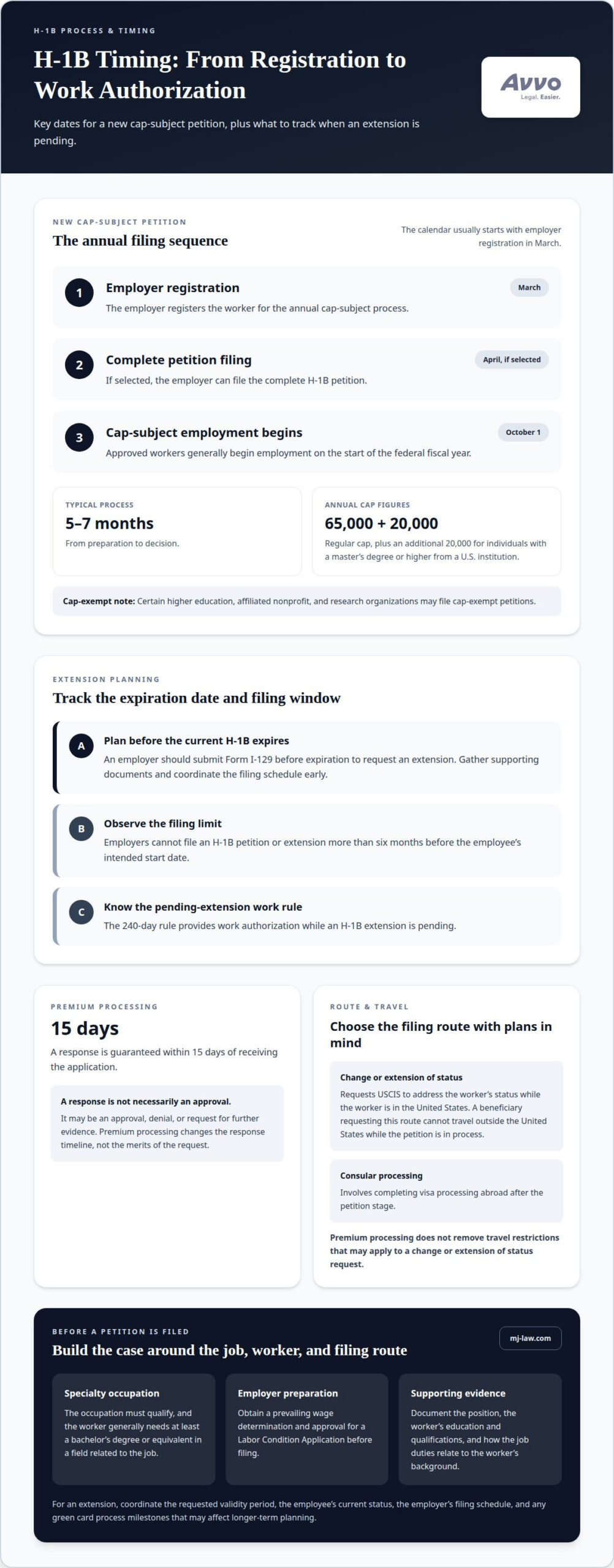
For a new cap-subject H-1B petition, the calendar usually begins with employer registration in March. If selected, the employer can file the complete petition in April, with approved workers generally beginning cap-subject employment on October 1, the start of the federal fiscal year. The typical process, from preparation to decision, takes five to seven months.
That annual sequence differs from an extension. An employer should submit Form I-129 before the H-1B visa expires to request an extension. Employers cannot file an H-1B petition or extension more than six months before the employee’s intended start date. Because an extension also requires preparation, the employer should plan around the expiration date and gather supporting documents early.
H-1B eligibility depends on both the job and the worker. The occupation must qualify as a specialty occupation, and the worker generally needs at least a bachelor’s degree or equivalent in a field related to the job. A degree in an unrelated subject may not establish the required connection. The petition should explain how the position’s duties relate to the worker’s education and experience.
The employer’s preparation includes wage and workplace steps. Before filing, the employer must obtain a prevailing wage determination from the U.S. Department of Labor and receive approval for a Labor Condition Application. The employer also attests that hiring the H-1B worker won’t adversely affect the working conditions of similarly employed U.S. workers. The petition then documents the job, the worker’s education, and relevant qualifications.
- Employer: Offers a qualifying specialty occupation and files the petition with supporting job and wage documentation.
- Worker: Shows education or equivalent qualifications related to the occupation.
- New employer: Files an H-1B transfer petition; the worker may begin working after filing, subject to status and work-history conditions.
The regular cap is 65,000 visas each fiscal year, with an additional 20,000 visas for individuals with a master’s degree or higher from a U.S. institution. Certain higher education, affiliated nonprofit, and research organizations may file cap-exempt petitions. These categories affect whether a new worker enters the annual selection process; they don’t replace the employer’s petition requirements.
For an extension, the practical first step is to coordinate the requested validity period, the employee’s current status, and the employer’s filing schedule. A pending green card process may also matter to longer-term planning, but it doesn’t remove the need for a properly supported H-1B petition.
Do H-1B Visas Qualify for Premium Processing?
Yes. Premium processing offers a faster response timeline, but it does not guarantee approval. The filing route matters too: requesting a change or extension of status differs from consular processing, particularly when travel is planned.
Processing Timelines and Premium Processing
Premium processing guarantees a response within 15 days of receiving an H-1B application. A response may be an approval, denial, or request for further evidence, so faster review doesn’t mean the case will be approved. Employers weighing this option should consider the petition’s decision timeline and whether a faster response affects a worker’s planned start or continued employment.
According to U.S. Citizenship and Immigration Services, the 240-day rule provides work authorization while an H-1B extension is pending. This answers a common concern: a worker may continue working during that period under the rule. Premium processing changes the response timeline, not the merits of the extension request.
Filing Fees and Premium Processing Costs
Form I-129 filing costs may vary, and additional fees may apply. Premium processing is a separate cost, so employers should account for it apart from the petition filing fee. The total depends on which filing fees apply to the petition and whether premium processing is requested.
If USCIS delays a decision, premium processing may provide a response within 15 days of receiving the H-1B application. If USCIS denies an extension, the requested extension hasn’t been approved; the decision notice and the worker’s current status inform the available next steps. An employer and worker should promptly review the notice and the timing of the current status rather than assume the pending petition remains a basis for work.
Choosing a Status or Consular Processing Route
A petition requesting a change or extension of status asks USCIS to address the worker’s status while the worker is in the United States. A consular-processing route instead involves completing visa processing abroad after the petition stage. The route affects travel planning: an H-1B beneficiary requesting a change or extension of status cannot travel outside the United States while the petition is in process.
Before filing, employers should align the requested route with the worker’s location, current status, and travel plans. For example, a worker planning to travel while an extension is pending needs to account for restrictions that may apply to a change or extension of status request. Premium processing does not remove those travel restrictions; it affects the decision timeline. Consider the filing route and travel plans together.
Employers comparing filing approaches can discuss H-1B petition timing in light of the worker’s status and travel plans. That conversation can help clarify which questions to resolve before submitting the petition.
H-1B petition process and status changes
An H-1B petition links the employer’s position to the worker’s qualifications and requested status. The filing also needs evidence that supports the job details and the worker’s ability to perform them.
Supporting Documents
Form I-129, Petition for Nonimmigrant Worker, is supported by a certified Labor Condition Application, detailed job descriptions, and evidence of the beneficiary’s education. The documentation should connect the position’s duties with the worker’s degree and field. Evidence supporting the worker’s proficiency in that field also forms part of the petition.
A bachelor’s degree or higher may support eligibility if it relates to the occupation. For example, a master’s degree in a relevant field can help show the connection between the worker’s education and the offered position. The petition’s job description should clearly explain the duties, rather than relying on the job title alone.
Petition Filing Process
The employer first obtains a prevailing wage determination and submits a Labor Condition Application to the Department of Labor using Form ETA-9035. The Department of Labor must approve the application before the employer files Form I-129 with U.S. Citizenship and Immigration Services. The petition package then presents the position, wage, and beneficiary qualifications together.
For a new employer, the filing is an H-1B transfer petition. The worker may begin employment after the new employer files, subject to the worker’s status and work history. This is distinct from an extension with the same employer, where the petition requests continued H-1B status for the existing employment.
Status requests affect what the petition asks USCIS to decide. A petition may request an extension of the worker’s current H-1B status or a change to H-1B status from another immigration category. The documents and requested action should match the worker’s circumstances and the employer’s position.
Travel planning matters if the petition requests a change or extension of status. An H-1B beneficiary requesting either action cannot travel outside the United States while the petition is in process. That restriction makes the requested processing route a practical part of filing preparation, especially when a worker has international travel planned.
The employer’s and worker’s records should tell a consistent story. The position description, certified labor condition application, and education evidence should support the same job and qualifications. If the petition relies on a master’s degree, the submitted evidence should document the credential and its relevance to the offered occupation.
Before filing, the employer assembles the required evidence and identifies whether the petition requests an extension, a change of status, or a transfer. Aligning the requested action with the worker’s current status helps USCIS assess the request. Supporting documents should explain the employment arrangement and show that the job description matches the qualifications presented.
Is It Possible To Extend The H-1B Visa Beyond The Six-Year Limit?
Yes. Some H-1B workers pursuing a green card may qualify for extensions beyond the usual six-year period, depending on specific immigration milestones.
Maximum H-1B Period
The usual maximum H-1B stay is six years: an initial period of three years, followed by a possible additional three years. The six-year total matters when an employer plans another petition, because a standard extension does not itself create time beyond that limit.
Track the time spent in H-1B status and compare it with the requested extension period. Some H-1B workers on Department of Defense projects may remain in H-1B status for 10 years. That circumstance is distinct from the usual six-year period and depends on the project and applicable eligibility.
Eligibility for Extensions Beyond Six Years
Two green card process milestones may support extensions beyond six years. Under AC21 §106, a worker may qualify for one-year extensions when a labor certification or I-140 petition has been pending for at least 365 days. Under AC21 §104(c), an approved I-140 and visa backlog preventing adjustment of status may support a three-year extension.
These routes use different milestones. A pending labor certification or I-140 for at least 365 days is relevant to the one-year extension route. For the three-year route, the I-140 must be approved, and visa backlogs must prevent the worker from adjusting status. The worker’s education or employer’s organization type alone does not establish either condition.
Before reaching the six-year limit, the employer and worker should identify the milestone that supports the requested extension period. The petition evidence should establish the relevant filing or approval status and explain how the visa backlog affects adjustment, where applicable. An immigration attorney can assess whether the documented green card process supports the extension basis.
The extension period therefore depends on the specific basis. A qualifying worker may seek one-year increments under AC21 §106 or a three-year extension under AC21 §104(c). The ordinary H-1B period remains six years, and the conditions for an extension beyond it are not interchangeable.
After reaching the six-year H-1B limit, a worker generally must remain outside the United States for one year before another H-1B petition can be approved. This makes timing important for workers whose green card process may support continued H-1B status. The country where the worker lives during that period does not replace the need to meet the applicable extension criteria.
H-1B visa duration and extensions
An H-1B stay usually has a defined limit, but qualifying green card milestones can affect how long a foreign worker may remain. The practical takeaway is to connect the requested extension period to the worker’s current status, petition history, and documented immigration process.
An H-1B worker may generally remain in the United States for up to six years, beginning with an initial three-year period and a possible additional three-year extension. The six-year total is the standard limit, not a separate allowance that restarts with each petition. A specialty occupation and a new filing alone do not extend that maximum.
Green card progress can provide a basis for time beyond six years. Under AC21 §106, an H-1B worker may qualify for one-year extensions when a labor certification or I-140 petition has been pending for at least 365 days. The employer’s filing should document the relevant pending milestone and the requested extension period.
A different route may apply under AC21 §104(c). An approved I-140, combined with visa backlogs that prevent the worker from adjusting status, may support a three-year extension. The key distinction is the I-140’s approval and the backlog’s effect on adjustment, rather than simply having started a green card program.
According to U.S. Citizenship and Immigration Services, the 1B rule provides work authorization while an H-1B extension is pending for 240 days. This period matters when an extension remains undecided after the current authorized stay ends. It is a temporary work authorization rule while the extension is pending, not an extension approval or a new maximum stay period.
To assess the timeline, the employer and worker can map the current H-1B expiration date against the green card case milestones. They should identify whether a labor certification or I-140 has been pending for at least 365 days, or whether an I-140 is approved and visa backlogs prevent adjustment. Those records determine which extension basis the petition presents.
Individuals should distinguish the H-1B status period from the validity of a visa used for travel. For extension planning, the central issues are the requested H-1B period, the supporting green card milestone, and the status of the petition. A foreign worker approaching the six-year limit should address those items before the current period ends.
For an H-1B worker whose green card process may support more time, schedule a discussion about extension planning to review the relevant milestones and petition timing.
MJ Law
MJ Law assists individuals and employers with employment-based visa matters, including H-1B petitions and extensions. If your expiration date is approaching, a petition is pending, or you’re considering an extension beyond the usual limit, legal guidance can help clarify which eligibility rules and filing timelines apply to your circumstances.
For an H-1B matter, the relevant details may include your current status, employment history, petition record, and any green card process milestones. Reviewing these factors can help you understand the available path and prepare for the next filing step. Contact MJ Law to discuss your H-1B extension question.
Plan Your Next H-1B Step With Confidence
Start by clarifying your immigration timeline. Gather your current petition notices, employment details, and any green card case records before discussing options. These documents help focus the discussion on key questions, including whether an extension request fits your current status and longer-term plans.
Working with an H-1B visa extension lawyer in Silicon Valley can help you evaluate those details and understand the available path. The right time to seek guidance is before an approaching expiration date, a planned status change, or a significant employment decision creates urgency. MJ Law assists with employment-based immigration matters and can help you consider how your H-1B plans fit your broader circumstances.
Contact MJ Law about your H-1B extension to discuss your situation and possible next steps. A thoughtful plan can help you move forward with greater clarity.
Frequently Asked Questions
Can my company file an H-1B extension for an employee who is still in a lottery-based cap season?
Yes, an extension for a current H-1B worker is distinct from a new cap-subject petition. The employer files Form I-129 for the extension before the worker’s H-1B visa expires. The March lottery registration and selection process applies to cap-subject cases, while an extension request concerns continued employment in H-1B status. Confirm that the petition requests the correct action for the employee’s circumstances.
How long can an alien be in H-1B status?
An H-1B worker may generally stay for up to six years, usually an initial three-year period and a possible additional three-year period. Some workers pursuing a green card may qualify for extensions beyond six years. For example, an approved I-140 combined with visa backlogs preventing adjustment of status may support a three-year extension under AC21 §104(c).
What Are the Common Challenges in H-1B Visa Applications?
Common challenges include showing that a position qualifies as a specialty occupation and connecting the worker’s education to its duties. Problems can also arise when the job description, wage information, and Labor Condition Application do not align. For example, if the worker’s degree is in a field unrelated to the role, supporting evidence may need to explain how their qualifications relate to the position.
What Should Be Included in an H-1B Petition?
An H-1B petition includes Form I-129, a certified Labor Condition Application, detailed job descriptions, evidence of the worker’s education, and documentation supporting proficiency in the field. The employer’s materials should present a consistent account of the offered position and the beneficiary’s qualifications. For a worker with a master’s degree, include education evidence that clearly identifies the credential and its relevance to the role.
How do I find an experienced H-1B visa extension lawyer in Silicon Valley?
Look for legal support focused on employment-based immigration and H-1B matters, including extensions and status changes. MJ Law assists with employment-based visas, including H-1B cases, in the San Jose area. The firm offers consultations in English and Spanish. A useful first discussion can focus on the worker’s current petition, employment situation, and the specific timing question that prompted the search.
What documents are needed for an H-1B extension petition?
Supporting materials include Form I-129, the certified Labor Condition Application, an updated job description, education evidence, and documentation of the worker’s proficiency in the field. For an extension, organizing the existing petition record alongside current employment details can help present a clear account of the continuing role. If a green card process supports an extension beyond six years, include records of the relevant filing milestone.
How long does USCIS take to process an H-1B extension in 2026?
The typical H-1B process, from preparation to decision, takes five to seven months; that figure describes the overall process, not an extension-specific USCIS estimate. Premium processing guarantees a response within 15 days of receiving an H-1B application. A response may require further action, so the premium timeline refers to USCIS’s response, not necessarily a final approval.
How do H-1B extension lawyers compare in San Jose, Santa Clara, and Mountain View?
The city where a lawyer practices does not change the federal petition requirements. For someone in San Jose, Santa Clara, or Mountain View, a practical point of comparison is whether the legal work addresses the specific issue, such as an extension, a status change, or a green card-related extension basis. MJ Law is based in San Jose and handles employment-based visa matters, including H-1B cases.