
Some work permit renewals can preserve work authorization after the current card expires. A U.S. Employment Authorization Document (EAD), also called a work permit, is a card issued by U.S. Citizenship and Immigration Services that allows eligible noncitizens to work in the United States, but it doesn’t grant or extend immigration status. Certain applicants who timely renew in the same eligibility category may receive an automatic extension of up to 540 days from the card’s expiration date, according to U.S. Citizenship and Immigration Services. Understanding how that rule applies is a key part of working with a work permit renewal attorney in San Jose.
It’s understandable to worry about a gap in work authorization when a renewal is pending. Filing early matters: a U.S. EAD renewal is generally recommended 90 to 180 days before the current card expires, though eligibility and timing depend on the applicant’s category.
This article explains how work permits and EADs work, when to renew, and how automatic extensions may help reduce a gap in authorization. It also outlines what can affect processing and how an immigration attorney can assist with the renewal process.
Key Takeaways
- Identify the eligibility category tied to your work permit before planning a renewal, since filing requirements can differ by category.
- Plan ahead for expiration and processing delays to help reduce the risk of an interruption in work authorization.
- Keep your renewal documents and USCIS notices organized so you can follow the application’s progress and respond to case developments.
- An immigration attorney can help assess how a renewal fits with your underlying immigration matter and address complications in the filing process.
- Learn when employment-based immigration support may be relevant and how MJ Law can guide you through that part of your case.
What is a Work Permit and How Does it Work?
A U.S. Employment Authorization Document, or EAD, is a work permit issued by U.S. Citizenship and Immigration Services (USCIS). It authorizes employment but does not grant or extend immigration status. U.S. citizens and permanent residents do not need an EAD because their status already authorizes them to work. For other applicants, eligibility depends on the immigration category connected to the application.
Form I-765 is the application used to request an EAD. The correct eligibility category matters: it determines which requirements and supporting documents apply. For example, an adjustment of status applicant with a pending Form I-485 may apply under category (c)(9). An approved EAD in that category allows employment with any U.S. employer while the adjustment case remains pending. The work permit itself doesn’t decide the outcome of the green card application.
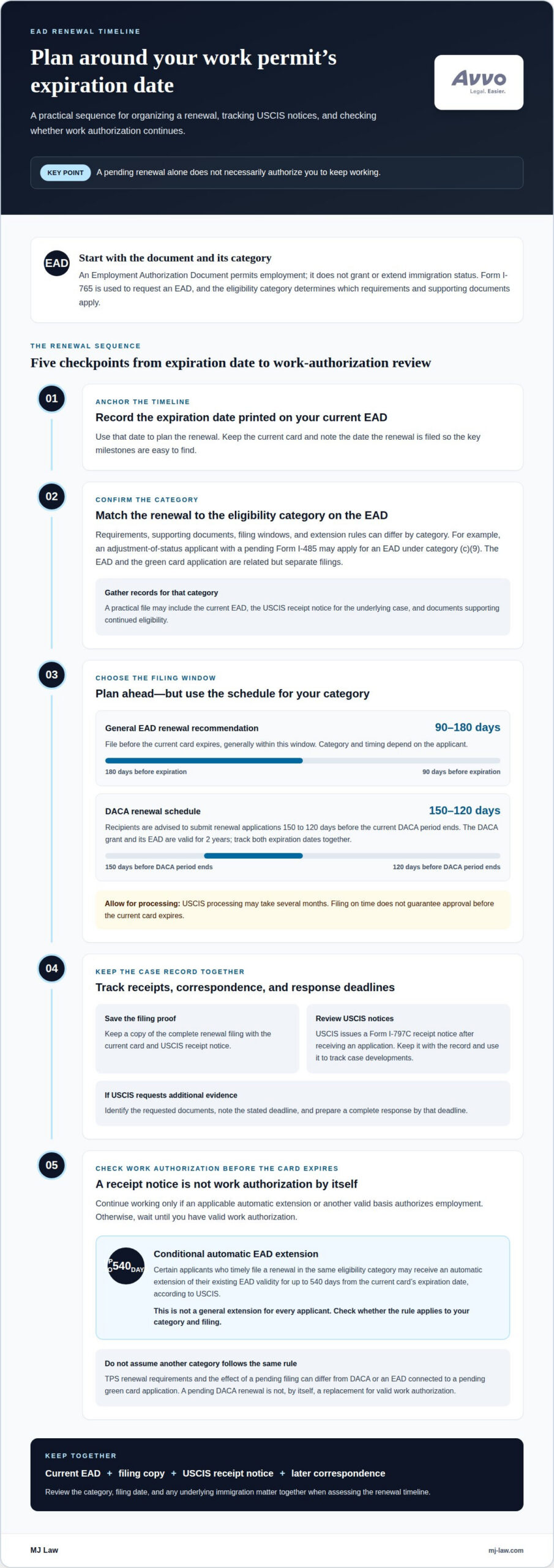
Renewal applicants should connect each document to the category and filing they’re renewing. A practical file may include the current EAD, the USCIS receipt notice for the underlying case, and documents supporting continued eligibility. Certain U.S. EAD renewal applicants who timely file in the same eligibility category may receive an automatic extension of their existing EAD validity for up to 540 days from the current card’s expiration date, according to U.S. Citizenship and Immigration Services. That extension is conditional, not a general extension for every applicant.
- Confirm the category: Match the renewal request to the eligibility category shown on the current EAD.
- Gather supporting records: Include the documents required for that category and keep copies of the complete filing.
- Track USCIS notices: USCIS issues a Form I-797C receipt notice after receiving an application. Keep it with the filing record and use it to track case developments.
- Respond to requests: If USCIS asks for additional evidence, identify the requested documents and submit a complete response by the stated deadline.
These steps also matter for applicants in San Jose and elsewhere in the San Francisco Bay Area. An immigration attorney can review the Form I-765 category, supporting documents, and any USCIS request before a response is prepared. For a person whose work authorization depends on a pending adjustment case, the attorney can also consider how the EAD filing relates to the Form I-485. A law firm’s review helps identify mismatched details, missing evidence, or a response that does not address USCIS’s request. Keep the EAD, receipt notice, and USCIS correspondence together so the application history is clear.
Renewal timing and avoiding gaps in work authorization
If your work permit expires before your renewal is approved, do not assume that a pending application alone lets you keep working. Continue working only if an applicable automatic extension or another valid basis authorizes your employment. Otherwise, wait until you have valid work authorization.
Start planning from the expiration date printed on your employment authorization document, then identify the category connected to your current permit. A general recommendation is to file a renewal 90 to 180 days before expiration. That lead time gives you room to prepare category-specific documents and address filing issues, while USCIS processing may take several months. A timely filing doesn’t guarantee approval before the card expires, so don’t treat the receipt notice as work authorization by itself.
DACA recipients have a distinct renewal schedule. The DACA grant and its EAD are valid for 2 years, and recipients are advised to submit renewal applications 150 to 120 days before the current DACA period ends. Because both the grant and work authorization have expiration dates, track them together. A pending DACA renewal is not, by itself, a replacement for valid work authorization.
TPS applicants should also plan around the expiration date and their eligibility category. Renewal requirements and the effect of a pending filing can differ from those for DACA or an EAD connected to a pending green card application. Avoid assuming that one category’s filing window or extension rule applies to another. For a green card applicant, keep the EAD timeline alongside the pending Form I-485 timeline, since those are separate filings with related but distinct purposes.
Use a simple record system to reduce preventable delays:
- Record the dates: Save the EAD expiration date and the date the renewal is filed.
- Keep proof together: Store the filing copy, USCIS receipt notice, current card, and any later correspondence in one place.
- Review notices promptly: If USCIS requests evidence, identify the requested items and the response deadline before preparing a reply.
- Reassess work eligibility: Before the card expires, determine whether a category-specific extension or other valid authorization applies.
Clients facing an approaching expiration can benefit from reviewing the category, filing date, and pending immigration matter together. A lawyer can assess whether the renewal timeline matches the underlying case and help organize a response to USCIS correspondence. If your work authorization is connected to an employment-based matter or marriage-based green card, discuss those timelines during a work authorization case discussion.
Support throughout the renewal process
USCIS processing times depend on the EAD category and service-center workload. In 2026, EAD processing generally takes 3 to 12 or more months, and some cases take longer. These estimates help explain why a pending renewal may not be decided before the current card expires. A receipt confirms that USCIS received an application, but it doesn’t by itself authorize employment. Applicants need to distinguish case progress from permission to work legally in the United States.
DACA renewal delays can be especially concerning because the DACA grant and employment authorization have connected timelines. A delayed decision does not mean every applicant has the same options. The category, filing date, current card expiration, and applicable extension rules all matter. Keep the receipt notice and USCIS correspondence together, review the case status, and check whether USCIS has requested evidence. If a notice asks for documents, focus your response on the specific items requested.
An immigration attorney can assess how a delay affects your situation by reviewing your EAD category, application history, and related immigration filings. For example, a pending green card application may be relevant to an EAD renewal, but each filing serves a separate purpose. An attorney can identify whether the renewal appears to fit the correct category, organize supporting records, and help prepare a response to USCIS correspondence. A case review can also clarify which documents may help demonstrate continued eligibility.
To make a case review more efficient, organize these records before discussing the delay:
- Application record: Keep a copy of the submitted Form I-765 and its supporting documents.
- USCIS notices: Gather the receipt notice, requests for evidence, and any decisions received.
- Authorization details: Note the EAD category and expiration date, then compare them with the renewal filing.
- Related filings: Include notices for a pending adjustment, asylum, or other case tied to eligibility.
These records help an attorney distinguish a processing delay from a filing issue. A missing document, an incomplete response to a request, or a category mismatch may need different attention from a case awaiting a decision. The appropriate next step depends on the notice and application history, not only on how long the application has been pending.
Some applicants may qualify for an automatic extension, while others may not. Eligibility category and timely filing are key factors. Reviewing these details can help determine whether you may continue working or need to wait for renewed authorization. If USCIS requests evidence, respond by the deadline in the notice and keep a copy of the complete response. Maintaining a clear record of each step makes the case history easier to review as processing continues.
Work permit renewals and attorney assistance
An attorney can review your renewal filing, supporting evidence, and its connection to your immigration matter. Ask how the lawyer will assess your eligibility category, identify potential filing issues, and address USCIS requests.
Attorney Assistance With EAD Renewals
For an EAD renewal, attorney assistance can include reviewing your current card, identifying the eligibility category, and comparing the application with supporting documents. The attorney can also consider how a pending immigration case relates to the requested employment authorization. Look for a clear explanation of the filing steps, the evidence supporting eligibility, and how USCIS correspondence will be handled.
A review should begin with the case history, not just a blank form. For example, a renewal tied to a pending green card application may need to be considered alongside the adjustment filing. A renewal based on another immigration category calls for a different, category-specific review. Comparing the current EAD, prior application, receipt notices, and new evidence can help identify inconsistencies before submission.
An attorney can explain what a USCIS notice requests and help prepare a focused response. The response should address the specific evidence gap or question in the notice rather than add unrelated records. Keep copies of the application, supporting documents, and correspondence together. These records give the lawyer a clear timeline to review if USCIS asks for more information or the case encounters a filing issue.
Questions for a San Jose Attorney
Ask whether the attorney has handled renewals in your eligibility category and how they will assess your filing. Clarify who reviews the forms and evidence, how you will receive updates, and what assistance is provided if USCIS sends a request. You can also ask how the lawyer will consider your underlying immigration status and related applications before advising on work authorization.
- Eligibility: Which category applies to my renewal, and what facts or documents support it?
- Filing review: How will you check the application and supporting records for consistency?
- USCIS correspondence: If USCIS requests evidence, how will you help prepare the response?
- Related matters: How could my pending immigration case affect the renewal strategy?
Clear answers help you understand the attorney’s role and the decisions that remain yours. If your renewal connects to an employment-based or family immigration matter, discuss both filings together. You can use an immigration case discussion to raise questions about the renewal process and its relationship to your broader case.
Which San Jose attorneys handle work permit (EAD) renewals?
Immigration attorneys who work with employment authorization and Form I-765 filings are the relevant professionals to consider. The right fit depends on your EAD category, the immigration matter behind it, and whether USCIS has raised an issue. A renewal linked to a pending green card application, for example, may need to be considered alongside the adjustment case.
Look for an attorney who can explain how the renewal category fits your circumstances instead of treating every EAD application alike. Ask how they review the current card, prior filings, and supporting records for consistency. A useful review identifies which parts of your case affect eligibility and what documents the attorney needs to assess before preparing or reviewing the filing.
Experience with related immigration matters can also be relevant. An EAD may connect to a family-based case, an employment-based matter, or another eligibility category. The attorney should explain how the work permit filing relates to the underlying case without suggesting that the EAD itself changes immigration status. If USCIS has sent a request for evidence, ask how the response will address each item in the notice.
- Category review: Ask how the attorney determines the correct EAD eligibility category for your renewal.
- Document review: Ask which records are needed to assess the application and support continued eligibility.
- Case coordination: Ask how the renewal fits with a pending green card or other immigration filing.
- USCIS notices: Ask how the attorney handles a receipt notice, evidence request, or decision.
- Communication: Clarify how you’ll receive updates and what information you should provide when case details change.
These questions help you understand the work involved and the decisions the attorney will address. A thorough review distinguishes filing preparation from USCIS’s decision, explains what evidence is relevant to your category, and identifies concerns in the case history. For example, differences between information in an earlier filing and the current renewal may need careful review before submission.
Bring the current EAD, prior Form I-765 copy, USCIS notices, and records for any related immigration application to a case discussion. Those materials help an attorney understand the filing timeline and spot questions that need attention. If you’re evaluating legal help for an EAD renewal in San Jose, schedule an immigration case discussion to discuss your situation and the documents relevant to your renewal.
MJ Law
MJ Law helps individuals understand how employment authorization relates to their broader immigration matter. If your EAD is connected to an employment-based visa or a family immigration case, reviewing both together can clarify which questions concern the work permit and which relate to the underlying case.
MJ Law handles immigration matters involving Employment-Based Visas, Family Immigration Services, Business and Investor Visas, and Entertainment and Artist Visas. The right next step depends on your situation, including the basis for your EAD and any pending immigration application. A discussion can help you organize the relevant details, identify questions about your case, and understand how the immigration matters fit together.
Contact MJ Law to discuss your work authorization and related immigration matter.
Take the Next Step With a Clear Case Plan
Connect your EAD renewal question with the immigration matter behind it. A work permit renewal attorney in San Jose can review how the application fits your circumstances and identify issues to address before you decide how to proceed. Bring your current card, USCIS notices, and records related to the underlying case so the discussion can focus on your filing history and current concerns.
For some people, the key question is whether a renewal relates to a pending family or employment matter. For others, it is understanding a USCIS notice or planning for an approaching expiration. A focused review can clarify which questions to address and the next procedural steps for your situation.
MJ Law works with individuals on immigration matters connected to family and employment. Contact MJ Law to discuss your EAD renewal and the immigration case related to it. A clear conversation can help you approach the next step with greater confidence.
Frequently Asked Questions
How long does it take to get an EAD?
EAD processing generally takes 3 to 12 or more months in 2026, with timing depending on the eligibility category and USCIS service-center workload. For example, two applicants filing Form I-765 under different categories may have different processing timelines. After approval, the card is typically produced within 2 weeks. Plan around the possibility of a lengthy wait, and distinguish the approval decision from card production and delivery.
Who Needs an EAD?
People who aren’t U.S. citizens or permanent residents may need an EAD if their immigration category requires separate employment authorization. Examples include some F-1 students, dependents of certain workers, asylum seekers, and people with pending adjustment of status applications. Eligibility and filing requirements depend on the person’s category. For instance, an adjustment applicant may request an EAD while a green card case is pending, but the application doesn’t itself grant immigration status.
How early can I file an EAD renewal before my current work permit expires?
A general recommendation is to file an EAD renewal 90 to 180 days before the current card expires. The suitable filing date depends on your eligibility category and the documents needed for the renewal. For example, someone assembling evidence for a category-specific application may need time to gather those records before filing. Check the expiration date on your card and plan the renewal around that date, rather than waiting for a decision deadline.
Do EAD renewals qualify for an automatic extension, and how long is it?
Some do. Certain applicants who timely file a renewal in the same eligibility category may receive an automatic extension of up to 540 days from the current card’s expiration date, according to U.S. Citizenship and Immigration Services. The extension doesn’t apply to every renewal, so the category and filing conditions matter. For example, don’t assume a timely filing in one category carries the same extension as a filing in another.
Can I keep working while my EAD renewal is pending?
You can keep working during the pending period only if you have valid employment authorization. This may include an applicable automatic extension or a separate basis authorizing your employment. A pending renewal receipt alone does not establish permission to work. Before continuing after your card expires, identify your category and determine whether its extension conditions apply. If no valid authorization covers that period, do not work until you are authorized again.
How do I choose between a San Jose immigration attorney and filing an EAD renewal myself?
A straightforward renewal may be manageable independently if you understand your category and can prepare the required evidence. A work permit renewal attorney in San Jose may be helpful if your eligibility depends on a pending immigration case, your filing history raises questions, or USCIS requests additional evidence. Consider whether you can explain your category, assemble consistent records, and respond to notices. The decision depends on your case’s complexity and the support you need.