
Traveling before an immigration case is resolved can affect whether it continues. People with a pending adjustment of status application should receive approval for Form I-131 before traveling abroad, according to U.S. Citizenship and Immigration Services. An advance parole travel document lawyer in San Jose can help assess whether your travel plans and immigration history may put a pending case at risk.
It’s reasonable to want a clear answer before making travel plans, especially when a trip involves family, work, education, or humanitarian needs. This article explains who may qualify for Advance Parole, how pending adjustment applications and humanitarian purposes affect the process, and what to know about document validity.
You’ll also learn when legal guidance may help, including with DACA-related travel or a case with important timing considerations. Start by understanding your status, the reason for travel, and whether you have an approved document before departure.
Key Takeaways
- Understand why people with pending adjustment applications should address travel plans before leaving the United States.
- Learn how Advance Parole works as temporary travel authorization and why approval before departure matters.
- See which humanitarian, educational, or employment-related reasons may support a DACA recipient’s travel request.
- Find out how immigration status and the purpose of travel shape eligibility and application preparation.
- Learn what to consider about document validity and when legal guidance may help you assess travel-related risks.
Advance parole for people with pending adjustment applications
A pending adjustment of status application can make international travel a consequential decision. Before leaving, understand how Form I-131 approval and your current immigration status affect your return.
Travel Restrictions During a Pending I-485
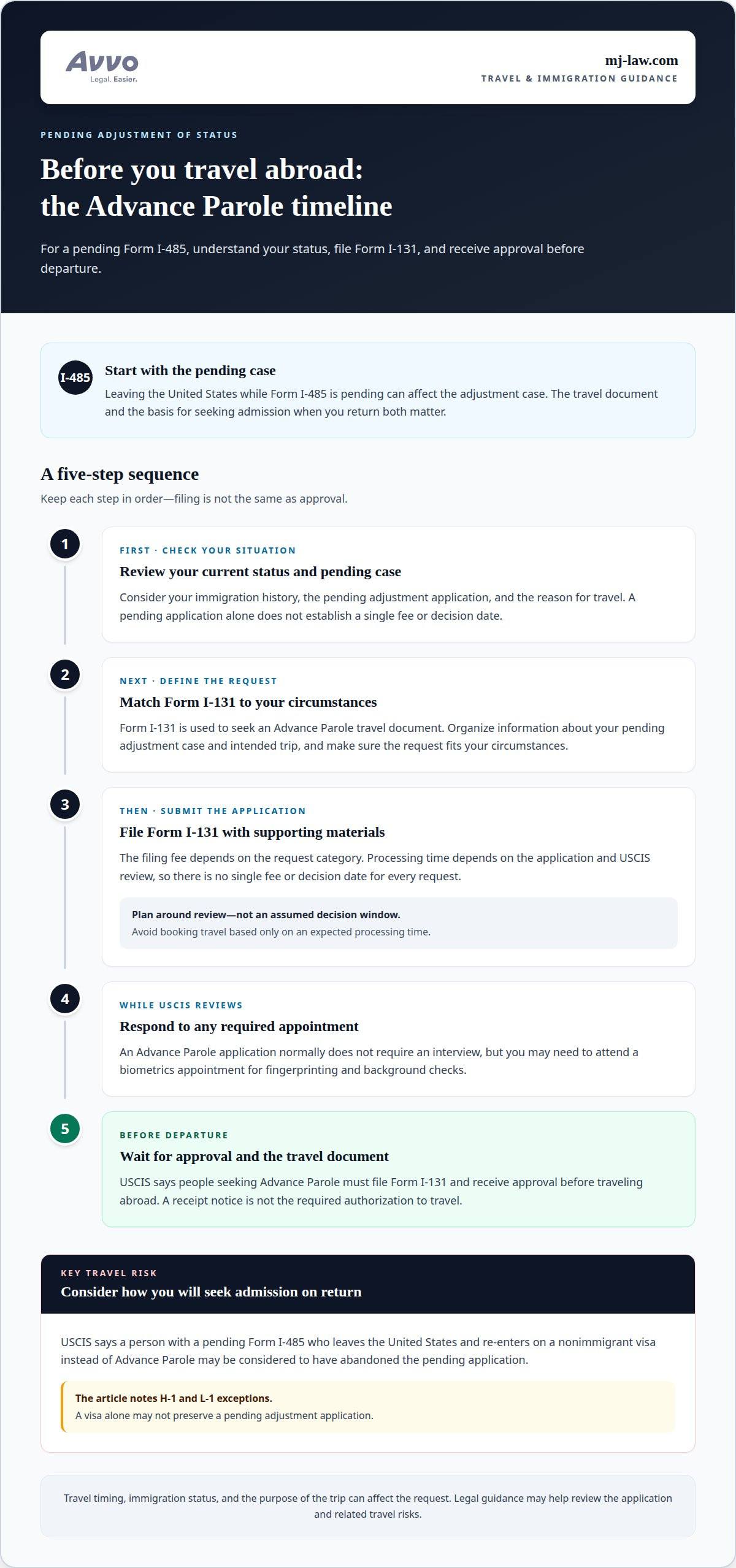
Leaving the United States while Form I-485 is pending can affect the adjustment case. According to U.S. Citizenship and Immigration Services, a person who files Form I-485, leaves the United States, and re-enters on a nonimmigrant visa instead of Advance Parole may be considered to have abandoned the pending application, with H-1 and L-1 exceptions.
Consider the whole trip, not just the departure date. For example, someone with a pending application who plans to visit family needs to consider both the document required to leave and the basis for seeking admission upon return. A visa alone may not preserve an adjustment application.
Form I-131 Travel Document Applications
Form I-131 is the application used to seek an Advance Parole travel document. According to U.S. Citizenship and Immigration Services, people seeking Advance Parole must file Form I-131 and receive approval before traveling abroad. The application concerns the traveler’s eligibility and request for temporary travel authorization.
Before submitting, organize information about the pending adjustment case and intended travel. An immigration attorney can review the application for completeness and help present supporting materials clearly. Form I-131 is also used for other travel-document requests, so the request must match the applicant’s circumstances.
Approval Before Travel
Filing Form I-131 is not the same as receiving an approved travel document. Wait for approval before departing; a receipt notice alone does not provide the required authorization to travel abroad. This distinction matters when a departure is planned around a family event, work obligation, or other commitment.
USCIS generally reviews the application materials before issuing an approved document. An Advance Parole application normally does not require an interview, but you may need to attend a biometrics appointment for fingerprinting and background checks. Legal review can help identify missing information and prepare the case for agency review.
Filing Fees and Processing Times
There isn’t one fee or processing time that applies to every Form I-131 request. The applicable filing fee depends on the request category, while processing time depends on the application and USCIS review. A pending I-485 does not, by itself, establish a single fee or decision date.
For planning, distinguish the filing step from approval and document issuance. Avoid booking travel based only on an expected decision window. Review the fee that applies to the specific Form I-131 filing and allow for the time needed to complete agency review, including any biometrics appointment USCIS requires.
Who may need an immigration attorney for Advance Parole?
Advance Parole is temporary travel authorization, not a general solution for every immigration or employment concern. An attorney can review whether your status, reason for travel, and supporting evidence fit the request before you make plans that depend on approval.
Legal guidance can be especially useful when a travel request involves DACA, a pending immigration matter, or several connected deadlines. For example, a DACA recipient planning overseas training needs to consider both the travel request and the status supporting it. DACA recipients must have approved DACA before traveling abroad, and an initial DACA request pending with USCIS does not make someone eligible to apply for DACA Advance Parole.
The purpose of the trip matters. DACA recipients may seek Advance Parole for employment purposes, such as attending a conference, training, work meeting, interview, or overseas work assignment. They may also seek it for educational or humanitarian purposes. The application needs evidence supporting the stated reason, and an attorney can help organize records that connect the planned activity to the request.
Temporary travel authorization and employment
Advance Parole concerns travel, while employment authorization is separate. A travel document is not a work permit. If you rely on employment authorization, distinguish its status from the status of an Advance Parole request rather than assuming one approval resolves both issues.
For DACA recipients, status and work-permit renewal follow a separate cycle: renewals are required every two years. USCIS recommends submitting a renewal request 120 to 150 days before current DACA expires. That timing can matter when planned work travel overlaps with a renewal period. An attorney can help assess how the travel request, DACA status, and employment plans fit together.
Choose supporting documents that fit the specific travel purpose. A conference attendee might need records identifying the event and explaining its connection to work. Someone traveling for academic research would need materials describing the educational activity. For humanitarian travel, relevant records should support the circumstances behind the request. Clear, consistent evidence helps explain why you seek to travel.
An advance parole travel document lawyer in San Jose may be helpful when eligibility is unclear, a deadline is approaching, or a prior immigration history complicates the application. The review can focus on the requested purpose, current status, supporting materials, and how travel plans interact with employment authorization. For guidance on an immigration matter involving family or employment, schedule an immigration consultation.
Immigration attorney assistance in San Jose
When seeking legal support for immigration-related travel, compare the attorney’s relevant experience, the issues they review, and the steps they explain. A focused discussion should connect your pending case, current status, travel purpose, and timing.
Who May Need Attorney Assistance
Legal guidance can help when an immigration decision has several connected parts. For example, someone with a pending application and planned travel may need to understand how departure could affect the case and which documents support the request. A review can identify questions to address before travel plans move forward.
A travel request can also overlap with family immigration or another pending benefit. Start with a clear timeline: the application already filed, any agency notices received, the planned departure, and the reason for travel. These details keep the legal analysis focused on your actual case rather than a general overview.
Attorney Experience
Relevant experience includes working with immigration filings, status issues, and applications that depend on a person’s individual history. Raul Ray has been a licensed California attorney for over 36 years. That professional background can help readers understand why an attorney’s immigration experience matters when an application and travel plans interact.
Experience is most useful when it leads to practical case analysis. A careful review can organize your immigration timeline, identify documents related to the pending matter, and explain how the travel request fits the record. An old immigration filing or agency notice, for example, may call for closer attention to specific facts.
Comparing San Jose Attorneys
Look at the substance of the legal review, not just a general description of immigration services. Useful criteria include whether the attorney considers your pending application, travel purpose, immigration history, and timing together. The explanation should identify which records support the analysis and what steps follow from the facts of your case.
A structured comparison can focus on three points: relevant immigration experience, a clear explanation of the issues, and a defined process for reviewing documents. Notice whether the discussion addresses your specific application and distinguishes travel authorization from other immigration matters. These criteria help you assess whether the guidance fits your situation.
Before a discussion, organize agency notices, prior filings, and a travel timeline. Those records help an attorney understand the action already taken and the question still unresolved. For a case involving family immigration, schedule a family immigration consultation to discuss the matter and its relevant records.
Humanitarian travel purposes
For recipients of Deferred Action for Childhood Arrivals (DACA), humanitarian circumstances can support an Advance Parole request. Examples include obtaining medical treatment abroad, caring for a sick or elderly relative, or attending funeral services. Explain why travel is needed and how the circumstances relate to the requested trip.
A humanitarian request needs more than a statement that travel matters. DACA recipients must support the application with evidence that the trip serves a humanitarian, educational, or employment purpose. For a medical visit, explain how the treatment relates to the travel plan. For a funeral, describe the family circumstance and planned attendance.
Present the purpose as a clear, complete account. Identify the person or circumstance involved, why travel is necessary, and what you plan to do abroad. For example, a request involving an elderly relative should describe the relative’s situation and your intended role. Relevant records can help document these details.
Humanitarian reasons are one of several grounds available to DACA recipients. They may also seek Advance Parole for economic or scholastic considerations, including qualifying educational purposes. Keep the requested purpose focused to distinguish a medical or family emergency from an academic or work-related trip. Supporting materials should match the reason presented.
Timing matters when a funeral or medical need creates a narrow travel window. You still need to prepare the request and supporting evidence to address the stated circumstances. A sudden change in plans may also mean the original explanation no longer accurately describes the trip. Keep the travel purpose and application account consistent.
Humanitarian circumstances can be sensitive, especially when a close relative is ill or has died. A clear, factual explanation can address the situation without unnecessary personal detail. For example, someone seeking treatment can state the medical purpose and planned care, with records supporting the reason. Evidence should reinforce the request, not distract from it.
DACA status is central to this type of request. Someone whose initial DACA request is pending, or whose DACA has expired without current status, cannot apply for DACA Advance Parole. An attorney can assess your status history alongside humanitarian evidence, particularly when a renewal or pending immigration action affects your travel plans.
Before submitting a humanitarian request, organize the explanation around the actual need, planned activity, and evidence supporting that purpose. A medical treatment request, a visit to a sick relative, and funeral attendance each call for different supporting details. This focused preparation helps present the circumstances accurately and keeps the requested travel purpose clear.
What is Advance Parole and who is eligible?
Advance Parole is a travel document that may allow certain people to return to the United States after temporary travel abroad without an immigrant or nonimmigrant visa. You need approval before departure. The document supports travel but doesn’t guarantee admission; returning travelers are inspected at the border.
Eligibility depends on immigration status and the type of travel document requested. U.S. Citizenship and Immigration Services lists people with Deferred Action for Childhood Arrivals (DACA) status as potentially eligible for Advance Parole. People granted Temporary Protected Status and people with pending asylum applications may also seek it. These categories involve different circumstances, so the application needs to match the person’s status.
DACA recipients need approved DACA status before traveling abroad. Someone with an initial DACA request pending, or with expired DACA and no current DACA status, cannot apply for DACA Advance Parole. Eligible recipients may request travel for humanitarian, educational, or employment purposes. For example, a request could relate to medical treatment, academic research, or an overseas work assignment, supported by evidence of the stated purpose.
Form I-131 covers several distinct travel-document requests. A person seeking Advance Parole uses it for that request, while a refugee or asylee may apply for a refugee travel document before traveling abroad. A U.S. green card holder planning an extended stay outside the country may seek a re-entry permit. These documents serve different immigration situations and aren’t interchangeable.
Document validity also depends on your circumstances. An Advance Parole document is typically valid for one year, depending on immigration status. Check the printed validity dates and plan travel within that period. Approval for one trip or period doesn’t remove the need to check whether the document remains valid for later travel.
Before applying, identify the correct document category, current immigration status, and purpose of travel. Then prepare Form I-131 and supporting evidence that fits the request. For a DACA recipient, that means addressing approved status and the humanitarian, educational, or employment basis. For a green card holder, the relevant question may instead concern a re-entry permit for an extended absence.
If you’re weighing which travel document fits your status, schedule an immigration consultation to discuss your circumstances and application options.
MJ Law
MJ Law helps individuals understand how immigration matters connect with broader family or employment-based plans. If a pending adjustment case is based on a family relationship, Family Immigration Services may provide relevant support. For work-related immigration matters, Employment-Based Visas may relate to the underlying case. Discuss your status, travel purpose, and pending application together with MJ Law.
Bring any USCIS notices, copies of prior filings, and a clear outline of your planned travel to make that discussion specific. These details help frame the questions around your immigration history and the case currently before USCIS. To discuss your circumstances, contact MJ Law to arrange a consultation.
Plan Your Next Step With Care
A planned trip can affect more than your calendar. Before making commitments, bring your travel purpose, pending immigration paperwork, and relevant agency notices together in a clear timeline. This provides a practical starting point for deciding what needs attention before departure and how the trip fits your broader immigration plans.
The right approach depends on your status, case history, and reason for travel. An advance parole travel document lawyer in San Jose can help assess how those details interact and identify questions to resolve before you proceed. MJ Law provides immigration legal services in San Jose and can discuss how your circumstances relate to its practice.
Contact MJ Law to discuss your Advance Parole questions. A thoughtful next step can help you approach your travel plans with greater clarity and confidence.
Frequently Asked Questions
How do you apply for advance parole using Form I-131?
Apply by submitting Form I-131 with information and supporting evidence that match your immigration status and travel purpose. According to U.S. Citizenship and Immigration Services, applicants must receive approval before traveling abroad. For example, someone with a pending adjustment case can organize relevant application notices and travel details to support a complete request. Keep copies of the submitted materials and any USCIS correspondence together for reference during the process.
Can you travel while an advance parole application is pending?
Don’t travel abroad based only on a pending Form I-131 application. U.S. Citizenship and Immigration Services requires approval before departure for people seeking Advance Parole. A receipt notice confirms filing, not approval. If you also have a pending adjustment application, consider how your status and intended re-entry method affect that case. For example, a planned family visit should wait until you understand which travel document or visa applies to your circumstances.
What are the risks of traveling with advance parole, including for people with unlawful presence or removal orders?
Advance Parole doesn’t resolve every immigration concern, and unlawful presence or a removal order can raise separate questions about travel and return. Have an attorney review any prior immigration notices, court or agency orders, and status history before departure. For example, share a removal order or record of a past immigration decision during the legal review. Don’t assume that holding a travel document settles issues beyond the travel authorization itself.
Does advance parole guarantee reentry into the United States?
No. Advance Parole doesn’t guarantee re-entry into the United States. Returning travelers are inspected at the border, where officials assess their circumstances. Treat the document as travel authorization, not a promise of admission. Before departure, keep your travel document and relevant immigration records accessible for the return journey. If your case includes an unusual history or prior agency action, discuss those details with an attorney before making travel plans.
How can an immigration lawyer in San Jose help with an advance parole application?
An immigration lawyer can assess how your status, application history, and travel purpose fit together, then help organize the request and supporting records. For instance, an advance parole travel document lawyer in San Jose can review whether a planned trip relates to a pending adjustment matter or a separate immigration concern. Bring relevant USCIS notices and explain any prior filings so the discussion addresses your case, not only general eligibility.
What documents should you bring to a San Jose immigration lawyer for an advance parole consultation?
Bring copies of immigration applications, USCIS notices, and any travel document already issued. Include records that explain your travel purpose, such as information about a medical appointment, family circumstance, academic activity, or work event. A simple timeline of past filings and planned travel can clarify the questions. If you have received an immigration order or decision, include it so the attorney can consider it with your other records.
Where can you get local legal aid for advance parole in San Jose or Santa Clara County?
For local immigration legal guidance, contact MJ Law in San Jose to discuss your situation and related immigration questions. The firm offers consultations in English and Spanish. Bring your USCIS notices, prior filings, and travel details so the discussion can focus on your circumstances. If your matter relates to a family-based immigration process, explain that relationship when arranging the consultation.