
Yes, you can submit additional documents or a legal brief with Form N-336 or present evidence at the hearing. USCIS may also review the original record and request more evidence or testimony. An N-336 naturalization hearing lawyer in San Francisco can help organize your evidence around the reason USCIS denied your N-400, though you aren’t required to hire an attorney.
A denial can feel final, but an N-336 hearing gives you an opportunity to address the issues behind the decision. The review considers your eligibility as of the date of the N-400 decision, so the details of your residence history and any good moral character concerns may matter.
This article explains what happens at the hearing, how new evidence fits into the review, and how residence and good moral character issues can affect eligibility. You’ll also learn what the filing deadline means and when legal support may help you present a clear response.
Key Takeaways
- Track the N-400 denial notice carefully: the N-336 filing window is short, and the deadline can depend on how USCIS sent the decision.
- Build your response around the specific reasons for denial, including any evidence that clarifies your residence history or addresses good moral character concerns.
- Understand what the review can involve: a different USCIS officer may reassess the case, ask questions, and reach a decision on the denial.
- Consider whether a residence break affects your eligibility timeline, especially if you spent an extended period outside the United States.
- Learn what an attorney can do at the hearing and what representation paperwork must accompany the case.
Can I submit new evidence?
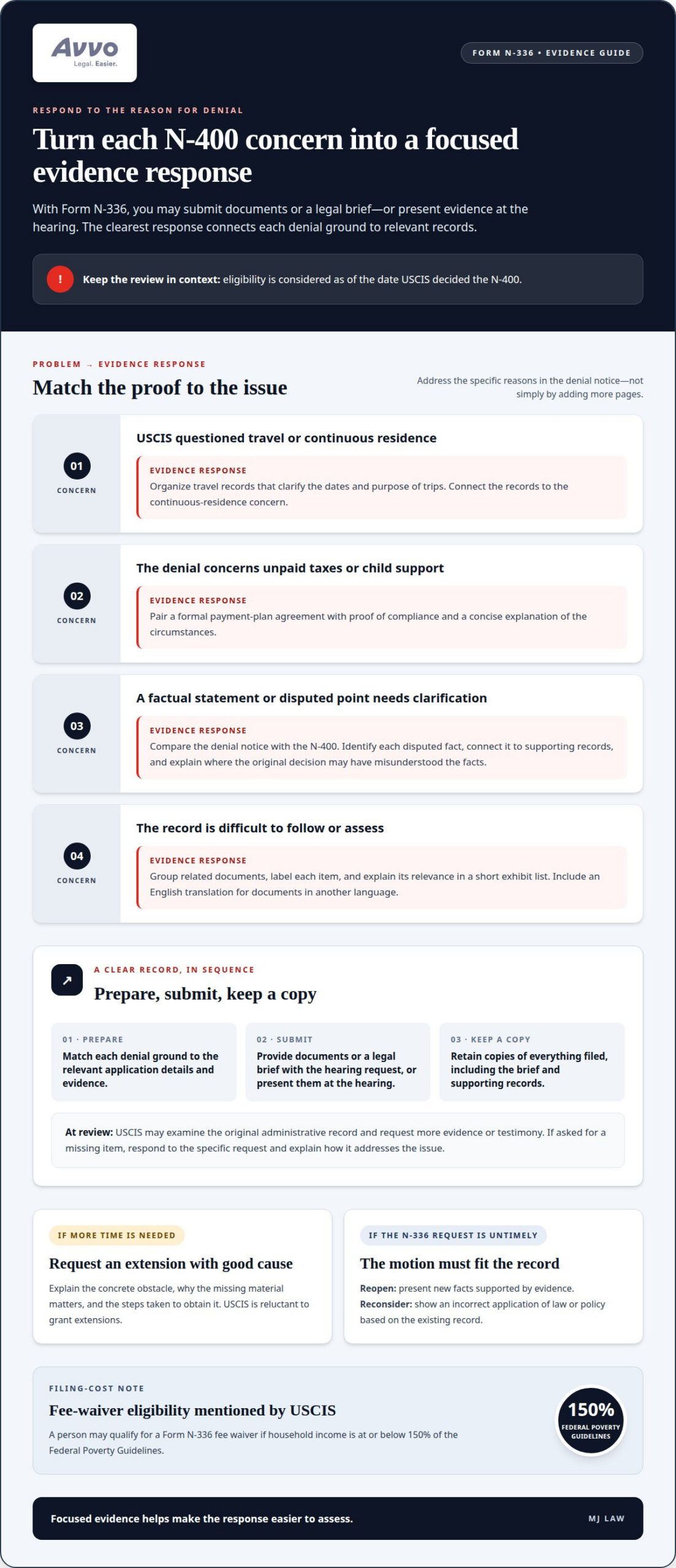
Yes. You may submit additional documents or a legal brief with Form N-336 or present them at the hearing. The strongest materials answer the specific reasons in your N-400 denial, rather than simply adding more pages. For example, if USCIS questioned a travel history, organize records that clarify the dates and purpose of the trips. If the denial concerns conduct, provide documents and context that address the concern directly.
Build a focused record before preparing your arguments. Compare the denial notice with your application and identify each disputed fact or eligibility issue. Then connect each point to evidence, such as travel records for a continuous-residence concern or payment-plan documents for unpaid support or taxes. A legal brief can explain how the records relate to the denial and where the original decision may have misunderstood the facts.
Make the evidence easy to follow. Group related documents, label each item clearly, and explain its relevance in a short exhibit list. For example, pair a payment-plan agreement with proof of payments and a concise account of the circumstances. If a document is in another language, include an English translation so the officer can assess it. Avoid relying on a broad personal statement when records can verify dates, payments, or events.
You may submit additional documents and legal arguments with the hearing request or bring them to the hearing. The reviewing officer may examine the original administrative record and request further evidence or testimony. If USCIS asks for a missing item, respond to the specific request and explain how your submission addresses it. Keep copies of everything filed, including the brief and supporting records, so your preparation stays consistent with the materials submitted.
If you need more time to gather evidence, you can request an extension by showing good cause. USCIS is reluctant to grant extensions, so explain the concrete obstacle and why the missing material matters. A pending document request alone may not explain its relevance; identify the issue it supports and the steps taken to obtain it. For an untimely N-336 request, a motion to reopen must present new facts supported by evidence. A motion to reconsider must show an incorrect application of law or policy based on the existing record. Both require a clear connection between the argument and the case record.
Evidence may also address rehabilitation, not just dispute past events. In a case involving unpaid taxes or child support, relevant materials may include a formal payment plan, proof of compliance, and context explaining the circumstances. U.S. Citizenship and Immigration Services states that a person may qualify for a Form N-336 fee waiver if household income is at or below 150% of the Federal Poverty Guidelines. That eligibility can help address the filing cost while you assemble a complete response.
Attorney assistance and hearing representation
You may handle an N-336 without a lawyer, but an attorney can help connect the denial’s factual basis to your arguments and documents. Representation also affects what paperwork must accompany the hearing request.
Whether Legal Representation Is Required
An attorney isn’t required to file Form N-336 or attend the hearing. That matters if you’re weighing whether to prepare the case yourself or seek help with legal arguments and evidence.
Start by matching each reason in the denial notice to the relevant part of your N-400 application and supporting record. If the decision turns on a travel date, for example, gather records that clarify the trip and explain how it relates to continuous residence. If the issue concerns a factual statement, identify the statement and collect documents that clarify its context. A lawyer can help assess which points need a legal response and which need additional proof.
Representation at the Hearing
Federal law permits an attorney to attend an N-336 hearing and present legal arguments. That can help keep the discussion focused on the denial grounds, especially if the officer asks questions about application details or supporting documents.
A representative must submit Form G-28 with the N-336 request or at the time of the interview. Coordinate this filing with your hearing materials so USCIS knows who represents you. Before the interview, review the denial notice, your original application, and any new evidence with your attorney. Prepare to explain factual discrepancies clearly, rather than relying on a brief to speak for you.
Having a representative does not remove your role in the hearing. You may need to answer the officer’s questions about your history and documents. A clear timeline can help you respond consistently and explain whether a statement was a mistake rather than deliberate.
Finding an N-336 Lawyer in San Francisco
To find an experienced N-336 naturalization hearing lawyer serving San Francisco, look for an immigration attorney who handles naturalization denials and administrative hearings. Ask how they would analyze the specific denial grounds, organize the record, and prepare you for questions at the interview. Those discussions reveal whether the proposed approach addresses your actual case.
Bring the denial notice, N-400 application, USCIS correspondence, and relevant supporting documents to an initial case discussion. Ask how the attorney will distinguish factual disputes from legal issues and whether they will appear at the hearing. A San Francisco lawyer focused on N-336 naturalization hearings should identify what the record establishes, what remains unclear, and how each proposed document supports the response.
If you want to discuss how legal representation may fit your naturalization matter, you can schedule a case discussion. Bring your denial notice so the conversation can focus on the stated reasons and the hearing issues.
Naturalization eligibility issues, including residence and good moral character
An N-400 denial may turn on good moral character, residence, or information in the application. To request a hearing, file Form N-336; according to U.S. Citizenship and Immigration Services, the general deadline is 30 calendar days from the denial date, or 33 calendar days if USCIS mailed the decision.
Good Moral Character Requirements
Good moral character is an eligibility requirement USCIS assesses over a relevant period, commonly five years or three years for certain applicants married to U.S. citizens. The officer may consider conduct and statements on your application during the applicable period, rather than focusing on a single event in isolation.
A denial may allege false statements or misrepresentation. For example, if USCIS says an applicant omitted biological children born abroad, the response should address the exact statement, what information was available when the application was filed, and documents that clarify the facts. Explain why the issue was an error rather than an intentional misrepresentation, and respond directly to the officer’s concern.
Good moral character concerns may also involve unpaid taxes or child support. Relevant materials can include a formal payment plan, proof of payments, and a clear account of the circumstances. These records help explain the conduct and steps taken to address it. The key is how the evidence relates to eligibility during the applicable period.
Court Records and Eligibility Concerns
Court records can clarify conduct raised in a naturalization denial. If the officer refers to a court matter, compare the denial’s description with the available court documents. Differences in dates, allegations, or case outcomes may affect how USCIS understands the facts.
Prepare a consistent account by reviewing the court record alongside the N-400 and any prior statements to USCIS. For example, if an application describes an incident differently from a court document, identify the precise difference and explain it with supporting evidence. Avoid relying on a summary that leaves out the outcome or relevant context.
Residence concerns call for a separate review of travel and time spent outside the United States. An absence of one year or more can trigger a statutory break in continuous residence. A shorter trip may also receive scrutiny in a particular case: one example described USCIS treating eleven months abroad as a break. Compare your travel dates with the denial’s reasoning, then address the facts and their effect on eligibility directly.
An appeal through N-336 focuses on the denial and the record supporting your eligibility as of the N-400 decision date. Organize the response around each stated concern: identify the officer’s finding, point to relevant records, and explain how the evidence affects the conclusion. This approach keeps residence, conduct, and application accuracy distinct while showing how each issue fits the overall eligibility review.
Continuous residence and physical presence
Continuous residence and physical presence are related, but they measure different aspects of naturalization eligibility. Review a residence denial against your travel history and the specific reasons stated in the denial notice.
Continuous Residence Requirements
Continuous residence concerns maintaining U.S. residence during the applicable naturalization period. An absence of one year or more can trigger a statutory break in continuous residence. The officer may decide the application based on whether travel interrupted the required period.
Start with the denial notice and mark each trip identified by the officer on a calendar. Compare departure and return dates with travel records, passport stamps, and other documents showing where you lived. A clear timeline can reveal a date error or explain why a trip does not support USCIS’s reason for denying the application.
A break may affect when you can apply again. An applicant who resumes U.S. residence after a continuous-residence break may be able to file a new application four years and one day after returning. For an applicant filing as the spouse of a U.S. citizen, the period may be two years and one day after returning. The return date and basis for filing are therefore important.
Residence Disputes and Physical Presence
Physical presence measures time spent in the United States; continuous residence concerns maintaining residence here. A travel calendar can show the dates you spent abroad and at home. Review the two requirements separately: evidence of a U.S. home may not establish how long you were physically present.
For a residence dispute, list travel dates chronologically and compare them with the denial notice. Identify the disputed trip, the officer’s stated reason, and records that clarify the dates or circumstances. Passport stamps and travel records, for example, can help resolve disagreement about when an absence began or ended.
Keep the timeline consistent with the N-400 and statements made during the interview. If the dates differ, explain the discrepancy and support the correction with records. An N-336 review evaluates eligibility as of the N-400 decision date, so later residence cannot by itself change the historical facts USCIS considered. Present the travel evidence in a way that addresses the original finding, rather than treating every trip as equally relevant.
If USCIS treated a trip as breaking residence, distinguish that issue from physical presence in your response. State which dates are disputed, what the documents establish, and how the travel relates to the applicable filing timeline. This focused comparison helps clarify whether the denial concerns a break in residence, physical presence, or both.
Administrative hearing under INA Section 336
According to U.S. Citizenship and Immigration Services, Form N-336 requests a hearing under Section 336 of the Immigration and Nationality Act. It lets a naturalization applicant challenge an N-400 denial through an administrative review.
For San Francisco applicants, the USCIS scheduling notice identifies the office and hearing location. The mailing address used to file a request does not, by itself, tell you where the hearing will occur. Read the notice for the assigned location, date, and attendance instructions, then keep it with your N-400 denial and filing records.
The deadline depends on how you receive the decision. According to U.S. Citizenship and Immigration Services, a person generally should file Form N-336 within 30 calendar days of receiving a decision denying Form N-400. If USCIS mailed the decision, a person generally should file within 33 calendar days. Use the denial notice and delivery details to determine which period applies, and avoid treating the date you read the letter as the only relevant date.
After filing, USCIS must schedule a properly filed Form N-336 hearing within a reasonable period, no later than 180 days from filing, according to U.S. Citizenship and Immigration Services. The hearing gives a different reviewing officer an opportunity to evaluate the denial and the applicant’s response. The review may involve the original record, additional documents, testimony, and arguments about the eligibility issue.
The officer may conduct a de novo hearing, considering the matter as though no earlier decision had been made, or use a less formal review focused on the denial issue. The reviewing officer must be different from the officer who conducted the original examination or issued the denial, and must be at an equal or higher grade. Prepare to explain how each argument relates to the original decision and the record.
The administrative review can affirm the denial, deny the case on newly discovered grounds, or reverse the decision and approve naturalization. Applicants who failed the English or civics examination during the first two attempts will be retested at the N-336 hearing. Applicants who passed those tests but were denied for another reason generally don’t retake them. The hearing notice and denial grounds help you prepare for the issues USCIS will evaluate.
After exhausting the N-336 administrative hearing, an applicant may seek de novo review in the U.S. district court for the district where they reside under 8 U.S.C. § 1421(c). That is a separate stage, not part of the USCIS hearing. If you need help assessing the denial and preparing for the hearing, schedule a discussion about your N-336 case.
MJ Law: Family Immigration Services
MJ Law offers Family Immigration Services for people addressing family-based immigration matters alongside a naturalization concern. An N-336 hearing focuses on the N-400 denial, while family petitions involve separate eligibility questions and supporting records.
If your immigration plans also involve a spouse or another family member, keep those matters distinct when organizing documents and decisions. MJ Law assists with family immigration needs, while your hearing response should address the reasons USCIS gave for denying naturalization.
Contact MJ Law to discuss your family immigration needs or visit mj-law.com.
Take the Next Step With a Clear Plan
Your next move is to turn the denial issues into a focused plan: identify what needs a legal response, what evidence supports your position, and what you need to prepare for the hearing. Working with an N-336 naturalization hearing lawyer in San Francisco can help you assess those issues and organize your case for review.
MJ Law also offers Business and Investor Visas and Employment-Based Visas for people with related immigration needs. Keep those matters separate from your N-336 response, while considering how each fits into your broader plans.
If you’re ready to discuss your hearing and the issues raised in your denial, schedule a conversation with MJ Law. A focused discussion can help you identify a practical path forward and prepare for the next stage with greater clarity.
Frequently Asked Questions
What Is Form N-336?
Form N-336 lets a person challenge USCIS’s denial of a naturalization application through an administrative hearing. U.S. Citizenship and Immigration Services describes it as a request for a hearing under Section 336 of the Immigration and Nationality Act. The review concerns the N-400 denial, and the applicant may present arguments about the issues behind that decision. It’s a separate administrative review, not a new naturalization application.
Do I have to take the English and Civics test again?
You may need to retake the English or civics test if you failed it during the first two attempts. At an N-336 hearing, USCIS retests applicants in that situation. If you passed both tests but your application was denied for another reason, you generally don’t retake them. For example, a denial based on a residence issue differs from a test failure, so review the denial grounds and hearing notice.
What is Form N-336 and who can request a naturalization hearing?
A person whose Form N-400 was denied after the naturalization eligibility interview can request an N-336 hearing. The request allows the applicant to challenge the denial and address the stated reasons with arguments or supporting evidence. For example, someone disputing USCIS’s understanding of an answer in the N-400 can use the hearing to explain the factual context. The denial notice identifies the decision and the hearing option.
What happens at an N-336 hearing, and how long does it take?
A USCIS reviewing officer examines the denial and may ask questions, consider testimony, or review additional materials. The officer can conduct a new review of the case or focus on the issue that led to denial. USCIS must schedule a properly filed hearing within a reasonable period, no later than 180 days from filing. That scheduling deadline is not the length of the hearing itself, which depends on the issues and evidence reviewed.
How can a lawyer help with an N-336 naturalization hearing?
An attorney can analyze the denial, organize the record, and present legal arguments at the hearing. For example, counsel can compare an alleged misstatement with the relevant N-400 answer and documents explaining the applicant’s understanding. An attorney may attend and represent you, but you remain responsible for answering the officer’s questions truthfully. The representative must submit Form G-28 with the N-336 request or at the interview.
What evidence should I bring to an N-336 hearing?
Bring materials that directly address the reasons USCIS gave for denial, along with copies of the N-400 and relevant USCIS notices. If the decision questions information about children born abroad, for example, records clarifying family details and the applicant’s original answer may help explain the discrepancy. Arrange documents by issue and keep a copy of the packet. This makes it easier to locate a record when the officer asks about a specific point.
What are the risks and alternatives if an N-336 request is denied?
The reviewing officer may affirm the original denial or deny the case on newly discovered grounds. After completing the N-336 administrative hearing, an applicant may seek de novo review in the U.S. district court for the district where they reside. A denied N-400 generally leaves the applicant a lawful permanent resident, though certain denial grounds may lead to deportation proceedings. If the N-336 deadline is missed, a person may generally file a new N-400 later.