
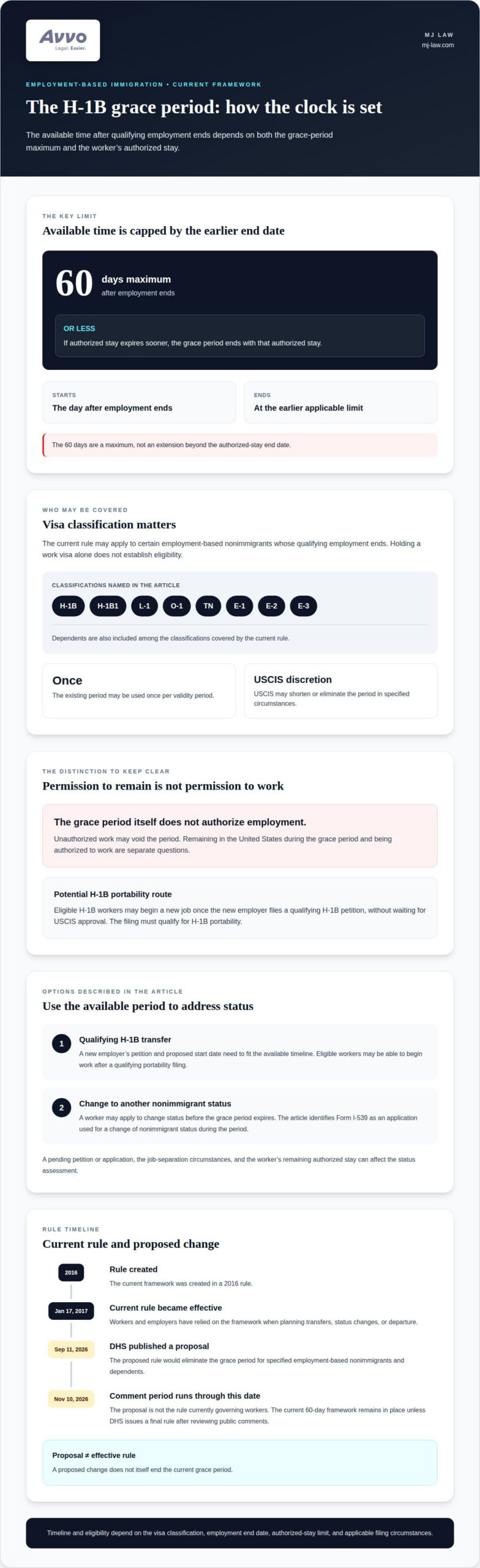
Under current U.S. rules, certain employment-based nonimmigrants, including H-1B workers, may remain in the country for up to 60 days after employment ends, or until their authorized stay expires if that comes sooner. The period begins the day after employment ends. A San Jose lawyer assessing H-1B 60-day grace period eligibility will consider both the worker’s visa status and the dates that shape the available time.
A job ending can make the next steps feel urgent, and the grace period is not permission to keep working for the former employer. It can, however, provide time to pursue another lawful status or a new qualifying job. This article explains who may qualify, how long the period can last, and what the proposed rule change could mean.
You’ll also see which employment-based classifications the current rule covers, including H-1B1, L-1, O-1, TN, E-1, E-2, and E-3 workers and their dependents. Understanding whether the rule applies to your visa category is an important starting point for planning what comes next.
Key Takeaways
- Identify your visa classification and authorized-stay end date to understand whether the employment-based grace period may apply to your situation.
- Use the available period to assess a qualifying change of status or new employment option, while keeping in mind that the grace period itself does not authorize work.
- Understand how the proposed rule could affect the current framework and why the distinction between a proposal and an effective rule matters.
- Consider employment-based immigration guidance when weighing next steps after a job loss, especially if a new petition or change of status is part of your plan.
What Is the 60-Day Grace Period?
The 60-day grace period can give certain H-1B workers time to address their immigration status after employment ends. Its effect depends on the worker’s remaining authorized stay, any new petition or status application, and the circumstances of the job separation.
Consequences of Losing Lawful Status
Falling out of lawful status means remaining in the United States without an authorized immigration basis. During an authorized grace period, the time does not count as unlawful presence under INA § 212(a)(9)(B). But failing to obtain another status after the period may lead to a Notice to Appear and removal proceedings. A departure can also affect the options available to return.
Work During the Grace Period
The grace period itself doesn’t authorize employment for a new employer. Unauthorized work may void the period, so a worker should distinguish between being allowed to remain and being allowed to work. Eligible H-1B workers may begin a new job once the new employer files a qualifying H-1B petition, without waiting for U.S. Citizenship and Immigration Services approval. The filing must qualify for H-1B portability.
Options for Maintaining Status
A worker may pursue a qualifying H-1B transfer or apply to change nonimmigrant status before the grace period expires. According to the Office of the Federal Register, National Archives and Records Administration, a worker may file Form I-539 to apply for a change of nonimmigrant status during the grace period. Under bill 1B, the U.S. Government Publishing Office states that an unemployed H-1B worker who finds new employment during the 60-day period would remain in lawful status while the petition is pending.
For example, a worker with a prospective employer can coordinate the H-1B petition filing and proposed start date. Someone considering another visa category may need a change-of-status application instead. A San Jose H-1B lawyer can assess the relevant dates, petition, and status options. To find an experienced H-1B immigration lawyer in San Jose, look for a practice handling employment-based petitions, transfers, and status changes.
For a lawyer consultation, organize your passport, current visa documents, I-94 record, H-1B approval notice, and employment end-date information. Include any new employer or petition details, plus immigration records for dependent family members. These documents help clarify the timeline and whether a transfer or status application is being considered. The lawyer’s fee depends on the case and is given after a quote request; relevant cost factors include the work involved and the type of filing.
Dependent family members also need attention when the principal worker’s employment ends. Their immigration status and any related applications should be considered alongside the H-1B worker’s plans, rather than treated as separate from the household’s departure or status decision.
Eligibility and duration of the current employment-based grace period
The current rule may allow certain employment-based nonimmigrants to remain in the United States after sponsored employment ends. Eligibility, the end date of authorized stay, and the rule’s discretionary nature all affect how much time is available.
Eligibility for the Grace Period
The current grace period applies to certain employment-based nonimmigrants whose qualifying employment ends. H-1B workers are among those covered, but holding a work visa alone doesn’t establish eligibility. The worker’s visa classification and authorized stay matter. The existing period may be used once per validity period, so a previous employment termination within that period can affect whether it is available again.
For a worker relying on the rule, the key distinction is between permission to remain and permission to work. The grace period generally means that ending employment does not, by itself, cause the worker to fail to maintain status during that time. It does not extend authorized stay beyond its end date. USCIS also has discretion to shorten or eliminate the period in specified circumstances.
Duration After Sponsored Employment Ends
The current maximum is 60 days after employment ends, or the remainder of the worker’s authorized stay if that is shorter. The period begins the day after employment ends. For example, if the authorized stay expires before the 60-day period would finish, the worker cannot rely on the full maximum. The actual end date therefore depends on both dates.
This framework was created in a 2016 rule that became effective January 17, 2017. Workers and employers have relied on it when planning a transfer petition, a change of status, or departure from the United States. A new employer’s filing timeline matters because a transfer petition must fit within the available period. The worker’s records should establish the employment end date and authorized-stay limit.
The Department of Homeland Security published a proposed rule on September 11, 2026, that would eliminate the grace period for specified employment-based nonimmigrants and dependents. It is a proposal, not the rule currently governing workers. The existing 60-day period remains in place until DHS reviews public comments and issues a final rule. The comment period runs through November 10, 2026.
That distinction matters for employers making hiring decisions and workers planning their next status. A proposed rule can signal potential change, but it does not itself end the current period. For case-specific planning around eligibility, dates, or a new petition, consider discussing employment-based immigration options.
Existing H-1B grace period after job loss
After H-1B job loss, the current grace-period rule still governs while the Department of Homeland Security considers its proposed change. The proposal would eliminate the period for specified employment-based nonimmigrant workers and their dependents, but it has not replaced the existing rule. Workers and employers should distinguish the current legal effect from a proposed future change.
Under the current framework, a qualifying worker may remain for up to 60 days after employment ends, or until authorized stay expires if sooner. The period starts the day after employment ends, and the rule may be used once per validity period. USCIS has discretion to shorten or eliminate the period in specified circumstances. That makes the worker’s status records and termination date important to assessing the available time.
For an employer, the distinction affects hiring and petition timing. A prospective employer may need to file Form I-129 within the worker’s grace period for a qualifying H-1B transfer. The worker should promptly share the employment end date and current approval information with the new employer or an attorney. A proposed start date alone does not replace the required petition filing.
The proposed change concerns specified workers and dependent family members, so households should consider each person’s immigration status together. A spouse’s or child’s status may depend on the principal worker’s circumstances and relevant filings. If a worker plans a transfer, the family should coordinate related status applications rather than assume the principal’s petition automatically resolves every dependent’s situation.
The existing rules are discussed in INA § 214, 8 C.F.R. § 214.1, and the USCIS Policy Manual. Those references help explain the present framework, while the proposed rule would require further action before changing it. The Department of Homeland Security must review public comments and publish a final rule before changes take effect. Until then, the current grace period remains in place.
Workers facing job loss should organize key dates immediately: the last day of employment, the authorized-stay end date, and any new employer’s filing plans. Employers should respond promptly when a worker provides those details, since petition timing can affect the transition. An attorney can assess how the current rule applies to the termination and proposed next step. The proposal’s status does not itself extend an individual worker’s available period.
Visa classifications covered by the grace period
The current U.S. grace period covers several employment-based visa classifications, not only H-1B. The listed categories include H-1B, H-1B1, L-1, O-1, TN, E-1, E-2, and E-3 workers, plus their dependents.
That range matters after a job ends because a worker’s visa classification helps determine whether the current rule may apply. Someone with H-1B status should not assume the same classification as a colleague holding L-1 or O-1 status. The categories are distinct, even though each appears in the covered list. Start by identifying the classification shown in the worker’s immigration records.
H-1B1 is listed separately from H-1B, as are E-1, E-2, and E-3. A person should use the classification attached to their own authorized stay, rather than rely on a broad description such as “work visa.” For example, an employee who describes their status only as employment-based should review the actual visa and approval records before planning next steps.
Dependents are included in the current coverage alongside workers in the listed categories. This means families should identify each member’s classification and authorized-stay dates, rather than assume every person has identical records. For example, a principal H-1B worker and dependent family members may have separate immigration documents. Keeping those records together can help clarify which category applies to each person.
The classification list also helps frame a transition. A worker in a covered category may be considering a new employer, a change of status, or departure from the United States. Those options can involve different filings and timelines. The visa category is a starting point, not a substitute for reviewing the worker’s documents and current authorization.
To prepare, compare the visa classification on the worker’s approval notice and immigration records. Then identify the employment end date and each family member’s authorized-stay information. This makes it easier to distinguish a principal worker’s category from a dependent’s classification. For instance, don’t treat an H-1B worker’s records as proof of a dependent’s separate status.
The Department of Homeland Security has proposed eliminating the grace period for specified employment-based nonimmigrants and dependents. Until a federal final rule is issued, the current coverage remains the relevant framework. If finalized, a change could affect workers beyond H-1B, so people in H-1B1, L-1, O-1, TN, E-1, E-2, or E-3 categories should follow developments and prepare to assess their own classification and timing.
Can I work during the H-1B grace period?
The 60-day grace period is time to address immigration status, not independent permission to work. An H-1B worker cannot treat the period itself as authorization to start a job with a new employer. Unauthorized employment may void the grace period, so distinguish permission to remain in the United States from permission to work. That difference matters even when a new position is ready.
A separate route may allow eligible H-1B workers to begin employment with a new employer before U.S. Citizenship and Immigration Services approves the petition. The new employer must first file a qualifying H-1B petition. Filing and approval are different steps. A job offer, signed agreement, or planned start date alone doesn’t meet the filing condition described by the rule.
For example, an H-1B worker receives an offer while within the grace period. The worker and prospective employer should establish whether the petition qualifies and when USCIS receives it. The filing date is central to determining when work may begin under this process. Starting earlier risks unauthorized work, which may affect the worker’s ability to rely on the grace period.
Keep the employment timeline clear. Record the last day with the former employer, the new employer’s petition filing date, and the proposed start date. Compare them with the worker’s authorized-stay records. If the new employer has not filed a qualifying petition, the grace period alone does not authorize work there. A worker considering a change of status should also distinguish that application from work authorization.
Dependent family members don’t gain work authorization from the H-1B worker’s grace period. Their status and any permission to work depend on their own immigration classification and documents. For instance, a spouse should not assume that the principal worker’s petition filing changes the spouse’s work authorization. Review each family member’s records separately and coordinate related filings with the worker’s plan.
Before accepting a start date, the worker and employer can align the offer, petition, and employment timeline. An immigration attorney can review whether the petition fits the worker’s circumstances and explain the difference between filing and approval. For advice about your H-1B work authorization and next steps, schedule an immigration consultation.
MJ Law: Family Immigration Services
MJ Law helps workers assess employment-based immigration options after an H-1B job loss, including the timing of a new petition or status application. If a spouse or child’s immigration status is also affected, its Family Immigration Services can help address the family’s related needs. The right path depends on each person’s visa classification, authorized-stay dates, and the filings under consideration.
If you need to understand how a job transition may affect your status or your family’s plans, speak with MJ Law in San Jose. Bring your immigration records, employment end date, and any prospective employer’s petition information so the discussion can focus on your circumstances. Contact MJ Law to discuss your employment-based or family immigration needs.
Make Your Next Immigration Decision Deliberately
After a job change, the next step is to connect your immigration plans with your employment and family circumstances. An H-1B 60-day grace period lawyer in San Jose can help you assess the records and decisions that shape that plan. Bring your employment timeline and immigration documents so the discussion can focus on your priorities.
MJ Law handles Employment-Based Visas and Family Immigration Services, helping individuals consider work-related and family immigration needs together. Its Business and Investor Visas practice may also be relevant when another employment or investment-based direction fits your goals. The focus is on understanding the available path and making informed decisions.
For help thinking through your H-1B status and next steps, contact MJ Law about your H-1B status. A clear plan can help you move forward with greater purpose.
Frequently Asked Questions
What Should Workers Do Right Now?
Workers should establish their key dates and identify a lawful next step promptly. Record the last day of employment, the authorized-stay end date, and any prospective employer’s petition plans. Gather the H-1B approval notice, I-94 record, and dependent family members’ immigration documents. A San Jose H-1B 60-day grace period lawyer can review these details alongside employer communications about termination and a potential new position.
What is the H-1B 60-day grace period and when does it begin?
It is a limited period when certain workers may remain in the United States after qualifying employment ends. For H-1B workers, it begins the day after employment ends. The maximum is 60 days, or the remainder of authorized stay if shorter. For example, a worker whose authorized stay ends before the period concludes cannot rely on the full period. Remaining during it doesn’t itself authorize new employment.
Who qualifies for the H-1B grace period after job loss?
Certain employment-based nonimmigrants may qualify, including H-1B workers and their dependents. Eligibility depends on the classification and the person’s authorized stay, not simply on having held a job in the United States. The current period may be used once per validity period, and USCIS can shorten or eliminate it in specified circumstances. Compare approval and stay records with the employment end date.
Can the H-1B 60-day grace period be extended beyond 60 days?
The current rule provides up to 60 days, but the period is shorter when the worker’s authorized stay ends sooner. It doesn’t extend the underlying H-1B stay. A separate lawful basis, such as an appropriate status application, may be relevant before the period ends. For example, filing Form I-539 during the grace period may apply to change nonimmigrant status, but it doesn’t extend the grace period itself.
How soon must a new employer file an H-1B transfer petition?
The new employer must file Form I-129 within the worker’s grace period for the transfer route described here. Coordinate petition preparation with the employment end date and authorized-stay deadline. Eligible H-1B workers may begin working for the new employer after a qualifying petition is filed, without waiting for USCIS approval. A job offer alone doesn’t meet the filing requirement, so the proposed start date should account for the petition’s filing.
What happens if the H-1B grace period ends before a new petition is filed?
After the grace period ends, it no longer provides a basis to remain. The worker needs another lawful basis to stay, such as a different valid status. Failure to obtain new status may lead to a Notice to Appear and removal proceedings. Accruing more than 180 days of unlawful presence may result in a bar to future admission. The worker’s status history and timeline matter.
Can I change to another visa status during the H-1B grace period?
Yes. A worker may file Form I-539 during the grace period to apply for a change of nonimmigrant status. Consider the application alongside the current authorized-stay end date and the status sought. For example, someone exploring a family-based option should assess whether that category and filing fit their circumstances. A pending application and permission to work are separate issues, so don’t assume one provides the other.
What risks or deadlines should I discuss with an H-1B lawyer after losing my job?
Discuss the employment end date, authorized-stay expiration, prior use of the grace period, and timing for any proposed I-129 or I-539 filing. Raise any work performed after termination, because unauthorized work may void the grace period. Include dependent family members’ documents and plans. An H-1B 60-day grace period lawyer in San Jose can assess how those dates and records relate to a transfer, status change, or departure.