
A TN visa denial can’t be appealed to the Administrative Appeals Office. If you’re searching for a TN visa denial appeal attorney in San Francisco, start by reading the decision notice carefully and identifying the concerns a new application would need to address. A rejection is different: it may happen when an application is incomplete or fails to meet filing standards, rather than after an officer reviews and denies the case.
A negative decision can leave you unsure whether to correct paperwork, add evidence, or reapply. This article explains common reasons TN applications are denied, how to distinguish a rejection from a denial, and what to look for in the notice before deciding what to do next. It also explains the limits of appealing and how legal guidance can help you assess options based on the decision.
Key Takeaways
- Identify which part of your eligibility evidence may have raised concerns, including citizenship, credentials, or the proposed professional role.
- Distinguish a rejected application from a denial after officer review; the difference helps clarify what needs attention next.
- Before reapplying, connect each concern in the decision notice to specific changes or supporting evidence.
- Understand the limits of an appeal and consider which available next step best addresses the stated reason for the decision.
- Keep the proposed TN role and your qualifications aligned when organizing documents for a new application.
Common reasons for TN visa denials
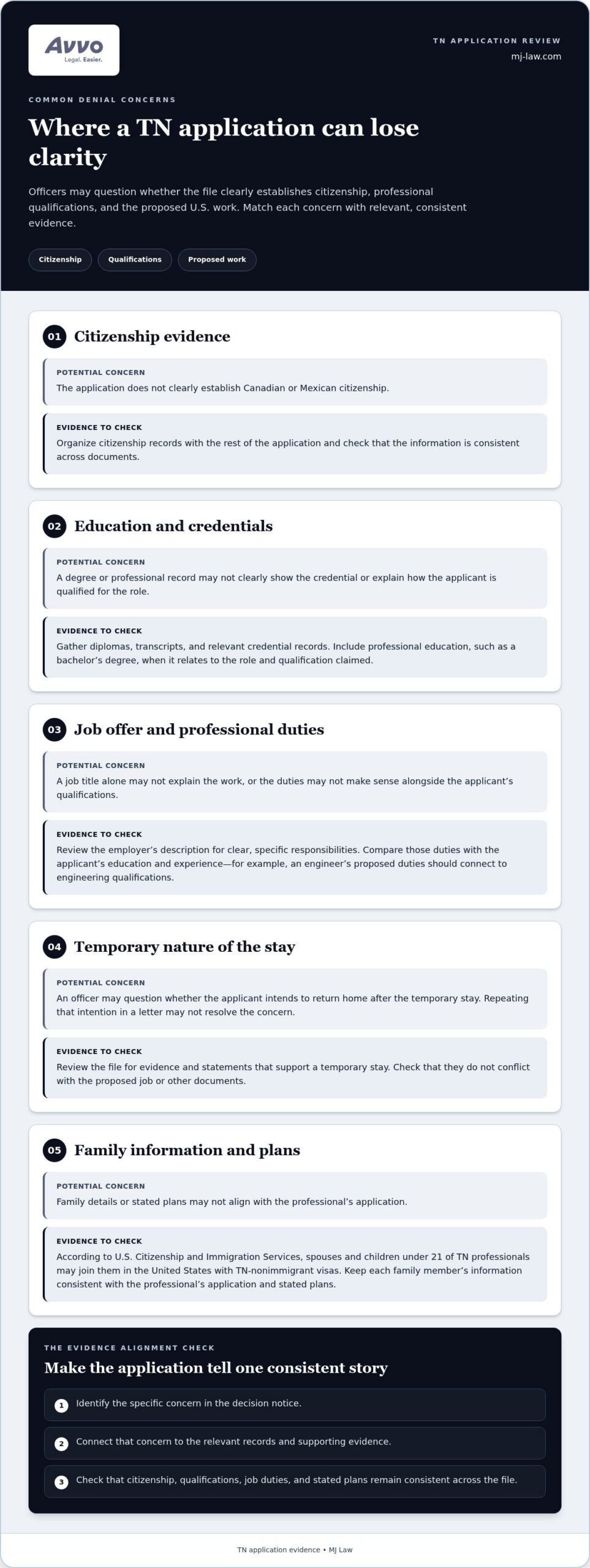
A TN denial can reflect concerns about eligibility or missing evidence. The decision often turns on whether the application clearly establishes the applicant’s citizenship, professional qualifications, and proposed U.S. work. Identifying the specific gap helps you prepare a focused response instead of resubmitting the same materials.
Citizenship evidence is one part of the review. TN status is available to qualifying Canadian and Mexican professionals, so the application should clearly establish the applicant’s citizenship. If the evidence does not establish Canadian or Mexican citizenship, the officer may find that eligibility has not been proven. Organize citizenship records with the rest of the application and make sure the information is consistent across documents.
Education and professional credentials can also raise questions. Applicants should provide evidence of professional education, such as a bachelor’s degree, when it is relevant to the role and qualification claimed. A degree document that does not clearly show the credential, or records that do not explain the applicant’s qualifications, may leave a gap. Gather diplomas, transcripts, and credential records that relate directly to the proposed work. If you rely on professional credentials, include records that make those qualifications clear.
The job offer and duties must make sense together. A U.S. job offer is evidence an officer may consider, but a job title alone may not explain the work. For example, if the application describes you as an engineer, it should show how the proposed duties connect to your engineering qualifications. Review the employer’s description for clear, specific responsibilities, then compare them with your education and experience. A mismatch can make the professional basis of the application harder to assess.
An officer may also question whether you intend to return home after your temporary stay. Repeating that intention in a letter may not resolve the concern. Review the application for evidence and statements supporting the temporary nature of your planned stay, and ensure they do not conflict with the proposed job or other documents. An immigration lawyer can help identify inconsistencies that may distract from the eligibility evidence.
Family plans can matter to the file’s context. According to U.S. Citizenship and Immigration Services, spouses and children under 21 of TN professionals may join them in the United States with TN-nonimmigrant visas. Keep each family member’s information consistent with the professional’s application and stated plans.
For a consultation with a TN visa denial attorney, bring the denial notice, the application you submitted, and its supporting documents. Include the job offer, citizenship evidence, education records, and any correspondence about the decision.
Reviewing those materials in order can reveal whether the concern involved missing evidence, unclear duties, or a mismatch between your qualifications and the position. Bring a written timeline of key application steps, too. It gives the immigration lawyer a practical starting point for assessing the reasons in the notice and the evidence already available.
Difference between a rejection and a denial
A rejection generally means an application was incomplete or failed to meet submission standards. A denial follows an officer’s review and conclusion that the applicant has not established eligibility. The distinction matters: correcting a filing defect is different from responding to an officer’s assessment of the evidence.
At a U.S. port of entry, a Canadian professional may present a TN application to U.S. Customs and Border Protection for review and permission to enter. A USCIS decision follows a filing submitted to that agency; for an extension, an employer may file Form I-129. These routes involve different reviewing agencies and procedural records, so identify which agency issued the notice before deciding what to address.
Start with the document you received. Identify the issuing agency, the decision date, and the language describing the outcome. A rejection may identify an incomplete field, missing item, or unmet filing standard. A denial notice reflects an officer’s review, so read the stated concerns closely. Don’t treat every unfavorable document as the same kind of decision.
For example, if a submission is returned because required information is missing, the immediate issue is whether the filing is complete. If an officer reviews the materials and questions whether the proposed work qualifies, the issue is substantive. Separate these issues before preparing another submission. Repeating the same package without addressing the identified problem may leave the core concern unresolved.
The place of review also shapes which records to examine. For a review at a Canadian border, gather the materials presented to CBP and any written decision or explanation you received there. For a USCIS filing, collect the submitted petition, supporting documents, and agency correspondence. Compare the notice with that record. Note whether the decision points to missing evidence, a procedural defect, or an eligibility concern.
This distinction can guide the next step in immigration matters. A rejection calls for understanding the submission requirement that wasn’t met. A denial calls for analyzing the officer’s reasoning and the evidence considered. If the notice’s wording or reviewing agency leaves the procedural issue unclear, arranging legal assistance to review the TN decision can help organize the record and identify the question that needs attention.
Keeping these categories separate helps you understand the issue without treating every unfavorable result as equivalent. The key distinction is whether the application was incomplete or failed to meet standards, or whether an officer reviewed it first. This framing keeps attention on the type of decision rather than blurring the two outcomes.
Reapplying after a denial
A new TN application should address the reasons for the original denial. Compare the notice with the evidence you submitted. Identify each concern, then decide what new or clearer documentation directly responds to it. Refilling an unchanged application can leave the original issue unresolved. A focused review of the denial is the first step in applying again.
Compare your options before acting. Reapplying lets you present a revised application and additional evidence, but it must address the officer’s concerns. An appeal seeks review of a prior decision, yet TN applicants cannot appeal a denial to the Administrative Appeals Office. The risks of either route depend on the decision and the record, so don’t assume an appeal is available or that a new filing will automatically fix the problem.
What risks come with appealing a TN visa denial versus submitting a new application? TN applicants cannot appeal denials to the Administrative Appeals Office, so treating an appeal as an available route can waste effort. A new application also carries risk if it repeats the same gaps without addressing the stated reasons.
Use the denial notice to build a response plan. Match each concern to a specific document or explanation. For example, if the officer questioned how the offered work fits your professional background, revise the supporting materials to explain that connection. If the notice identifies missing evidence, organize the relevant records and make their purpose clear. Immigration decisions depend on the facts presented, so keep the application consistent throughout.
- Record the concern: Quote or summarize each reason in the notice.
- Map the evidence: List the document or explanation that addresses each concern.
- Review consistency: Compare the revised application with the earlier filing for conflicting details.
How do you file Form I-290B after a TN visa denial? TN applicants cannot appeal a denial to the Administrative Appeals Office, so Form I-290B should not be treated as an automatic appeal route. First identify who made the decision and what the notice says; get legal analysis of the specific decision before submitting a form.
Keep the original notice, prior application, and supporting records together. This allows an immigration lawyer to compare the decision with the filing and assess whether reapplying would address the stated concerns. If the denial followed a review at a port of entry, preserve the materials presented there as well. A careful record helps distinguish a genuine change in evidence from simply resubmitting the same case.
Treat reapplication as a reasoned response, not a repeat submission. Use each point in the decision to guide what changes, which evidence supports the case, and whether the proposed filing addresses the officer’s concern.
Reviewing a denial notice
A denial notice is the starting point for understanding what the officer decided and why. Read it alongside the application and supporting documents submitted to U.S. authorities.
Reading the Denial Notice
Begin with the issuing agency and the outcome stated in the notice. A decision from U.S. Customs and Border Protection after a port-of-entry review differs from a USCIS decision on a filing. Record the decision date and identify each concern the officer raises. Then compare those concerns with the application and documents actually presented.
Separate direct findings from general explanations. If a notice questions whether the proposed position qualifies, locate the employer’s description and the materials explaining the work. If it identifies a document or fact that was not established, find the corresponding part of the submitted record. This comparison helps clarify whether the concern relates to eligibility, evidence, or inconsistencies between documents.
Create a short issue list before considering a response. For each point, note the wording in the notice, the document that addressed it, and any apparent gap. For example, if the officer refers to professional duties, compare the job description with evidence of your qualifications. Keep the original notice and a complete copy of the application together.
Check names, dates, and facts across the notice and filing. A discrepancy between an employer letter and another application document can complicate review, even if each document appears complete on its own. Mark unclear language for discussion rather than guessing what the officer meant. An organized record gives an immigration lawyer a precise basis for assessing the decision.
Appeal and Motion Filing Deadlines
The deadline to file an appeal or motion after a TN visa denial depends on the decision and the review process available. TN applicants cannot appeal a denial to the Administrative Appeals Office, so first identify the issuing agency and the procedure described for that decision.
Use the notice to establish the relevant dates and instructions. Note when the decision was issued, when you received it, and any filing deadline expressly stated. Keep the envelope or delivery record with the notice, as it can help document when the decision arrived. Don’t assume a deadline for one agency or type of decision applies to another.
Make a timeline with the application date, decision date, and any later communication from U.S. authorities. Then identify whether the matter concerns a port-of-entry review or a USCIS filing. These details help clarify which procedure applies and whether an appeal or motion is available. A new application and a request to review an earlier decision are different steps.
If the notice does not clearly explain a review option, don’t infer one from a different case. Gather the complete decision and filing record for legal review. This allows the next step to be assessed against the actual decision, its issuing agency, and the applicable instructions, rather than an assumed deadline.
Can you appeal a TN visa denial, and what options are available?
A TN visa denial cannot be appealed to the Administrative Appeals Office. That does not mean every case has the same next step. The practical options are to examine the decision, consider whether a new application can address its stated concerns, and seek immigration advice based on the record and the agency that made the decision.
Start by distinguishing an appeal from a new application. An appeal asks for review of an existing decision, while a new application presents the case again with revised or additional material. Let the original denial guide your choice. Reapplying without addressing the stated reasons may repeat the same weaknesses rather than resolve them.
Review the notice and the file together. Identify what the officer decided, which evidence was considered, and what concern remains. For example, if the decision questions how a proposed position fits your qualifications, examine whether the application clearly explained that connection. If the notice points to a missing or unclear document, determine whether a new filing can provide clearer evidence.
The agency and setting also matter. A decision made after review at a port of entry has a different record from a decision on a filing submitted to U.S. Citizenship and Immigration Services. Gather the complete application, supporting documents, decision notice, and any written communication. Keeping these materials in one file helps an immigration lawyer assess what happened before recommending a response.
Consider these steps before choosing a path:
- Read the decision: List each reason the officer gave, using the notice’s wording.
- Compare the record: Find the documents that address each reason and note any gap.
- Assess a new application: Identify specific changes or evidence that would respond to the decision.
- Get case-specific guidance: Discuss the decision and procedural options with an immigration lawyer familiar with TN matters.
For example, if your file contains an unclear explanation of job duties, you may need to reassess how the proposed work is documented. If the concern involves your qualifications, examine the credentials and their relationship to the position. These examples show why the notice, rather than a generic appeal template, should shape your next step.
Because the Administrative Appeals Office isn’t an appeal route for TN denials, don’t assume a standard appeal will be available. A TN visa denial appeal attorney in San Francisco can review the decision, explain the viable procedural options, and help assess whether a new application addresses the specific problem. Schedule a consultation to review your TN denial and discuss the decision record.
For advice tailored to your circumstances, consult an immigration attorney who handles TN visa matters. The right response depends on the denial and the available record.
MJ Law: Family Immigration Services
MJ Law can help you assess how a TN denial affects your employment-based immigration plans. When the notice raises questions about the application, proposed position, or supporting evidence, a focused legal review can clarify the issues and inform your next steps.
MJ Law’s Employment-Based Visas practice is relevant when you need guidance about work-related immigration options. Bring the denial notice and the materials submitted with your application so the discussion can address the decision and your circumstances. If you’re also considering immigration options for relatives, MJ Law offers Family Immigration Services.
Contact MJ Law or visit mj-law.com to discuss your situation.
Choose a Clear Next Step
A denial can affect more than one part of your immigration planning. Before taking another step, consider how the decision affects your work plans, your employer’s needs, and any related plans for your family. A TN visa denial appeal attorney in San Francisco can help you assess the options based on your decision and records, without treating an appeal as automatic.
MJ Law offers Employment-Based Visas, Business and Investor Visas, and Family Immigration Services. These practice areas may be relevant when a TN decision raises broader questions about work or family immigration planning. A useful discussion starts with your circumstances and the documents connected to the decision.
For guidance on your situation, contact MJ Law about your TN visa. A thoughtful review can help you approach your next step with greater clarity.
Frequently Asked Questions
Can you reapply for a TN visa after a denial, and when?
Yes, you can consider submitting a new TN application after a denial. Before doing so, prepare a response to the specific concerns in the decision and revise the relevant supporting materials. For example, if the employer’s description did not explain the role clearly, work with the employer to provide a more detailed account. The timing depends on preparing a complete, consistent application that addresses the reason for the earlier decision.
What are common reasons for TN visa denial and how can they be addressed?
Denials can involve unclear evidence of citizenship, professional qualifications, or how the offered position fits your background. Address each concern with clear, relevant documents. For instance, organize education records alongside a job description that explains the professional duties. Review names, dates, and job details across the materials so the application presents a consistent account rather than conflicting versions of the facts.
How do I find a San Francisco attorney experienced with TN visa denials and appeals?
Look for an immigration attorney who can analyze TN decisions and explain the options for your particular record. Ask how the attorney would review the notice, application materials, and proposed job duties together. MJ Law serves individuals in the San Jose and San Francisco area and handles Employment-Based Visas. A focused discussion of your denial can clarify what legal assistance fits your circumstances.