Your spouse and children may travel with you on a P-3 visa, but they need P-4 status. A spouse and unmarried children under 21 may apply, and P-4 dependents may study in the United States but may not work. A P-3 cultural artist visa lawyer in San Francisco can help performers understand how family applications fit alongside the main petition.
It is also important to show that the proposed performance, teaching, or coaching is culturally unique and promotes understanding or development of the art form. The U.S. sponsor, supporting evidence, and consular application each play a part in the process.
This guide explains who may qualify, how sponsorship and consular applications work, how long P-3 status can last, and what family members can do while in the United States. You’ll also learn how immigration representation can support artists and entertainers in California as they prepare for a performance or tour.
Key Takeaways
- Assess whether the performance reflects an artistic style, method, or medium associated with a particular cultural group and supports understanding or development of that art form.
- Plan for the U.S. petitioner to file Form I-129; U.S. Citizenship and Immigration Services says a new petition may include up to 25 beneficiaries in specified group or essential-support circumstances.
- Account for separate paperwork for essential support personnel: U.S. Citizenship and Immigration Services requires a separate Form I-129 petition for them.
- Build the performance schedule around the approved program: U.S. Citizenship and Immigration Services says an initial stay may be up to 1 year, based on the event or program duration.
- Learn how the sponsor, supporting documents, and consular application fit together before setting performance and travel plans.
P-3 visa eligibility for culturally unique artistic performances
A P-3 visa may suit an artist, entertainer, or performing group coming to the United States to perform, teach, or coach in a culturally unique program. The activity must further understanding or development of the art form, and it may be commercial or noncommercial. Under 8 CFR 214.2(p)(3), the petition must establish cultural uniqueness.
“Culturally unique” refers to an artistic style, method, or medium associated with a particular group. Eligibility depends on the proposed performance and its cultural context, not simply the artist’s skill or an event’s popularity. For example, a traditional dance performance might be part of a program that teaches its techniques and cultural significance.
Artists and entertainers may qualify individually or as members of a group. The regulations also describe P-3 classification as covering people who develop, interpret, represent, coach, or teach a culturally unique or traditional art form. The program should connect those activities to the relevant artistic tradition. A concert, workshop, or cultural presentation can be assessed through its purpose, content, and planned activities.
The evidence should make that connection clear. The petition can explain the tradition or artistic method, show how the performance represents it, and describe how audiences or participants will engage with the art form. A program that combines performance and instruction, for example, can explain what attendees will see and learn. Connect each engagement to the cultural purpose rather than relying on a broad label alone.
How does P-3 compare with P-1B and O-1 visas? P-3 focuses on culturally unique artistic work, while P-1B petitions have a group association period that P-3 petitions don’t require. O-1 is a category for people of extraordinary ability, so the central eligibility focus differs from P-3’s cultural-program criteria.
Can P-3 applicants request premium processing? A petitioner may request premium processing when U.S. Citizenship and Immigration Services makes it available for the relevant Form I-129 filing. It concerns petition processing, not whether the performance meets the cultural eligibility standard.
Essential support personnel have a separate filing requirement: according to U.S. Citizenship and Immigration Services, personnel traveling with a P-3 artist must have a separate Form I-129 petition. Their role should support the artist’s performance or program; it does not replace the artist’s own eligibility evidence.
In practical terms, a P-3 culturally unique artist visa is for an artist, entertainer, or group whose U.S. activities center on a culturally distinctive art form. Before planning engagements, organize the program description and evidence around the tradition, the proposed activities, and how they further understanding or development of that art form.
How Do You Apply for a P-3 Visa at an American Consulate?
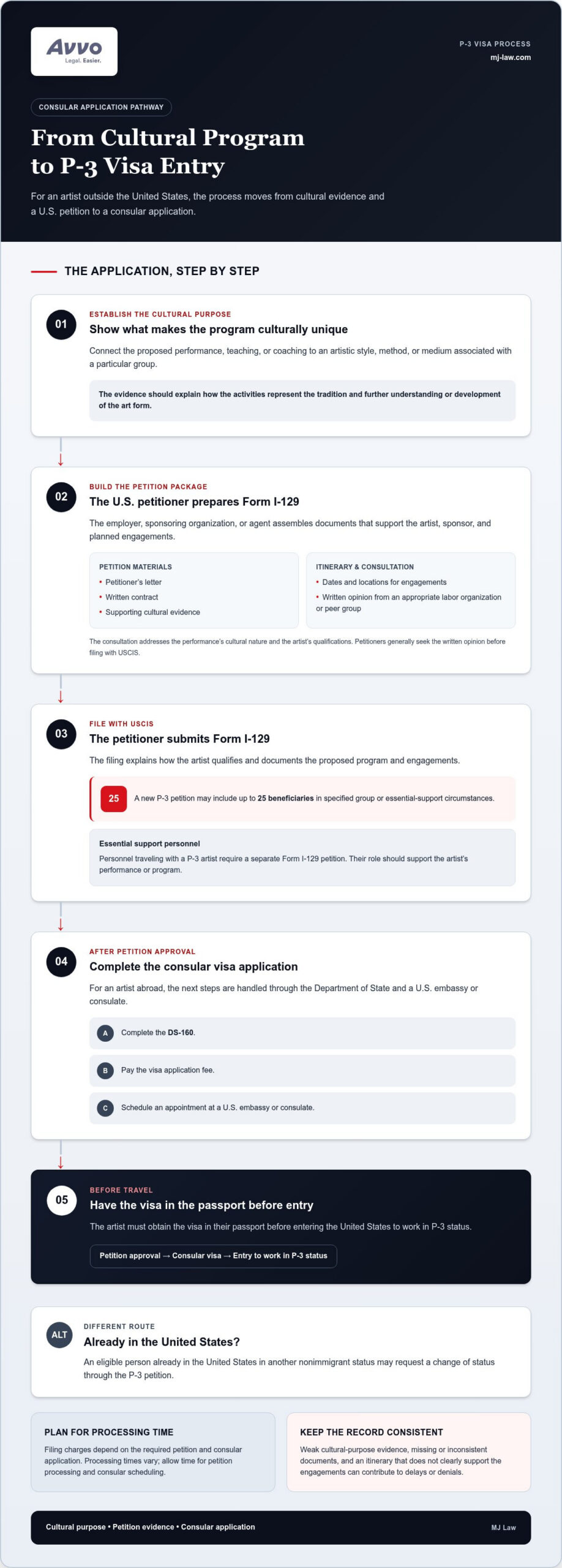
For an artist outside the United States, the process typically moves from sponsor preparation to a USCIS petition and then a consular visa application. The petition documents should link the planned performances, sponsor, and cultural purpose.
Petition Documents and Consultation Letters
The U.S. petitioner prepares Form I-129 and supporting documentation, including its letter, a written contract, and an itinerary. If performances span more than one venue or city, the itinerary should identify the dates and locations. A consultation from an appropriate labor organization or peer group addresses the performance’s cultural nature and the artist’s qualifications. Petitioners generally seek this written opinion before filing with USCIS.
Bay Area venues and cultural organizations involved in the actual program can contribute useful evidence, such as engagement details, contracts, schedules, and descriptions of the event. Their documents should support the proposed work rather than substitute for the required consultation. According to U.S. Citizenship and Immigration Services, a new P-3 petition may include up to 25 beneficiaries in specified group or essential-support circumstances.
Petition Filing and Change of Status
The U.S. employer, sponsoring organization, or agent files Form I-129 with USCIS and explains how the artist qualifies. After USCIS approves the petition, an artist abroad completes the Department of State’s DS-160, pays the visa application fee, and schedules an appointment at a U.S. embassy or consulate. The artist must obtain the visa in their passport before entering to work in P-3 status.
An eligible person already in the United States in another nonimmigrant status may request a change of status through the P-3 petition. Common reasons for delays or denials include weak cultural-purpose evidence, missing or inconsistent documents, and an itinerary that does not clearly support the engagements. A new employer must file Form I-129 and receive USCIS approval before the artist starts work there; material employment changes may require an amended petition.
Filing Fees and Processing Times
Filing charges depend on the required USCIS petition and consular application, while processing times vary with the filing and the relevant agency’s workload. Allow time for both petition processing and consular scheduling when planning performances. A complete, consistent record can help the decision-maker assess the case, but it does not replace any required steps.
Before filing, organize the contract, consultation, itinerary, petitioner’s letter, and supporting cultural evidence into a consistent record. If you want legal guidance on preparing an artist petition and its supporting documents, you can schedule a discussion about P-3 petition planning.
P-3 visa duration and extensions
According to U.S. Citizenship and Immigration Services, a P-3 visa holder in the United States may receive an initial stay of up to 1 year, based on the event or program duration. The approved period relates to the planned work, not simply the artist’s preferred travel dates. A program scheduled for a shorter period may therefore support a shorter stay. Keep performance dates and the requested period consistent.
Continued programs can support an extension request. According to U.S. Citizenship and Immigration Services, P-3 visa extensions in the United States may be granted in increments of up to 1 year for continued programs. The extension concerns ongoing qualifying activity, so organize records that show the program continues. Updated engagement information and schedules help explain how the worker’s role remains integral to the cultural program.
Plan around the admission record, not just the visa in a passport. At the port of entry, Customs and Border Protection issues Form I-94 to record the permitted length of stay. After admission, review that record and compare its end date with the event schedule. A visa stamp facilitates travel to seek entry; the I-94 reflects the authorized stay recorded at admission.
This distinction matters for artists with engagements at multiple venues. If an itinerary includes a festival followed by workshops, for example, consider the program dates alongside the admission record. A published event schedule can help document planned activities, but an extension request should address the ongoing program and the beneficiary’s role. Keep contracts, schedules, and program updates organized.
For an extension, an attorney can review whether the continued activities fit the approved cultural program and whether the supporting documents present a consistent account. A labor organization’s consultation addresses the proposed performance’s cultural nature, while the authorized stay is tied to the program and admission record. Keep these functions distinct when planning a continuing engagement or a new performance.
Before travel, map the event dates against the requested stay and retain the approval and admission documents. After entry, record the I-94 end date alongside each performance commitment. If the program changes or continues, gather current schedules and engagement records before the existing stay ends. This practical timeline helps the artist and sponsor coordinate performances, travel, and any extension planning without confusing visa validity with authorized time in the United States.
U.S. employer, agent, or foreign employer sponsorship
A P-3 artist cannot file the petition personally. A U.S. employer or sponsoring organization, including an agent, may petition; a foreign employer may use a U.S. agent to sponsor the filing. The petitioner connects the artist’s proposed work to the engagements and program. For a tour, the sponsor’s role and itinerary should make clear which organization is presenting or arranging each performance.
The petitioning organization also provides a written contract and explains the qualifying cultural purpose. If an agent files the petition, it should still identify the artist’s actual engagements and the parties involved. For example, a tour arranged across several venues needs a coherent schedule connecting dates, locations, and work. This helps align the sponsor’s filing with the artist’s planned activities.
After USCIS approves the petition, the artist’s employment must remain consistent with its terms. Similar or comparable performances, engagements, or competitions may be added during the original petition’s validity without an amended filing. A materially different employment arrangement, however, may affect eligibility and require an amended petition. Compare each proposed change with the approved work before accepting it.
Changing employers requires a new step. The new employer must file Form I-129, and the artist must obtain USCIS approval before beginning work for that employer. A change in employment terms or eligibility can also require an amended petition. Keep the approved petition, contract, and revised engagement details together so the sponsor can identify whether a change affects the existing filing.
Support personnel have separate requirements. A P-3 essential support worker must provide services that cannot readily be performed by a U.S. worker, and the worker needs a separate petition. After approval, the support worker receives P-3S status. A performing group may seek to substitute similarly qualified members through a U.S. consulate, but essential support personnel may not be substituted. The group should account for that distinction before changing travel or staffing plans.
Family travel follows a different classification. A P-3 holder’s spouse and unmarried children under 21 may apply for P-4 status to accompany or join the artist. P-4 dependents may study in the United States but aren’t authorized to work. Each family member should plan around the artist’s approved stay and their own status. Keep family applications distinct from the employer’s petition for the performer.
Clear sponsor coordination matters when a tour involves an agent, multiple venues, or support workers. Align the contract, itinerary, and proposed roles before filing, then revisit them if employment changes. For help assessing how an employment-based petition fits a performance arrangement, schedule a discussion about visa sponsorship.
Immigration representation for entertainers and artists in California
For performers working in the San Francisco and San Jose areas, immigration planning connects the artist’s role, the sponsor, and the events. A P-3 cultural artist visa lawyer in San Francisco can help organize those elements into a clear petition strategy. The central task is showing how the proposed presentation fits the qualifying cultural program, not simply listing an artist’s skills or past performances.
Begin by matching each engagement to the petition’s purpose. An attorney can review the performance description, contract, itinerary, and consultation evidence together. If a cultural group plans a concert and teaching sessions, for example, the documents should explain what the group will perform and teach and how those activities relate to the art form. Dates, venues, and roles should tell a consistent story.
Bay Area engagements can involve a U.S. employer, sponsoring organization, or agent coordinating several venues. Immigration counsel can help identify the petitioner’s role and examine whether the planned work aligns with the submitted documentation. If an artist’s schedule changes, compare the new engagement with the approved petition before work begins. A change in employer requires a new Form I-129 petition and USCIS approval before the artist starts with that employer.
Representation also involves clarifying whom the attorney represents. When authorized, an attorney may represent both the petitioning employer and the employee-beneficiary, provided their interests do not conflict. This matters if a sponsor and performer disagree about the contract, itinerary, or work arrangements. Clarifying representation and responsibilities at the outset helps everyone understand how the petition will be prepared and who makes decisions.
Some entertainers may need to assess whether another category better fits their record and plans. O-1 classification is for people of extraordinary ability, while P-3 eligibility centers on a culturally unique program. The artist’s achievements, proposed activities, and evidence guide that assessment. A lawyer can compare the available facts and explain which petition structure best matches the intended work, rather than treating every performer’s case alike.
Family planning can be part of the timeline. A spouse may apply for P-4 status to accompany or join a P-3 artist, but P-4 dependents aren’t authorized to work. Discussing the family’s travel plans alongside the performance schedule helps keep separate applications and timelines coordinated.
For local artists, the practical takeaway is to organize the sponsor relationship, presentation evidence, event schedule, and any employment changes before filing. Schedule a discussion about artist visa representation with MJ Law to review how those elements may fit the petition.
MJ Law: Family Immigration Services
MJ Law handles Entertainment and Artist Visas for performers preparing U.S. immigration petitions, as well as Family Immigration Services. If you are planning a culturally focused performance, organizing sponsor documents, or coordinating travel with a spouse and children, legal guidance can help you consider these connected needs. Seek support before filing or making commitments based on an anticipated start date, especially when coordinating an artist’s petition with family travel plans. MJ Law also handles Employment-Based Visas and Business and Investor Visas. Contact MJ Law to discuss your circumstances and next steps for your immigration matter.
Plan Your Next Step With Confidence
Before travel plans and commitments become difficult to change, align the performance plan with your immigration strategy. Gather the current schedule, sponsor details, and any proposed changes to the artist’s role. A clear view of these details can focus the legal discussion on the decisions that matter to your plans.
A P-3 cultural artist visa lawyer in San Francisco can review how the proposed work and supporting materials fit together, and help identify questions to address before filing. If your plans include family travel or more than one sponsor, bring those details into the conversation early so they can be considered alongside the artist’s petition.
Contact MJ Law to discuss your P-3 visa plans. With a thoughtful plan and clear next steps, you can move forward with greater confidence.
Frequently Asked Questions
Can Your Spouse and Kids Travel With You on Your P-3 Visa?
Yes, your spouse and eligible children may apply to accompany or join you in P-4 status. Their travel plans should be coordinated with the performer’s petition and expected stay, especially if family members will arrive separately. P-4 status is for family travel, not employment. If a dependent hopes to work in the United States, they’ll need employment authorization rather than relying on P-4 status alone.
Can an Immigration Attorney Help You Get an O or P Visa?
Yes. An immigration attorney can help assess which category fits the artist’s proposed work and evidence, then assist with preparing the petition. A culturally focused performance, for example, may raise different eligibility considerations from a case focused on extraordinary ability. The attorney can also review sponsor details and event materials for consistency. The relevant U.S. authorities make the visa decision, so legal representation does not guarantee approval.
Can family members accompany P-3 visa holders?
Yes. A P-3 holder’s spouse and unmarried children under 21 may apply for P-4 status to accompany or join them. Dependents may study in the United States, but P-4 status doesn’t authorize employment. Families should coordinate each person’s travel plans and application timing with the artist’s itinerary. For instance, if a child will arrive later, plan that travel around the performer’s approved stay.
Do You Need an Immigration Interview to Come to the United States on a P-3 Visa?
Applicants outside the United States must complete the DS-160 and schedule an appointment at a U.S. embassy or consulate after the petition process. The consular process may include an interview, so prepare to explain the visit and the planned work clearly. Keep answers consistent with the petition, itinerary, and sponsor information. Applicants already in the United States seeking a change of status follow a different process.
Is there a cap or lottery for P-3 visas?
No. P-3 visas have no annual cap or lottery. That means a qualifying artist’s case is considered through its petition rather than a random selection among applicants. The petitioner still needs to establish eligibility and submit supporting materials tied to the proposed cultural program. For a group, the petition should identify its members and the work they’ll perform, so the filing reflects the actual proposed participation.
What evidence is required to prove a culturally unique performance or program for a P-3 visa?
Evidence should explain the cultural tradition or artistic method and connect it to the planned presentation. Relevant materials may include a program description, contracts, itinerary, and written consultation from an appropriate labor organization or peer group. For example, a workshop proposal can describe the techniques being taught and their cultural context. Make sure each document describes the same activities, participants, and event schedule.
Who can file a P-3 visa petition, and what are the petitioner requirements?
A U.S. employer or sponsoring organization, including an agent, may file; a foreign employer may petition through a U.S. agent. The petitioner submits Form I-129 and documentation that explains the qualifying work. The filing should identify the performer, sponsor, contract, and engagements clearly. If the artist changes employers, the new employer must file a petition and obtain USCIS approval before work begins.
How can I find an experienced P-3 visa lawyer in San Francisco?
Look for immigration counsel whose work includes artist and entertainer visas, then discuss your proposed program, sponsor, and supporting documents. A P-3 cultural artist visa lawyer in San Francisco can help assess how the petition evidence relates to your planned engagements. MJ Law serves immigration clients in the San Jose and San Francisco area and offers Entertainment and Artist Visas. Bring your current schedule and sponsor details to the discussion.