
The filing window matters more than the card’s printed expiration date. According to U.S. Citizenship and Immigration Services, conditional residents should submit Form I-751 within the 90 days before the card expires. For people looking for an I-751 removal of conditions lawyer in San Jose, understanding that deadline is a practical first step toward protecting their permanent resident status.
It’s understandable to have questions about what happens next, especially if your spouse can’t file with you or your conditional green card is nearing expiration. The right filing path depends on your circumstances, and the evidence you provide should support the basis for your petition.
This article explains joint filing and waiver options, the documents that may support an I-751 petition, and what to expect from USCIS biometrics appointments and interviews. It also covers how filing timing relates to conditional green card expiration, so you can better understand the process and the issues an attorney may help you address.
Key Takeaways
- Learn what Form I-751 does and how supporting evidence can help explain the history of your marriage.
- Understand when joint filing may fit and which circumstances can support a waiver request.
- See how an attorney can help organize the petition, identify evidence gaps, and prepare you for USCIS steps.
- Know what to expect from biometrics appointments and possible interviews, including when USCIS may combine interviews.
- Understand why filing timing matters and how a pending petition relates to conditional green card expiration.
How Can Your Immigration Attorneys Help with My Form I-751 Petition to Remove Conditions?
Conditional permanent residents seeking to remove conditions on residence file Form I-751, Petition to Remove Conditions on Residence, according to U.S. Citizenship and Immigration Services. An attorney can help organize marriage evidence, prepare waiver documentation, and respond to USCIS questions.
Marriage Evidence Preparation
Your evidence should show that the marriage began as a genuine, good-faith relationship, not solely to obtain immigration status. An attorney can review records for consistency and help connect them to your shared life. Examples include joint financial statements, tax returns, property records, utility bills, photographs, and affidavits from family or friends.
Choose evidence that reflects different parts of the marriage, such as shared finances and a common home. A timeline can clarify when records began, changed, or ended. If you lack a particular record, other documents may help describe the relationship and provide context.
- Group records by topic, such as finances, housing, and family life.
- Check that names, dates, and addresses align across documents.
- Add short explanations where a record needs context.
Comparing San Jose I-751 Lawyers
To compare I-751 lawyers in San Jose, ask how they assess marriage evidence, prepare waiver filings, and address USCIS requests. Look for a clear explanation of the work involved, including document review, legal arguments, and preparation for possible interviews. Ask who will handle each part of your case and how you’ll receive updates.
Look for a lawyer whose approach addresses circumstances like yours, rather than relying on broad claims. A separated couple, for example, may need a different evidence strategy from spouses submitting joint records. A focused discussion should clarify the filing path, likely documentation gaps, and next steps.
Petition Requirements and Case Representation
An I-751 petition requires the form and documentation supporting the filing basis. What does an I-751 petition to remove conditions require? It requires Form I-751 and evidence supporting a joint filing or an applicable waiver request. A lawyer can assess the facts, organize exhibits, and explain how each document supports eligibility.
For a waiver case, legal briefs can explain the circumstances and connect supporting records to the requested waiver basis. The evidence should be organized so USCIS can follow the account and assess its consistency. Which San Jose immigration lawyers handle I-751 waivers, interviews, and removal proceedings? Look for immigration counsel whose work addresses those specific stages, and ask how representation would apply to your case.
If USCIS sends a Request for Evidence, read the notice carefully. Identify each requested item, gather relevant records, and prepare a response that addresses the request directly. An attorney can help organize the documents, explain gaps, and follow the notice’s instructions. Keep copies of the notice and submitted materials with your petition records.
Joint filing and waiver options
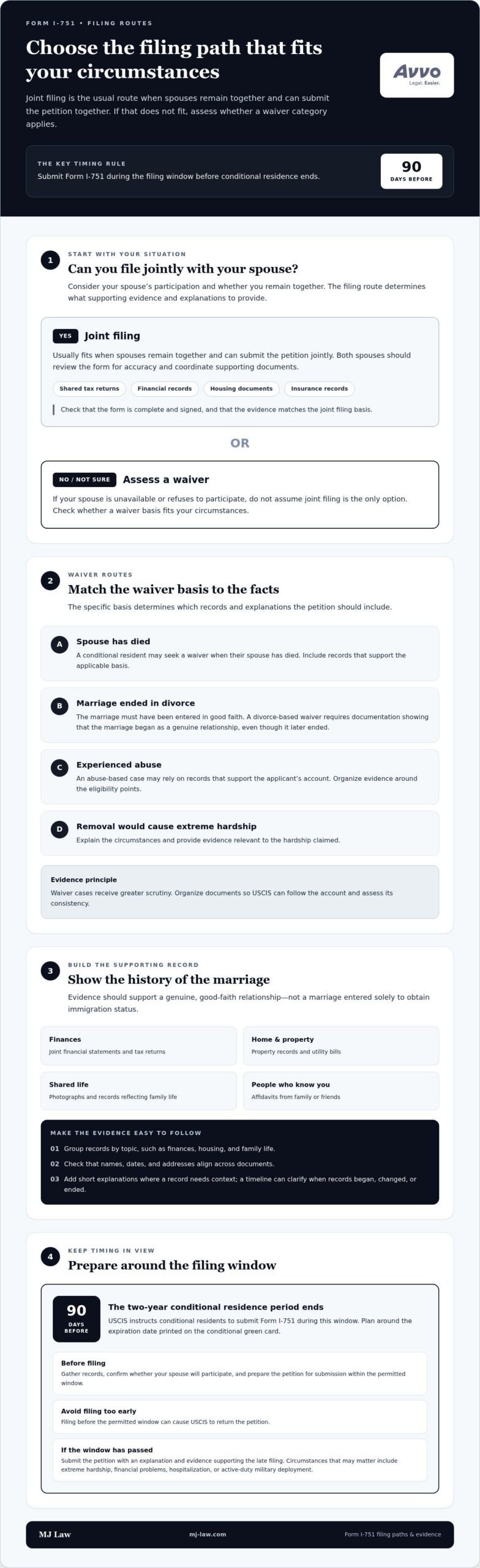
Choosing a filing route depends on your marriage, your spouse’s participation, and your circumstances. The filing window matters: according to U.S. Citizenship and Immigration Services, conditional residents are instructed to submit Form I-751 during the 90 days before their two-year conditional residence period ends.
Plan around the expiration date printed on your conditional green card. Gather the required records, confirm whether your spouse will participate, and prepare the petition for submission within the permitted filing window. Filing too early can cause USCIS to return the petition, so make sure the timing falls within that window.
Joint Filing with a Spouse
Joint filing is the usual route when spouses remain together and can submit the petition jointly. Both spouses should review the form for accuracy and coordinate supporting documents, such as shared tax returns, financial records, housing documents, or insurance records. Consistent information across the petition and evidence helps USCIS understand the couple’s shared life.
Before submitting, check that the form is complete, signed, and supported by evidence that matches the filing basis. If your spouse is unavailable or refuses to participate, do not assume joint filing is the only option. Assess whether a waiver category fits your circumstances.
When a Waiver May Apply
When can I file Form I-751 with a waiver instead of jointly with my spouse? A conditional resident may seek a waiver if their spouse has died, the marriage ended in divorce after being entered in good faith, they experienced abuse, or removal would cause extreme hardship. The specific basis determines which records and explanations the petition should include.
A divorce-based waiver requires documentation showing the marriage began in good faith, even though it later ended. An abuse-based case may rely on records that support the applicant’s account. A hardship request should explain the circumstances and provide evidence relevant to the claimed hardship. Waiver cases receive greater scrutiny, so organize documents around each eligibility point.
Late Filing and Case Preparation
If the filing window has passed, submit the petition with an explanation and evidence supporting the late filing. Circumstances that may matter include extreme hardship, financial problems, hospitalization, or active-duty military deployment. Keep records showing what prevented timely filing and when those circumstances affected your ability to act.
What are the current USCIS I-751 filing fees and processing times? USCIS sets filing fees, while processing time varies with the filing route, evidence, and case steps, including requests or interviews. Before submission, review the current agency instructions and organize the petition, supporting records, and any waiver explanation together.
A careful review can clarify whether joint filing or a waiver better matches your circumstances. If you want to discuss your I-751 filing options, bring your card expiration date and a summary of your situation.
Attorney assistance with I-751 petitions
An immigration attorney can help build a clear petition from your relationship history and supporting records. The work includes assessing eligibility, organizing documentation, and addressing problems that could weaken your case.
Purpose of the I-751 Petition
Form I-751 asks USCIS to remove the conditions attached to a marriage-based permanent resident status. The petition should explain the filing basis and provide documentation that supports it. An attorney can review the facts, identify missing records, and shape a consistent account before submission.
If you and your spouse maintained separate bank accounts, for example, an attorney can help assess other records showing shared responsibilities or a common household. The goal is to connect each document to your relationship history, rather than submit papers without explanation. A clear index can help USCIS follow the evidence and understand what each item demonstrates.
Reasons for Petition Denials
A petition may face problems if the evidence does not establish eligibility or conflicts with other information in the record. Different addresses on tax documents and housing records, for example, may need an explanation. Missing signatures, incomplete responses, or unanswered USCIS requests can also leave important issues unresolved.
Waiver petitions receive greater scrutiny than joint filings, so unsupported statements can create particular challenges. An attorney can compare dates, names, and explanations across the form, affidavits, and supporting documents. If a record appears inconsistent, explain why and include documents that clarify the circumstances.
Before filing, an immigration lawyer can review the petition in a structured sequence:
- Confirm the filing basis and check each answer against the applicant’s records.
- Organize exhibits by topic and label documents for easier review.
- Identify evidence gaps and prepare clear explanations for unusual circumstances.
- Review USCIS correspondence and prepare a focused response to each request.
If USCIS questions a marriage record, the response should address that specific concern with relevant documentation. A general statement that the marriage was genuine may not explain a missing record or conflicting date. An attorney can help frame the response around USCIS’s concern and connect each supporting item to your account.
Representation also helps keep the case file consistent as circumstances change. If a spouse becomes unavailable or the relationship ends, tell counsel promptly; the filing basis and supporting evidence may need careful reassessment. A timely review helps identify what has changed and which records remain relevant to the I-751 petition.
Biometrics appointments and USCIS interviews
After filing Form I-751, watch for USCIS notices about biometrics or an interview. Biometrics can include fingerprints, photographs, and background checks. An interview is not automatic, but USCIS can require one to review the petition, clarify answers, or examine evidence. Understanding each appointment’s purpose helps you prepare relevant records and respond consistently.
Preparing for Biometrics
Read the USCIS biometrics notice closely and follow its instructions for the appointment. The notice identifies the appointment details and any steps you must take. Bring the notice and requested identification, and contact your attorney promptly if a conflict or other issue affects your attendance.
Biometrics collect identifying information for USCIS processing, including fingerprints and a photograph. They are separate from an interview: the appointment does not replace evidence supporting your marriage or waiver. Keep the notice with your petition records, then save any appointment-related documents for future reference.
Preparing for an I-751 Interview
USCIS may schedule an interview to ask about your petition and supporting documents. Before attending, review the filed form, your relationship timeline, and the records submitted with the case. If you filed jointly, both spouses should understand the petition’s key details and answer truthfully from their own recollections.
Review how your application describes shared housing, finances, or changes in the relationship. If an answer differs from a document, be ready to explain the difference accurately. An immigration attorney can help identify likely topics, organize relevant records, and prepare you for questions without scripting your answers.
If you’re applying for a waiver, understand its specific basis and the evidence submitted. A divorce waiver, for instance, concerns a marriage entered in good faith, while an extreme-hardship waiver focuses on the claimed hardship. Keep your explanations consistent with the petition and supporting records. If circumstances changed after filing, discuss the update with your attorney before the interview.
Combined Interviews and Representation
An applicant may file for citizenship while an I-751 remains pending. USCIS may schedule a combined I-751 and N-400 interview, addressing both applications in one appointment. Review each filing separately beforehand, since the forms may cover different periods and questions. Bring the documents identified in USCIS notices for both matters.
Before an interview, organize copies of the submitted petition, USCIS correspondence, and evidence by topic. An attorney can help prepare you for the interview and provide legal representation. Tell your attorney about new documents, address changes, or changed family circumstances so preparation reflects the current record.
If you receive a biometrics or interview notice, note its instructions and appointment details right away. Keep copies of notices and submitted records together. This makes it easier to review the information discussed with USCIS and address follow-up requests accurately.
Conditional green card expiration and removal of conditions
A conditional green card has a fixed expiration date, but that date does not tell the whole story. According to U.S. Citizenship and Immigration Services, marriage-based conditional permanent residence generally lasts two years, and residents must file Form I-751 before the card expires to remove its conditions.
Use the Card’s Expiration Date to Plan
Start by finding the expiration date on your conditional green card, then work backward to prepare the petition and supporting documents. Filing on time matters: missing the deadline can put your resident status at risk. USCIS may terminate the status of a conditional resident who does not remove conditions on time, and removal proceedings may follow.
Filing before expiration is not the same as receiving approval before expiration. USCIS processing can continue after the card’s printed date. Keep the filing receipt and USCIS notices with your immigration records, and use the receipt to document the extension associated with a filed I-751.
What Happens While USCIS Reviews the Petition?
USCIS automatically extends a conditional green card when the resident files Form I-751 and issues a receipt extending status. Keep that receipt with the expired card, since both documents relate to the pending petition and its extension. If an employer, agency, or other party asks about your documents, present the records that establish your current status.
If your card expires while USCIS reviews your case, don’t treat the printed date as the whole record. Keep copies of the petition, delivery confirmation, receipt, and later notices together. Update your file whenever USCIS sends a biometrics appointment, interview notice, or decision.
If the Card Has Expired
If the expiration date has passed without a filing, act promptly to assess the next step. A late Form I-751 may be accepted in certain circumstances, including extreme hardship, financial problems, hospitalization, or active-duty military deployment. Keep documents that explain the delay, such as medical or deployment records, and prepare a clear account of the relevant circumstances.
If your marriage has changed, the expiration date alone does not determine whether joint filing remains appropriate. A spouse’s death, divorce after a good-faith marriage, abuse, or extreme hardship may affect the available filing route. Your explanation and supporting documents should reflect the circumstances behind the petition.
After approval, the conditional resident receives a permanent resident card valid for 10 years. An experienced immigration attorney can help assess a pending, late, or time-sensitive filing and organize the next steps around your expiration date. Discuss your I-751 expiration concerns and the records you have received from USCIS.
MJ Law: Family Immigration Services
MJ Law’s Family Immigration Services can help individuals assess I-751 filing options and organize next steps. If your conditional green card is nearing expiration, your spouse cannot file jointly, or USCIS has requested more evidence, an attorney can review the petition’s basis, supporting records, and relevant notices.
This guidance fits within the firm’s family immigration and marriage-based green card work. Bring your conditional card, any USCIS correspondence, and a summary of your circumstances to discuss your case and the questions you need answered.
Contact MJ Law to discuss your I-751 petition and family immigration needs.
Take the Next Step With a Clear Plan
Your next step can be a focused review of your situation, rather than another round of guesswork. Before speaking with an attorney, gather the documents you have and write down what has changed since your petition was filed or your card was issued. Note upcoming USCIS appointments, questions about your spouse’s participation, and concerns about your immigration record. This preparation gives the conversation a practical starting point.
An I-751 removal of conditions lawyer in San Jose can help you assess the issues that matter to your petition and identify a sensible path forward. MJ Law offers Family Immigration Services for people addressing family-based immigration matters. Bring your questions and relevant records, then schedule a conversation about your I-751 case.
With a clearer understanding of your options, you can approach the next step with greater confidence and purpose.
Frequently Asked Questions
What Does the Form I-751 Do?
Form I-751 asks USCIS to remove the conditions attached to certain marriage-based permanent residence. Conditional permanent residents use the petition to show that they qualify to continue their residence without those conditions. The filing basis determines which records matter: spouses filing together document their shared marriage, while a waiver applicant documents the facts supporting that waiver. Review the form and supporting evidence as one consistent account.
What is a conditional green card?
A conditional green card grants permanent resident status subject to conditions. In marriage-based cases, a person married to a U.S. citizen or lawful permanent resident for less than two years when receiving a green card receives conditional status. The card shows that status and its expiration date. Keep a copy with your USCIS notices and filing records so you can refer to the same dates and information throughout the process.
Who Is Eligible to Have Their Conditional Status Removed?
Conditional residents who qualify through a joint petition or an eligible waiver may seek removal of conditions. Waiver circumstances include a spouse’s death, divorce after a good-faith marriage, abuse, or extreme hardship if removal occurs. Your evidence should support the specific filing route. A divorce waiver, for example, needs records addressing both the marriage’s good-faith beginning and its later end.
Do both spouses need to file together?
No. A joint petition is one filing route, but a conditional resident may request a waiver of the joint-filing requirement in qualifying circumstances. These can include a spouse’s death, a marriage ending in divorce after it began in good faith, abuse, or extreme hardship. The applicant files independently and supports the waiver request with documents tied to the relevant facts.
What Are the Benefits of Establishing an Attorney-Client Relationship for a Petition to Remove Conditions of Residence?
An attorney can help you evaluate the filing basis, organize records, and identify inconsistencies before submission. For example, if your address differs across tax and housing documents, counsel can help you prepare a clear explanation supported by relevant records. An I-751 removal of conditions lawyer in San Jose can also help you understand USCIS notices and prepare for possible case steps based on your circumstances.
What if my spouse and I are separated or divorced?
Separation or divorce alone does not determine which filing route fits. If the marriage ended in divorce, a conditional resident may seek a waiver based on a marriage entered in good faith. Gather records showing the relationship’s history and keep divorce-related documents together. If you are separated but not divorced, review your circumstances and available evidence before deciding how to proceed.
Why Are Some I-751 Petitions Denied by the United States Citizenship and Immigration Services?
A petition can run into difficulty if the evidence does not establish eligibility, the filing basis does not fit the circumstances, or key information is inconsistent. An unanswered USCIS request can also leave questions unresolved. For a waiver case, organize supporting documents around each eligibility point. Before sending a response, compare dates, names, and addresses across the form and supporting records.
Will there be another interview?
Possibly. USCIS may require an interview during the I-751 process, and the appointment can address information in the petition or supporting records. Review your filed answers and bring documents identified in the interview notice. If you also file for citizenship while the I-751 is pending, USCIS may schedule a combined I-751 and N-400 interview. Prepare for questions about each application and its records.