
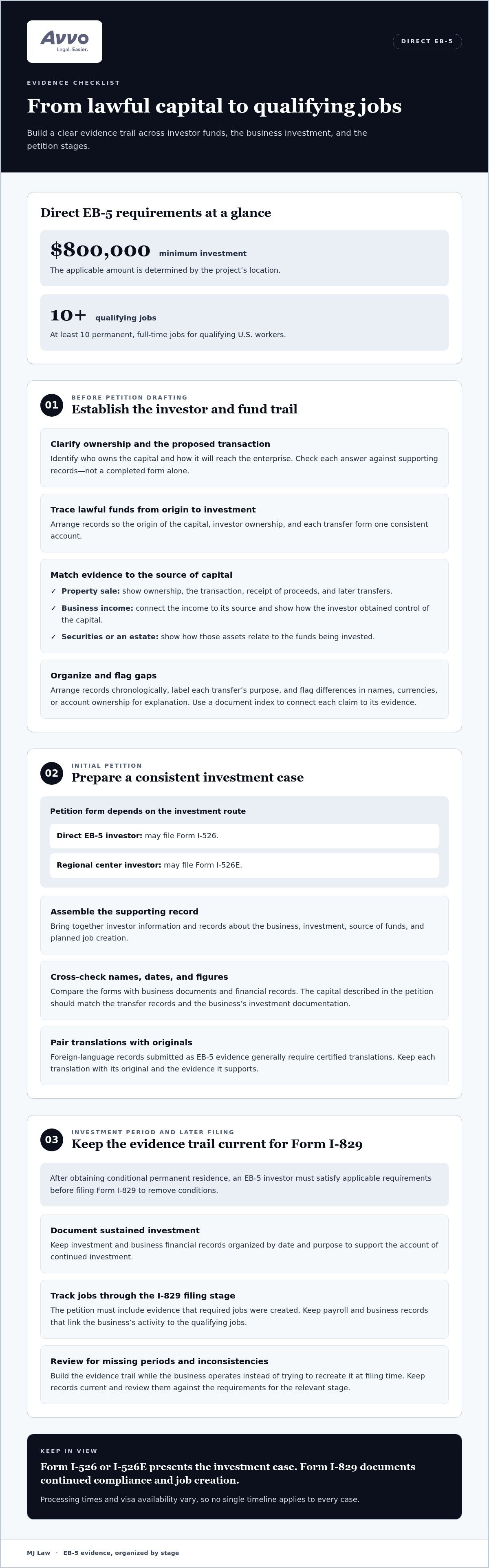
Direct EB-5 investment means investing in a business and meeting the program’s job-creation requirement: at least 10 permanent full-time jobs for qualifying U.S. workers, according to U.S. Citizenship and Immigration Services. The agency states that the minimum investment is at least $800,000, with the applicable amount determined by the project’s location. An EB-5 direct investment attorney in Silicon Valley can assess how your proposed investment, source of funds, and business plan fit these requirements.
It’s understandable to focus on the investment itself, but the petition also depends on clear documentation and a credible plan to create and maintain qualifying jobs. This article explains how an attorney can evaluate investor eligibility and lawful fund sources, prepare Form I-526 and Form I-829 petitions, and clarify how direct investment differs from the regional center route. You’ll also learn what evidence matters at each stage, so you can approach the decision with a clearer view of the process and the responsibilities involved.
Key Takeaways
- Organize records showing where investment funds came from and how they were transferred to support the source-of-funds analysis.
- Understand how Form I-526 and Form I-829 serve different stages of the direct investment process, and what evidence each petition requires.
- Compare direct investment with the regional center route by considering how each approach connects the investment to job creation.
- Plan to document employment and investment activity through the I-829 filing stage, not only when the initial petition is prepared.
- Use an immigration attorney to assess eligibility, organize supporting evidence, and clarify which direct investment path fits your circumstances.
I-526 and I-829 petition preparation and filing
EB-5 petitions connect an investor’s eligibility, capital, business plan, and job-creation evidence. Preparation differs for direct investment and regional center cases, and the I-829 stage requires evidence from the investment period.
Preparing Form I-526 and I-526E Petitions
Direct EB-5 investors may file Form I-526, while regional center investors may file Form I-526E, according to U.S. Citizenship and Immigration Services. The petition preparation process organizes the investor’s information alongside records about the business, investment, and planned job creation. Review how each document supports a specific part of the case, including the source of funds and the investment structure.
Filing EB-5 Petitions
Filing involves assembling the completed petition and supporting evidence into a consistent record. Before submission, compare names, dates, and figures across forms, business documents, and financial records. For example, the capital described in the petition should match the transfer records and the business’s investment documentation. This review can surface gaps that need explanation before the filing is ready.
Preparing Form I-829 to Remove Conditions
After obtaining conditional permanent residence, an EB-5 investor must satisfy applicable requirements before filing Form I-829 to remove conditions. The petition must include evidence that the investment was sustained and required jobs were created. Direct investors should track employment from the investment period through the I-829 filing. Keeping organized payroll and business records supports a clear account of job creation.
Build an evidence trail as the business operates, rather than trying to recreate it when preparing a petition. Keep investment records, business financial documents, and employment information organized by date and purpose. For a direct investment, employment evidence should link the business’s records to the qualifying jobs created. This can help identify missing periods or inconsistencies before preparing the petition to remove conditions.
Foreign-language records submitted as EB-5 evidence generally require certified translations. Pair each translated document with its original, and make sure the translation corresponds to the evidence cited in the petition. A clear filing helps reviewers follow the relationship between the investor, the source of capital, the business, and job creation without searching across disconnected records.
The two petition stages rely on different evidence. Form I-526 or I-526E presents the investment case, while Form I-829 documents continued compliance and job creation. Processing times and visa availability vary, so no single timeline applies to every case. Keep the records current throughout the process, and review them against the requirements for the relevant filing stage.
Investor qualification and source-of-funds analysis
Investor readiness involves two connected reviews: whether the proposed investment fits the case and whether its capital can be traced. A structured preparation process brings personal, financial, and business records together before petition drafting begins.
Investor Qualification Review
An investor qualification review connects the proposed capital and business investment to the facts presented in the petition. It also identifies questions that may affect how the case is documented, such as who owns the funds and how they will reach the enterprise. Check each answer against supporting records rather than treating a completed form as proof on its own.
Start by assembling a clear account of the investor’s financial history and proposed transaction. If the capital comes from business income, identify the business, the relevant income records, and the transfer into the investment. If securities or an estate are involved, show how those assets relate to the funds being invested. This can reveal missing links early and guide focused preparation.
Lawful Source-of-Funds Documentation
Direct EB-5 investors must document that their investment funds came from lawful sources. A source-of-funds analysis traces the capital from its origin to the account or business receiving it. The records should tell one consistent story, with dates, ownership, and transfers aligned across financial documents and the petition.
A property sale, for example, may require records showing ownership, the transaction, receipt of proceeds, and subsequent transfers. Business income may need a different evidence trail, linking the income to its source and showing how the investor obtained control of the capital. In either case, unexplained gaps can make the account harder to follow. A document index can connect each claim to its supporting evidence.
Source-of-funds readiness is practical, not just a matter of collecting statements. Arrange records chronologically, label the purpose of each transfer, and flag differences in names, currencies, or account ownership for explanation. If documents are in another language, prepare certified translations for records submitted as EB-5 evidence. Keep the original and translation together so the evidence remains easy to match.
Compliance depends on the relationship between the investor’s explanation and the documents supporting it. A useful review asks whether each transfer has a traceable origin, whether the investor’s ownership is clear, and whether the petition describes the same transaction as the records. A concise chronology can expose missing links before filing. To discuss the evidence and preparation needed for an EB-5 case, schedule a conversation about investor eligibility.
What is the difference between direct EB-5 and Regional Center EB-5?
A direct EB-5 investment goes into a business, while a regional center investment is made through a government-approved organization. U.S. Citizenship and Immigration Services states that an EB-5 investment must create at least 10 permanent full-time jobs for qualifying U.S. workers.
Direct Investment and Job-Creation Requirements
For a direct investment, the investor’s capital goes into the business responsible for creating the qualifying employment. A qualifying new commercial enterprise may be a for-profit legal entity formed after November 29, 1990. Review the company’s structure and the connection between its operations, investment, and planned jobs. This distinction matters when choosing between a direct business investment and a regional center offering.
In a direct investment case, the business plan should explain how the company’s operations support the required employment. Projected hiring, for example, should correspond with planned activities, staffing needs, and operating capacity. Regional center cases have a different investment structure, so compare the project arrangement and its approach to job creation before committing capital.
Business Plans and Job-Creation Analysis
A business plan explains how the company will operate and create employment. Check whether its products or services, revenue assumptions, staffing plan, and use of capital fit together. Corporate records and operating details should support the plan, not contradict it. The job analysis should show how proposed roles relate to the business’s actual activities.
Consider a company planning to expand production. Its hiring schedule should align with plans for facilities, equipment, and operations. Listing jobs without explaining how they connect to the business leaves a significant gap. Counsel can assess how the business offering, records, and job projections fit the petition narrative.
Evaluating Direct Investment Risks
Key risks include business performance, the ability to create the required jobs, and whether the investment evidence supports the immigration case. Review the business model, management responsibilities, use of capital, and hiring assumptions together. Examine offering documents and securities materials for investment terms, control rights, and potential conflicts. Investors should understand both the commercial exposure and the immigration evidence the business must maintain.
Compare projected employment with the company’s operating plans, then identify what could disrupt hiring or delay growth. Assess whether the company can document its operations and employment over time. These steps help distinguish a credible job-creation plan from projections without operational support.
Direct investment places the business and its employment records at the center of the case. Regional center investment instead routes capital through a government-approved organization, so the investor should examine that project’s structure and job-creation approach. A careful comparison weighs business oversight, evidence available to the investor, and the fit between the investment and personal risk tolerance. Discuss direct EB-5 investment considerations as part of evaluating the immigration implications.
Direct investor immigration assistance
Direct investor assistance can cover petition strategy, investment questions, and planning for a move to the United States. Immigration steps should remain distinct from business and tax decisions.
EB-5 Immigration Legal Services
Immigration counsel can assess the case, organize petition evidence, and explain how business records support the filing. Ask how counsel will coordinate updates, identify missing documents, and prepare for later steps toward permanent residence. Clear responsibilities help investors work effectively with business partners and other professionals.
Pre-immigration tax planning is a separate consideration. Discuss timing and cross-border financial questions with qualified tax professionals, and clarify how that work will coordinate with immigration counsel. An investor preparing to relocate, for example, may need to organize business and personal records for both processes without treating tax advice as immigration advice.
Choosing a Silicon Valley EB-5 Attorney
Ask whether the lawyer handles direct EB-5 cases, how the legal team analyzes job creation, and which records it needs for petition preparation. Ask how the engagement defines scope, communication, and fees. Attorney fees vary by case and are provided after a quote request; factors include case complexity, petition work, and the evidence requiring review.
Which Silicon Valley immigration attorneys handle direct EB-5 cases? Look for immigration counsel whose work includes direct-investor petitions, and ask how the attorney approaches business evidence and filing preparation. The EB-5 & Global Immigration Pitch Day was scheduled as a one-day event in Silicon Valley on May 16, 2026. Event panels or Q&A can help investors frame questions, but individual case analysis remains central.
Targeted Employment Area Rules
How do targeted employment area rules apply to EB-5 businesses in Silicon Valley? The project’s location determines the applicable minimum investment, according to U.S. Citizenship and Immigration Services. Evaluate the actual project location rather than relying on a broad Silicon Valley label, and connect that location to the investment structure being considered.
For petitions filed on or after March 15, 2022, the applicable EB-5 minimum thresholds depend on the project’s location. Ask counsel to explain how the location and supporting project records relate to the petition, then review that explanation alongside the business plan and investment documents.
Direct investor immigration assistance also involves planning around status and next steps. Eligible investors may pursue adjustment of status or consular processing from abroad after petition processing. Discuss which process relates to your circumstances, what information counsel needs, and how business partners will provide timely records. A focused EB-5 immigration discussion can help organize those questions.
Direct EB-5 investment
Direct EB-5 investment places capital into a business rather than a regional center project. An EB-5 direct investment attorney in Silicon Valley can help assess how the investment structure, location, and job-creation plan fit the immigration filing.
U.S. Citizenship and Immigration Services states that the EB-5 Immigrant Investor Program requires an investment of at least $800,000 in a project whose location determines the applicable minimum. U.S. Citizenship and Immigration Services also states that, unless otherwise specified, for EB-5 immigrant petitions filed on or after November 21, 2019, the amount of capital necessary to make a qualifying investment in the United States is one million eight hundred thousand United States dollars ($1,800,000). These rules make the project’s location and applicable investment category central to assessing the required capital.
For a direct investment, the investor puts funds into a business that will conduct commercial activity and create qualifying employment. A qualifying new commercial enterprise may be a for-profit legal entity formed after November 29, 1990. The investor should understand how the business will use the capital, who will manage its operations, and how its job-creation plan connects to real business activity.
Before committing funds, map the proposed investment from transfer through deployment. Review the business structure, investment documents, capital schedule, and operating plan as a connected record. If funds are intended for equipment and expansion, for example, the business plan should explain how those purchases support operations and hiring. The filing should describe the same transaction shown in the company’s records.
Job creation matters throughout the investment, not just in the initial business plan. Direct investors should establish a process for keeping employment records as the company operates. Payroll documents, job descriptions, and business records can connect actual hiring to the company’s activities. If operations change, document how those changes affect the original plan and the evidence supporting the petition.
Foreign investors should also review how the investment affects control and decision-making. Examine ownership documents, the investor’s role, capital commitments, and the business’s obligations. Developers and other partners may have separate responsibilities, so clarify who supplies records and tracks employment. An EB-5 direct investment attorney in Silicon Valley can help assess how these business details relate to the immigration case.
A sound assessment brings immigration and business questions together without treating one as a substitute for the other. Review the source of funds, investment terms, project location, company operations, and job-creation evidence before funds move. An EB-5 investment consultation can help you assess how the proposed direct investment fits the immigration filing.
Silicon Valley attorneys who focus on EB-5 direct investments can advise on the business structure, project location, and job-creation plan.
MJ Law: Family Immigration Services
MJ Law can help you consider the immigration path that fits your circumstances, including Business and Investor Visas for EB-5 matters. If family members are part of your planning, U.S. Citizenship and Immigration Services says an EB-5 investor’s spouse and unmarried children under 21 may also be eligible for lawful permanent residence through the program, subject to applicable requirements. Family Immigration Services can address separate family-based immigration needs, while an EB-5 case focuses on the investment and its immigration requirements. If you’re ready to discuss your situation and possible next steps, contact MJ Law.
Take the Next Step With a Clear Plan
Your next move is to turn the investment idea into a focused legal discussion. An EB-5 direct investment attorney in Silicon Valley can help you identify the questions that need attention before you commit to a business structure or move funds. Consider what you need to understand about your role, the proposed investment, and the records you’ll need to maintain.
MJ Law assists investors considering this path through its Business and Investor Visas practice, alongside Employment-Based Visas and Family Immigration Services for other immigration needs. Bringing a concise outline of your goals and current plans can make an initial discussion more useful. It also gives you an opportunity to raise questions about how immigration planning relates to your wider business and family decisions.
When you’re ready to discuss your direct EB-5 plans, contact MJ Law about direct EB-5. A thoughtful next step can help you move forward with greater clarity.
Frequently Asked Questions
How Can Your Team Assist With an EB-5 Case?
An immigration attorney can help organize the case, prepare and file visa petitions, and manage supporting records. MJ Law’s Business and Investor Visas work relates to EB-5 matters, including planning how business and investor evidence fits the immigration filing. For an initial discussion, prepare a brief outline of the proposed business, investment structure, and questions about your role. This helps focus the conversation on the legal work and documents involved.
How Much Do I Need to Invest for an EB-5 Visa?
The required investment depends on the project’s location and applicable category. U.S. Citizenship and Immigration Services states that the EB-5 Immigrant Investor Program requires an investment of at least $800,000 in a project whose location determines the applicable minimum. Other project details may affect which threshold applies. Treat the minimum as investment capital, not as a complete measure of the business and immigration planning involved.
What Is the Timeline for Obtaining an EB-5 Visa?
There is no single timeline that applies to every EB-5 case because processing times and visa availability vary. The process generally moves from petition preparation and processing to visa or green-card steps, followed by the later condition-removal filing. An investor’s next step depends on petition processing and visa availability. Eligible investors may pursue adjustment of status or consular processing from abroad.
What types of entities qualify as a “new commercial enterprise”?
The company’s formation documents and operating records help establish what kind of business it is and how it functions. Review its legal formation, ownership structure, and business activity together. The petition should describe the same enterprise reflected in those records, rather than relying on a project label alone.
What are the current EB-5 investment minimums for direct investments?
U.S. Citizenship and Immigration Services also states that, unless otherwise specified, for EB-5 immigrant petitions filed on or after November 21, 2019, the amount of capital necessary to make a qualifying investment in the United States is one million eight hundred thousand United States dollars ($1,800,000). The project’s location and applicable category matter.
What are the steps and timeline for a direct EB-5 petition?
Start by defining the business and investment structure, then assemble the supporting records and file Form I-526 as a direct investor. After petition processing, the next immigration step depends on visa availability and whether the investor pursues adjustment of status or consular processing. Conditional residence leads to a later Form I-829 filing. Processing times and visa availability vary, so the sequence is clearer than any fixed case timeline.
How do direct EB-5 investments compare with regional center investments?
A direct investment places capital into a business, while a regional center investment is made through a government-approved organization. U.S. Citizenship and Immigration Services distinguishes the petition forms: direct investors may file Form I-526, while regional center investors may file Form I-526E. To compare routes, consider how the investment is structured and what business or project records will support the immigration filing.
What business plans and evidence are needed for a direct EB-5 petition?
A direct EB-5 petition needs a business plan that explains the enterprise, its planned operations, use of capital, and approach to job creation. Supporting evidence can include formation and ownership records, investment documents, financial records, and a staffing plan. For example, a hiring projection should make sense alongside the company’s operating plans. Organize records so each key business-plan claim points to relevant evidence.