
The investment is only one part of an EB-5 decision. An investor green card consultation in Silicon Valley can help clarify how the proposed investment, its documentation, and the investor’s immigration goals fit together. When family members or family office representatives are involved, the discussion can also identify the questions each person needs answered before moving forward.
It’s understandable to want clear guidance before committing time and resources to a complex immigration process. This article explains what an EB-5 consultation can cover, how family office and private investor participation may be addressed, and what technology, life science, and healthcare investors can bring to the discussion. You’ll also learn how to prepare for a focused conversation about investment structure, supporting records, and the family’s plans.
Key Takeaways
- Learn how an EB-5 investment connects to eligibility and a path to permanent residency, and which personal and investment details matter.
- Understand how investment thresholds depend on the project’s location and how targeted employment area rules may apply.
- See what job creation means in an EB-5 case and which project records help document it.
- Prepare for a focused legal consultation by organizing investment, source-of-funds, identity, and family documents.
- Explore how family office and private investor participation, along with technology, life science, and healthcare investments, can shape consultation topics.
What is the EB-5 investor green card program and who qualifies?
EB-5 is a U.S. investor visa pathway connected to an investment in a U.S. commercial enterprise. The goal is to obtain permanent residency, but an investment alone doesn’t establish that a person qualifies. A careful review considers the investor’s immigration history, proposed investment, supporting evidence, and the project’s plan for creating jobs. The key question is how those parts fit together in the specific case.
Consider the case study of an Indian national who invested $500,000 in a U.S. commercial vehicle. The case reports that the investor obtained conditional permanent residency in less than about one year. The investor’s spouse and children under 21 were also able to obtain permanent residency. These details illustrate one reported case, not a universal investment threshold or timeline.
That distinction matters for Silicon Valley investors. Technology, life science, and healthcare ventures can have different business models, financing arrangements, and hiring plans. A consultation can help connect the investor’s proposed participation to the enterprise and identify records that explain the structure. For a family office, the discussion can also clarify who is investing, how funds move, and which representatives should be involved in the review.
A focused eligibility discussion can turn initial questions into practical steps:
- Describe the investor’s immigration objective and relevant history, including prior visa applications.
- Explain the proposed investment vehicle, the investor’s role, and how the funds are expected to reach the enterprise.
- Review the business plan and identify how projected hiring connects to the company’s operations.
- List the records that can support the investment structure, fund history, and job plan.
The investor’s country of birth can also shape the broader immigration discussion. In the featured case, the speaker stated there was no EB-5 backlog for individuals born in India, while noting that India and China nationals may face backlogs in other employment-based green card categories. The investor had tried the H-1B lottery a couple of times before pursuing EB-5. Those details provide context for that case, rather than a current prediction for every applicant.
Use an investor green card consultation in Silicon Valley to make the first discussion specific. Bring a concise account of the proposed enterprise, investment structure, family members, and immigration history. Ask how each item affects the case analysis and what evidence would help explain it. This approach is useful for individual investors and family offices alike. It also gives technology, life science, and healthcare investors a way to raise sector-specific questions without assuming that the same business model fits every EB-5 case.
What are the current minimum EB-5 investment amounts?
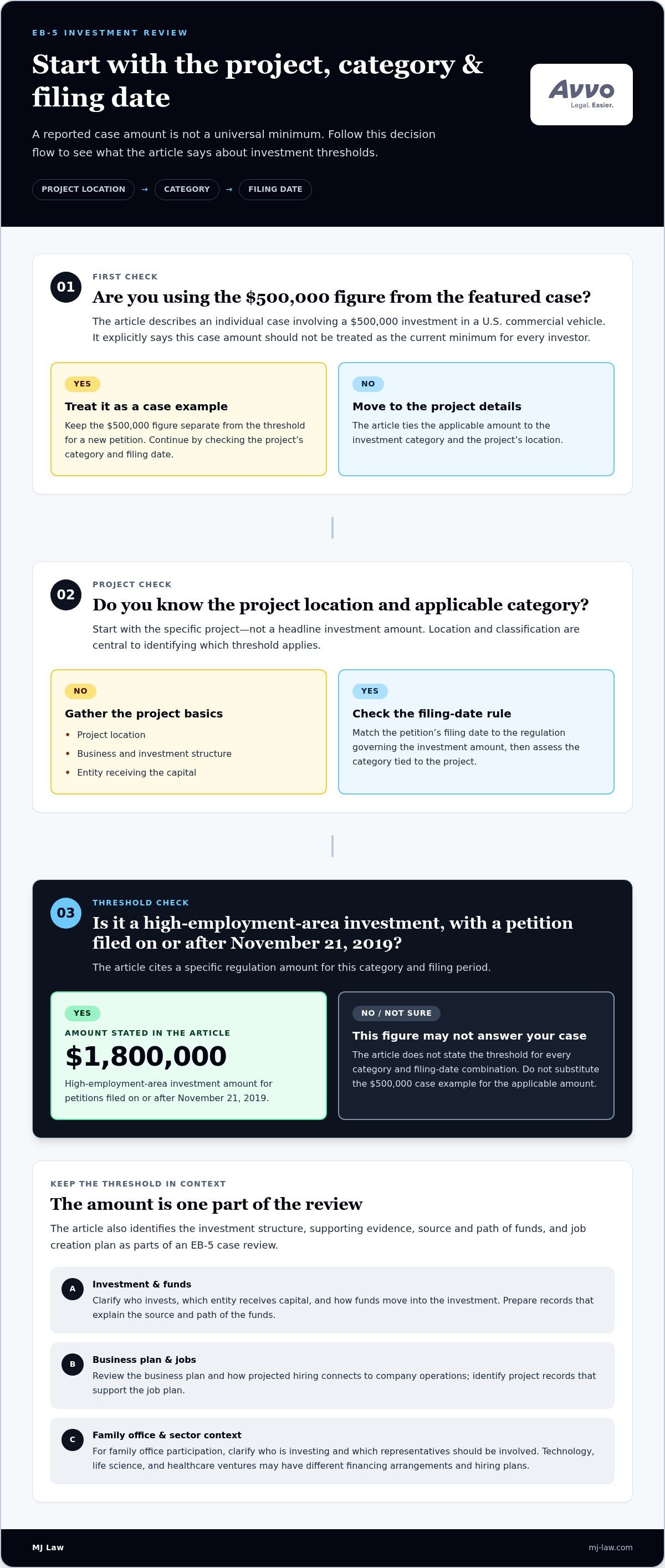
The amount depends on the category that applies to the investment and the project’s location. An investor should distinguish a current threshold from an amount mentioned in an individual case study. For example, a reported EB-5 case involved a $500,000 investment in a U.S. commercial vehicle. That figure describes the featured case; it should not be treated as the current minimum for every investor.
For petitions filed on or after November 21, 2019, the regulation sets the high-employment-area investment amount at $1,800,000, according to the Office of the Federal Register. This is a specific threshold tied to the category named in the regulation. It does not establish which category applies to a particular project. The project’s location and the applicable classification are central to that determination.
Before relying on an investment amount, organize the analysis around the investment itself:
- Identify the project. Record its location, business structure, and the entity receiving the capital.
- Clarify the category. Determine how the project’s location affects the applicable threshold.
- Review the timing. Match the petition filing date to the regulation governing the investment amount.
- Trace the funds. Prepare a clear account of the capital’s source and path into the investment.
These steps help separate the threshold question from other case requirements. An investment amount is only one part of an EB-5 review. The project structure, evidence documenting the funds, and job creation plan also affect how the overall case is assessed. A family office may need to clarify which entity invests and how representatives relate to the transaction. A technology startup, life science company, or healthcare venture may have a different financing structure and business plan.
For a Silicon Valley investor, begin with the specific project rather than a headline amount. Gather the project’s location, investment documents, proposed funding route, and filing plans. Then ask how those details connect to the threshold and what supporting records explain the transaction. Keep any example amount, such as the $500,000 case study, clearly separate from the amount governing a new petition.
A consultation can help structure those questions around the proposed investment and its documentation. If you’re preparing to discuss an investor visa matter, you can schedule an immigration consultation and bring the project details for review.
What are the EB-5 targeted employment area rules and investment thresholds?
A targeted employment area, or TEA, matters because a project’s location can affect which EB-5 investment threshold applies. The label should be examined alongside the project address, investment structure, and petition timing. A Silicon Valley project cannot be assessed by its region name alone. The specific location and its supporting records need attention.
For EB-5 petitions filed on or after November 21, 2019, the regulation sets the high-employment-area investment amount at $1,800,000, according to the Office of the Federal Register. This rule supplies a specific threshold for that category. It does not, by itself, determine whether a particular project qualifies for a different category. That requires a location-focused review.
Break the threshold review into clear questions. First, identify the project site, rather than relying only on the company’s headquarters or mailing address. Next, establish how the project location is classified for the investment. Then compare that classification with the applicable filing date and threshold. Keeping these steps separate helps avoid relying on a general description of a neighborhood.
- Project location: Gather the address tied to the investment and relevant project records.
- Classification: Identify the basis for treating that specific location as a targeted employment area.
- Filing timing: Connect the petition’s filing date with the governing investment threshold.
- Investment structure: Clarify which entity receives the funds and how the investor participates.
For example, a healthcare investor considering a Bay Area facility should distinguish the facility’s address from the company’s administrative office. A technology company may also operate across several locations. In either case, organize the project details so the location analysis reflects the actual investment, not an informal description of the business.
Family offices may need to address an additional layer of detail: which entity makes the investment and how the transaction connects to the project. Keep organizational records, investment documents, and location materials together to make gaps easier to spot before preparing a petition. A project’s industry or Silicon Valley identity alone does not establish its TEA classification.
A consultation focused on the threshold should examine the project address, supporting location information, investment documents, and intended filing timeline. Bring those materials in an organized form, then ask how each item supports the classification and amount analysis. For guidance on investment-related immigration questions, schedule an immigration consultation to discuss the project and its records.
Bay Area investment examples can make a project sound compelling, but their broader purpose and location do not answer the classification question. Venture capitalists invested in Bay Area-based Zoox to encourage clean autonomous cars. That describes an investment rationale, not the specific address or records needed to assess an EB-5 project’s location. Keep the business story separate from the evidence tied to the investment.
Policy context can also be distinct from project qualification. 20 countries had net-zero targets on the books, while more than 120 others were working on them. Such context may explain interest in clean technology, but it does not establish a targeted employment area or change the investment threshold. Review the project site, its classification support, and the filing timing on their own terms.
How many jobs must an EB-5 investment create, and how is job creation counted
Job creation is a central part of an EB-5 case. The investment plan needs to show how the enterprise connects capital with employment. Start by identifying the business receiving the funds, its operating model, and its hiring plan. Those details help explain how the project expects to produce jobs and what evidence will support that account.
No single counting method applies to every project. A Silicon Valley startup may hire employees directly, while a larger development project may use an economic analysis of broader employment effects. The project structure and available records shape how job creation is presented. A consultation can clarify which method applies to the proposed investment and how to document its assumptions.
For a technology company, the hiring plan might identify roles needed to develop, test, and support a product. A life science venture may describe laboratory, research, or operational positions. A healthcare enterprise could connect staffing needs to its planned services. These examples can make a business plan more concrete, but the project’s operations and supporting records must substantiate its employment claims.
Review job-creation evidence by separating the plan from the supporting proof:
- Business plan: Identify planned roles, hiring stages, and the business activities that require each position.
- Project records: Gather budgets, operating projections, and organizational plans that support the proposed hiring.
- Employment evidence: Organize payroll, hiring, and personnel records as the enterprise begins operating.
- Economic analysis: If the project uses modeled employment effects, understand the inputs and assumptions behind the analysis.
A family office should clarify how its investment vehicle relates to the operating project. For example, distinguish the entity receiving capital from the company expected to hire. This makes the connection between the investment, business activity, and employment evidence easier to follow. Use consistent entity names across project materials and records.
Check whether the hiring plan matches the enterprise’s actual activities. If a startup projects positions before launch, its timeline and operating assumptions should explain why those roles are needed. If the business changes direction, updated records can show how its employment plan has changed. Clear, consistent documentation is more useful than a generic hiring estimate.
Bring the business plan, entity chart, hiring projections, and available employment records to an EB-5 discussion. Ask how the project will present its job creation method and which assumptions require support. For help organizing investor visa questions, schedule an immigration consultation focused on your proposed investment and its records.
What documents should I bring to an EB-5 immigration lawyer consultation
Prepare an organized file explaining your identity, immigration history, proposed investment, and family plans. A consultation is more productive when documents show how the investment works, where the funds came from, and which entities are involved. Bring copies, not original records. If a document is unavailable, note its name and relevance to your case.
Start with personal and immigration records: your passport’s identity page, current U.S. visa or status documents, and prior immigration notices or applications. Add a brief timeline of entries, status changes, and earlier visa filings. For a family application, include each accompanying relative’s identity details and relationship documents, such as marriage or birth certificates. These records help frame the discussion around your household’s immigration history.
- Identity and family: Passports, visa documents, marriage certificates, and children’s birth records.
- Immigration history: Prior applications, approval notices, requests for evidence, and a dated travel or status timeline.
- Investment details: Draft agreements, subscription materials, ownership records, and communications describing the proposed transaction.
- Source of funds: Bank statements, tax records, sale documents, compensation records, or business records that explain how the capital was obtained.
- Project information: Business plans, organizational charts, financial projections, and job creation materials supplied for the investment.
For source-of-funds preparation, arrange a traceable sequence rather than bringing disconnected statements. If the investment capital comes from a business sale, for example, put the sale agreement, payment record, and bank statements in date order. If it comes from compensation, gather relevant employment and account records. A family office should also include documents showing which entity owns or transfers the funds and who can explain its structure.
Keep project records in a separate folder. A technology startup’s business plan, funding documents, and hiring projections can show how its proposed investment relates to operations. For a life science or healthcare venture, include available materials describing the enterprise, planned activities, and employment assumptions. Separate drafts from executed agreements, and label each file with its date and the entity it concerns.
Before the meeting, create a one-page index listing document names, dates, and questions. Clearly mark gaps, such as a missing transfer record between accounts. Bring a concise summary of your investment amount, funding route, project location, and family members included in your plans. This gives the discussion a clear starting point without requiring you to recall every record from memory.
Organize your documents and schedule an EB-5 immigration consultation to discuss how the investment and supporting records fit your goals.
MJ Law: Family Immigration Services
MJ Law can help you discuss how an EB-5 plan relates to your immigration goals and family’s plans. Its Business and Investor Visas offering is relevant when you’re assessing an investor visa pathway. Family Immigration Services may also be relevant when family members’ immigration needs are part of the broader discussion.
For your consultation, organize your investment details, immigration history, and family questions together. This gives the conversation a practical starting point, whether you’re investing individually or coordinating through a family office. Contact MJ Law to discuss your immigration needs and next steps.
Set a Clear Direction for Your Immigration Plans
Turn your investment questions into a practical decision agenda. Identify the choices you need to make, the people involved, and the records that explain your plans. An investor green card consultation in Silicon Valley can provide a focused setting to discuss how your immigration goals connect with your investment and family considerations.
MJ Law handles Business and Investor Visas, Employment-Based Visas, and Family Immigration Services. These areas may be relevant when an investor’s plans intersect with work or family immigration needs. Bring your priorities and questions to the discussion so it can focus on what matters most to you.
Contact MJ Law to schedule a consultation and take a considered next step toward your immigration plans.
Frequently Asked Questions
Which Silicon Valley immigration attorneys offer EB-5 investor consultations?
MJ Law in San Jose offers immigration consultations for investors exploring EB-5 options. Its practice includes Business and Investor Visas, and consultations are available in English and Spanish. For a useful first discussion, prepare a short outline of your proposed investment, business structure, and immigration objectives. Investors coordinating through a family office can also identify who will explain the investment arrangement and answer questions about the participating entities.
What are current EB-5 processing times and visa backlog risks for investors?
In the featured case, the Indian investor obtained conditional permanent residency in less than about one year, and the case states there was no EB-5 backlog for individuals born in India. That is not a current prediction for every applicant; India and China nationals may face backlogs in other employment-based green card categories.
What are the steps from an EB-5 petition to conditional and permanent residency?
In the reported case, the investor obtained conditional permanent residency through EB-5, and the investor’s spouse and children under 21 were also able to obtain permanent residency.
What are common EB-5 investment, immigration, and fraud risks?
An investment alone does not establish eligibility. A review should examine your immigration history, the investment structure and supporting fund records, and whether the project’s job-creation plan is documented.