
What if an artist’s talent is clear, but the planned U.S. engagement still doesn’t qualify for a P-2 visa? The key question is whether the performance falls under a documented reciprocal exchange program, not simply whether the artist is accomplished. A P-2 exchange program visa lawyer can review the exchange record and identify gaps before they complicate a petition.
It’s understandable to be unsure which organization should file, what makes an exchange reciprocal, and whether P-2 is the right category for the engagement. The petition generally involves a U.S. employer, sponsoring labor organization, or agent, along with evidence such as the reciprocal exchange agreement, a labor organization’s written consultation, and details of the planned event. Essential support personnel may also qualify, but their petitions require separate consideration.
This guide explains P-2 eligibility and its limits, the organizations and engagement details that matter, and the evidence to organize before discussing your case with an immigration lawyer. MJ Law’s entertainment and artist visa practice brings more than three decades of immigration law experience to this planning process for artists, representatives, and sponsoring organizations in San Jose, San Francisco, and the surrounding Bay Area.
Key Takeaways
- P-2 eligibility turns on a qualifying reciprocal exchange, not talent alone. Assess whether the planned engagement fits the category.
- Map the U.S. petitioner, foreign organization, exchange program, and artist before assembling petition materials.
- Compare P-2 with P-1 and P-3 classifications to understand which visa basis may better match the engagement.
- A P-2 exchange program visa lawyer can help organize evidence and identify issues in the exchange record, petitioner role, and filing plan.
- Prepare the engagement details and relevant organization and exchange records before discussing the petition with counsel.
What Is a P-2 Exchange Program Visa, and Who May Qualify?
A P-2 visa is a temporary U.S. nonimmigrant classification for qualifying artists and entertainers who come to perform individually or as part of a group under a formal reciprocal exchange program. Eligibility depends on the exchange arrangement and whether the proposed U.S. engagement fits its terms. An artist’s skill or reputation, by itself, doesn’t establish eligibility for P-2 classification.
The exchange program must involve U.S. and foreign artists with comparable skills, and the planned performance should reflect the program’s purpose and terms. For example, a tour or production should match the types of participants and artistic activities the exchange arrangement covers. A strong performance history can provide context, but it can’t replace evidence of a qualifying exchange relationship.
Who Can Participate in a P-2 Exchange Program?
The beneficiary is the artist or entertainer seeking to come to the United States to perform through the exchange. Depending on the arrangement and applicable rules, the beneficiary may be an individual performer or a member of a group. The relevant details are the person’s role in the U.S. engagement and how that role fits the exchange program, not simply the name or size of the act.
The petitioner is a separate party that files the petition on the beneficiary’s behalf. A U.S. employer, sponsoring labor organization, or agent may serve in that role, subject to current requirements. Foreign organizations may help establish or administer the exchange, but they are not automatically the U.S. petitioner. Keep these roles distinct when preparing the case: identify who will perform, who is organizing the exchange, and who is responsible for filing.
What Makes P-2 Different from a General Performance Visa?
P-2 is built around reciprocity. The central question is whether a qualifying program supports the proposed exchange, not whether the performer meets a general standard of achievement or has an opportunity to appear in the United States. That distinction affects how the engagement is structured and which records are relevant.
The proposed performance should make sense within the exchange’s documented scope. A mismatch between the agreement’s purpose and the artist’s planned role may raise questions, even if the artist is highly accomplished. A P-2 exchange program visa lawyer can help assess the connection between the program and the engagement before petition materials are assembled. The broader P visa classifications overview provides context on how P-2 sits alongside other artist and entertainer categories, but it isn’t a substitute for official guidance.
USCIS requirements and interpretations can change. Review current official guidance before relying on a particular agreement or filing approach. An initial review can help identify whether the exchange structure appears to fit P-2 and what questions need attention as planning continues.
How Does P-2 Visa Reciprocity Work Between U.S. and Foreign Organizations?
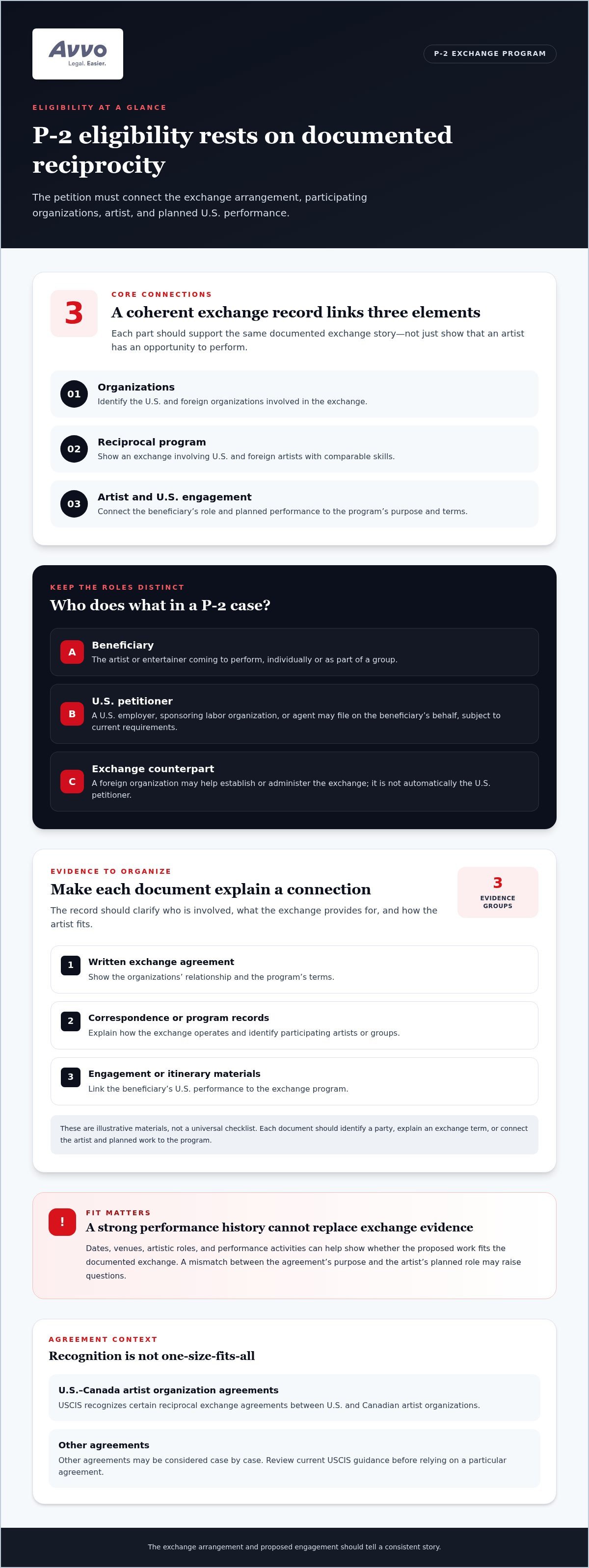
Documented reciprocity is central to P-2 eligibility because the petition must connect the U.S. engagement and beneficiary to an exchange arrangement involving U.S. and foreign artists with comparable skills. The organizations, program, and proposed performance should tell a consistent story. A signed agreement alone may not explain that connection if supporting records leave the participants or exchange terms unclear.
The roles are related but distinct. The beneficiary is the artist or entertainer coming to perform. A qualifying U.S. employer, sponsoring labor organization, or agent may file the petition on the beneficiary’s behalf, subject to current rules. A foreign organization may be the exchange counterpart or help administer the program. The agreement describes the reciprocal framework, while the petition connects that framework to the artist and the specific U.S. work.
USCIS recognizes certain reciprocal exchange agreements, including arrangements between U.S. and Canadian artist organizations, and may consider other agreements case by case. The question is not just whether organizations have a relationship, but whether their documented program supports the proposed exchange. Review current USCIS guidance before relying on a particular agreement.
What Evidence Can Help Show a Reciprocal Exchange?
Evidence should clarify who the participating organizations are, what the exchange provides for, and how the beneficiary fits within it. Depending on the arrangement, relevant materials may include:
- The written reciprocal exchange agreement, showing the organizations’ relationship and the program’s terms.
- Correspondence or program records explaining how the exchange operates and identifying participating artists or groups.
- Engagement or itinerary materials connecting the beneficiary’s U.S. performance to the exchange program.
This is an illustrative set of materials, not a universal checklist. Each document should have a clear purpose: identify a party, explain an exchange term, or link the artist and planned work to the program. A P-2 exchange program visa lawyer can help organize the record around those connections and identify gaps that need attention.
Why the U.S. Engagement Must Fit the Exchange
Dates, venues, artistic roles, and performance activities help show what the beneficiary will actually do in the United States. If an agreement describes an exchange of performers for a particular kind of production, for example, the itinerary and supporting records should explain how the proposed engagement relates to that program. Changes in dates or venues may require updated, consistent records.
Look for mismatches. An agreement might name one participating organization while the itinerary points to a different program, or the artist’s described role may not align with the exchange terms. These differences may have explanations, but the petition materials should make them clear rather than leave the reviewer to infer the connection.
Petitioner requirements and written labor-organization consultation rules are procedural details that matter to the petition. Review current USCIS guidance as part of filing preparation. Artists, representatives, and sponsoring organizations can schedule a consultation about P-2 exchange evidence to discuss how the agreement and engagement records fit together.
P-2 vs. P-1 and P-3: Which Artist or Entertainer Visa Fits?
P-2, P-1, and P-3 are distinct nonimmigrant categories, each with its own eligibility basis and evidence. The question isn’t which visa is generally “best,” but which category matches the artist’s work and the facts that can be documented. Engagements may involve similar performances while qualifying under different legal frameworks.
P-2
Qualifying basis: Participation in a qualifying reciprocal exchange program.
Typical purpose: An artist or entertainer performs in the United States as part of the exchange.
Key distinction: The exchange arrangement is central; credentials alone don’t establish this basis.
P-1
Qualifying basis: Classification criteria that include internationally recognized athletes or qualifying internationally recognized entertainment groups.
Typical purpose: Athletic competition or an engagement by a qualifying entertainment group.
Key distinction: The relevant criteria focus on the athlete or group, rather than a reciprocal exchange program.
P-3
Qualifying basis: Participation in a culturally unique program, subject to applicable requirements.
Typical purpose: A performance, teaching, or coaching program that presents or develops a culturally unique art form.
Key distinction: The cultural-program basis differs from P-2 reciprocity and P-1 recognition criteria.
When Does a Reciprocal Exchange Point Toward P-2?
Start with the documented exchange relationship: identify the relevant organizations and determine whether the program supports the artist’s U.S. engagement. Then compare the proposed role and activities with the arrangement’s terms. A performer’s résumé may establish a strong artistic record, but it doesn’t answer whether the reciprocal-program basis applies. Evaluate the exchange documentation and engagement together.
How Do P-1 and P-3 Differ from P-2?
P-1 focuses on specific athlete or entertainment-group criteria, while P-3 centers on a culturally unique program. P-2, by contrast, depends on reciprocal exchange. These categories can involve overlapping forms of artistic work, but a shared profession or performance style doesn’t make their legal tests interchangeable. Review current USCIS criteria for the individual’s circumstances.
Consider a musician invited to perform in the United States. If the proposed engagement is tied to a qualifying exchange arrangement, P-2 may warrant assessment. If the relevant evidence instead concerns an internationally recognized group or a culturally unique program, P-1 or P-3 may merit closer review. These are starting points, not conclusions. The full facts and supporting record determine which category fits.
A P-2 exchange program visa lawyer can compare the proposed engagement with the available evidence and identify which classification’s requirements appear relevant. The analysis should consider the nature of the performance, the participating organizations, and the basis the petition can substantiate. Review current USCIS rules before proceeding, since category requirements and their application depend on the case.
P-2 Petition Evidence and Filing: What Should You Prepare?
A well-prepared petition makes it possible to trace the connection from the reciprocal exchange agreement to the artist’s planned U.S. work. Organize the case in a deliberate sequence so the engagement, participating organizations, and supporting records tell a consistent story.
- Define the engagement. Record the proposed dates, locations, performance activities, and each artist’s role. Gather available contracts, invitations, schedules, or itinerary details describing the work, and note what remains tentative.
- Identify the organizations and their roles. Distinguish the U.S. petitioner from the foreign organization involved in the exchange and identify the beneficiary or beneficiaries. Clarify how each organization relates to the program and planned performance.
- Gather the exchange records. Locate the written reciprocal exchange agreement and related program records or correspondence explaining its terms and identifying participating artists. The evidence should show how the planned engagement fits the exchange.
- Organize supporting materials. Arrange documents by topic and compare names, roles, dates, and activities across records. Set aside discrepancies or questions for review rather than trying to resolve them through assumptions.
A P-2 petition generally involves Form I-129, a copy of the reciprocal exchange agreement, and a written consultation from an appropriate labor organization. The correct petitioner and supporting materials depend on current rules and the case facts. Review current USCIS instructions and form requirements before filing; this preparation sequence is not a substitute for the applicable filing checklist.
Which Case Details and Documents Should Be Organized?
Keep the exchange agreement, records identifying participating organizations, beneficiary information, and proposed activity materials in distinct groups. Depending on the case, useful engagement records may include dates, venues, performance roles, itineraries, invitations, and program communications. Compare the details across documents. If the itinerary names a different venue or role from other records, flag the difference and gather an explanation before submission.
What Should Applicants Expect During Petition Preparation?
Preparation generally begins by assessing the exchange structure and planned engagement, then identifying the petitioner and applicable requirements. Next, gather and review evidence, prepare the petition package, and file it under current USCIS procedures. Processing times and adjudication depend on the case and government procedures, so avoid relying on outdated estimates or assuming a filing will be decided by a particular date.
Working with a P-2 exchange program visa lawyer can help clarify the evidence plan, spot inconsistencies, and organize materials before filing. For artists, representatives, and sponsoring organizations planning an engagement in San Jose or San Francisco, MJ Law’s entertainment and artist visa practice provides immigration-law guidance. You can discuss a P-2 visa case and the documents you’ve assembled.
How Can a P-2 Exchange Program Visa Lawyer Help in San Jose or San Francisco?
A P-2 exchange program visa lawyer can assess whether the exchange arrangement, petitioner’s role, beneficiary, and planned U.S. work fit together under current requirements. That review goes beyond collecting documents. It involves examining what each record establishes, whether the proposed engagement is consistent with the exchange terms, and whether the petition materials leave important questions unanswered.
For example, an itinerary may describe an artist’s performance, while the agreement or related program records need to show how that work connects to the exchange. Counsel can identify mismatches, clarify what further information may help, and address filing considerations such as the appropriate petitioner and required consultation. Legal guidance can help prepare a clear petition, but USCIS makes the decision and no lawyer can promise an outcome.
What to Bring to a P-2 Visa Consultation
A useful discussion starts with the engagement’s basic facts. Bring what you have, even if some details are still being arranged, and note what remains uncertain.
- A summary of the proposed U.S. engagement, including dates, activities, locations, and each artist’s role.
- The exchange agreement, program records, and correspondence involving participating organizations.
- Available itineraries, invitations, contracts, and prior immigration filings relevant to the artist or group.
- Questions about who may petition, which individuals are beneficiaries, and how the exchange program is structured.
Organizing these materials by topic helps counsel identify missing links or conflicting details more efficiently.
What Legal Guidance Can Address
Legal review can examine the eligibility facts, the relationship between the exchange and proposed work, and whether the records support the roles of the organizations and beneficiaries. Counsel can also help organize petition materials, identify inconsistencies that need explanation, and flag filing questions for further analysis. Current USCIS rules and forms should guide final preparation, since requirements can depend on the case.
MJ Law’s entertainment and artist visa practice serves clients in San Jose and the wider San Francisco area. Consultations are available in English and Spanish, allowing artists, representatives, and sponsoring organizations to discuss their circumstances in the language they prefer. A concise engagement summary and available exchange records give the conversation a practical starting point.
If you’re planning a U.S. performance and want to discuss the exchange arrangement, petitioner role, or evidence with counsel, schedule a P-2 visa consultation with MJ Law.
Take the Next Step With a Clear Case Plan
Turn your plans into a focused case outline: what the U.S. engagement involves, which organizations are connected to the exchange, and what documents are already available. You don’t need to resolve every open question before seeking guidance. A conversation with a P-2 exchange program visa lawyer can help identify which issues need attention and what information to gather next.
MJ Law’s immigration practice dates back to 1985 and brings longstanding experience to the review of artist and entertainer visa matters. The goal is to help you approach the petition with a clearer understanding of the evidence and process, not to promise a particular USCIS decision.
Schedule a consultation about your P-2 visa to discuss your exchange arrangement and plan for your U.S. engagement.
Frequently Asked Questions
What is a P-2 exchange program visa?
A P-2 visa is a temporary U.S. classification for artists and entertainers participating in a qualifying reciprocal exchange program. The performer’s U.S. engagement must connect to the exchange, rather than simply be a standalone booking. A P-2 exchange program visa lawyer serving San Jose and San Francisco can help artists and sponsoring organizations assess how the proposed performance relates to the program and applicable requirements.
Who can petition for a P-2 visa?
A qualifying U.S. employer, sponsoring labor organization, or agent may file Form I-129 on behalf of the artist or entertainer, subject to current rules. The petitioner is not necessarily the beneficiary: the beneficiary is the person who will perform in the United States. An agent may handle the filing while the artist performs for a separate organization, for example. Clarify who is filing and how each organization relates to the engagement.
Does a P-2 visa require a written reciprocal exchange agreement?
Yes. A P-2 petition must include a copy of the reciprocal exchange agreement, alongside other required materials. Review the agreement in context rather than treating it as proof of every case detail by itself. If it names participating organizations but doesn’t clarify how the artist’s planned engagement fits the program, related records may help explain the connection. Review current USCIS instructions before filing.
Can an individual artist qualify for a P-2 visa?
Yes, an individual artist may qualify if the person will participate in a qualifying reciprocal exchange and meets the applicable criteria. The key issue is the individual’s connection to the exchange, not whether the engagement features a group. A solo performer could be considered within an exchange arrangement, but a solo booking without a qualifying program wouldn’t establish P-2 eligibility on its own. The evidence and current rules govern the assessment.
How is a P-2 visa different from a P-1 or P-3 visa?
P-2 relies on a reciprocal exchange program. P-1 has separate criteria for qualifying athletes or internationally recognized entertainment groups, while P-3 relates to culturally unique programming. A touring performer’s activity alone doesn’t determine the category. The relevant evidence matters: an exchange agreement may point to a different basis than records focused on a group’s recognition or a program’s cultural character. Review current USCIS criteria for the specific case.
How long can someone stay in the United States on P-2 status?
P-2 status is generally granted for the time needed to complete the event, up to one year. An extension may be granted in one-year increments to complete that same event. The planned dates and event details matter when assessing the requested period. An extension isn’t automatic, and the petition and current USCIS procedures should be reviewed before relying on a particular schedule.
Can a P-2 visa holder’s spouse or children come to the United States?
Yes. A P-2 visa holder’s spouse and unmarried children under 21 may seek P-4 dependent status. P-4 family members may attend school or college, but they aren’t permitted to work in the United States in that status. Families should plan for each person’s immigration documents and travel arrangements separately, and review current Department of State and USCIS guidance for the steps that apply to their circumstances.