
Could a California employer hire you in TN status if your job title isn’t listed among the eligible professions? The answer depends on how the role’s actual duties fit a TN category, whether your education or experience meets that category’s requirements, and which application route applies to your citizenship. A TN visa lawyer California applicants consult can help assess those details before you proceed.
It’s understandable to feel uncertain when a modern position doesn’t neatly match a profession on the list, or when Canadian and Mexican applicants follow different procedures. This guide explains the main eligibility questions, compares application routes, and outlines records that can help clarify your case. It also offers practical questions to bring to a legal consultation, including how to describe the role and your qualifications. MJ Law assists with employment-based immigration matters and offers consultations in English and Spanish. A case-specific review can help you prepare for an informed next step without assuming an outcome.
Key Takeaways
- TN status is limited to eligible Canadian and Mexican citizens working in qualifying professional roles under the USMCA.
- Assess how the position’s actual duties and required qualifications align with a listed TN profession, not just the job title.
- Canadian and Mexican citizens may use different application routes, so identify the process that fits your citizenship and circumstances.
- Organize applicant credentials separately from employer records to prepare a clearer, more complete application.
- A TN visa lawyer California consultation can help review category fit, supporting evidence, filing route, and case-specific concerns.
What a TN Visa Lawyer in California Can Help You Assess
TN nonimmigrant status allows eligible Canadian and Mexican citizens to work temporarily in the United States in certain professional occupations under the United States-Mexico-Canada Agreement (USMCA). A California job offer is only one part of the analysis. The proposed work must fit a TN profession, and the applicant must meet that profession’s requirements. A TN visa lawyer California applicants consult can help assess how those elements fit together before an application moves forward.
In brief: TN status is temporary work authorization for qualifying Canadian and Mexican professionals in eligible U.S. roles. It isn’t permanent residence or a general work permit. The category has its own eligibility criteria and application procedures, distinct from other employment-based visa classifications. For background on its origins and distinctions, see this TN visa overview.
Who may qualify for TN status?
Eligibility involves more than professional experience or an offer from a California company. The main elements work together:
- Citizenship: The applicant must be a citizen of Canada or Mexico.
- Eligible profession: The position must correspond to a profession covered by the TN category.
- Qualifying U.S. position: The role must involve professional work that meets the category’s requirements.
- Required credentials: The applicant must have the education, license, or other qualifications specified for that profession.
The job title alone doesn’t settle eligibility. A company might call someone a “data analyst,” “consultant,” or “engineer,” but the relevant questions are what the person will actually do and whether those duties align with a listed profession. Required credentials also vary by category. A degree that supports one profession may not meet another category’s criteria, so assess the role and the applicant’s qualifications together.
What does a California TN visa lawyer evaluate?
A lawyer can review the job description, proposed responsibilities, required qualifications, and applicant records to assess whether the case presents a coherent fit. Employer documentation matters too. It should clearly describe the position, work arrangement, and connection to the relevant professional category. This review can be particularly useful for specialized Silicon Valley and Bay Area positions, where modern titles and cross-functional duties may not closely resemble traditional profession names.
California doesn’t set separate TN eligibility rules. The governing criteria are federal, wherever the job is located. A case-specific review can help an employer and applicant explain a California position under those criteria, identify gaps in the evidence, and prepare focused questions about next steps.
Legal analysis can identify strengths, uncertainties, and documentation issues, but it can’t guarantee how a government officer will decide a case. A careful assessment gives the professional and employer a clearer basis for deciding how to proceed.
How the TN Profession, Job Duties, and Credentials Must Fit Together
A TN application is clearer when its central elements tell one consistent story: the profession category, the work the employer needs done, and the applicant’s credentials. A job title may help describe a position, but it can’t establish eligibility by itself. For TN eligibility, the day-to-day duties must align with a listed profession, and the applicant’s qualifications must meet that profession’s specific requirements.
How do job duties map to a listed TN profession?
Start with the actual work, not a title chosen for recruiting or internal use. A useful description explains what the employee will do, their level of responsibility, and the expected deliverables. “Technology role” is an industry label, not an explanation of professional duties. A position called “product engineer” needs a more precise description before anyone can assess whether a TN profession fits.
Break the responsibilities into concrete functions. Does the role involve analyzing systems, preparing designs, conducting research, or providing specialized professional advice? These examples describe different kinds of work; they aren’t interchangeable category labels. The employer should distinguish core responsibilities from incidental tasks so the application presents a clear picture of the position, rather than a broad collection of unrelated duties.
Compare that description with the current profession list and the requirements for the specific category. The USCIS TN NAFTA Professionals resource provides a government reference for reviewing eligible professions and their requirements. A mismatch between the title and duties doesn’t by itself resolve eligibility, but it can prompt closer examination. Address it with an accurate, well-supported description.
How do education and experience support the category?
Once you identify the proposed profession, assess the applicant’s credentials against that category’s standard. Requirements differ, so don’t assume that a degree or work history accepted for one profession will satisfy another. Experience can substitute for a degree only if the applicable category allows that alternative and the applicant meets its terms.
Relevant evidence may include diplomas, academic transcripts, professional licenses, and experience records, depending on the category’s requirements. The goal is to show how the person’s preparation relates to the work they’ll perform. Transcripts, for example, can clarify a degree’s field of study. A detailed employment record may document experience when it is relevant under the category’s criteria. A résumé alone may not make those connections clear.
A TN visa lawyer California applicants consult can review the duties and credentials together, identify gaps, and help the employer describe the position accurately. To discuss a proposed role and supporting records, schedule a TN eligibility consultation.
TN Visa Application Routes for Canadian and Mexican Citizens Compared
Canadian and Mexican citizens can pursue TN classification through different procedures, and an employer-filed petition may also be relevant. The route affects where documents are submitted and which officials review each stage. Check current government instructions before filing or traveling, since procedures and appointment requirements can change.
| Citizenship | Possible route | Core steps | Decision authority |
|---|---|---|---|
| Canadian | Apply for TN classification at a qualifying U.S. port of entry or preclearance location; an employer may also file Form I-129 with USCIS where appropriate. | Present supporting evidence for the role and qualifications at the border, or have the employer submit a petition to USCIS. If using an approved petition, the worker still seeks admission. | CBP decides admission at the border. USCIS decides an I-129 petition. |
| Mexican | Apply for a TN visa at a U.S. consular post; an employer-filed Form I-129 may be another applicable step. | Complete the consular visa process and attend the required interview. After visa issuance, seek admission in TN classification. A USCIS petition, if used, does not itself issue a visa. | The Department of State decides visa issuance; CBP decides admission. USCIS decides an I-129 petition. |
What route may a Canadian citizen use?
A Canadian citizen may generally request TN classification at a U.S. port of entry or designated preclearance location by presenting the required evidence for review. An employer can also consider filing Form I-129 with USCIS before the worker seeks admission. The appropriate option depends on the case and current procedures. Applying at the border doesn’t remove the need for clear employer documentation and proof that the applicant meets the profession’s requirements.
What route may a Mexican citizen use?
Mexican citizens generally apply for a TN visa through a U.S. consular post. Current procedures include an in-person interview. If an employer files Form I-129, that petition may be part of the process, but it doesn’t replace the visa application requirement. Keep the stages distinct: USCIS can decide a petition, the consular officer decides whether to issue a visa, and CBP makes the admission decision when the applicant seeks to enter the United States.
Approval at one stage doesn’t guarantee a favorable decision at another. Petition approval, for example, isn’t the same as admission at the border. The appropriate route depends on citizenship, case facts, timing, and current government procedures. A TN visa lawyer California applicants consult can help map the sequence, identify the officials involved, and prepare for the applicable stage without treating one route as universally best.
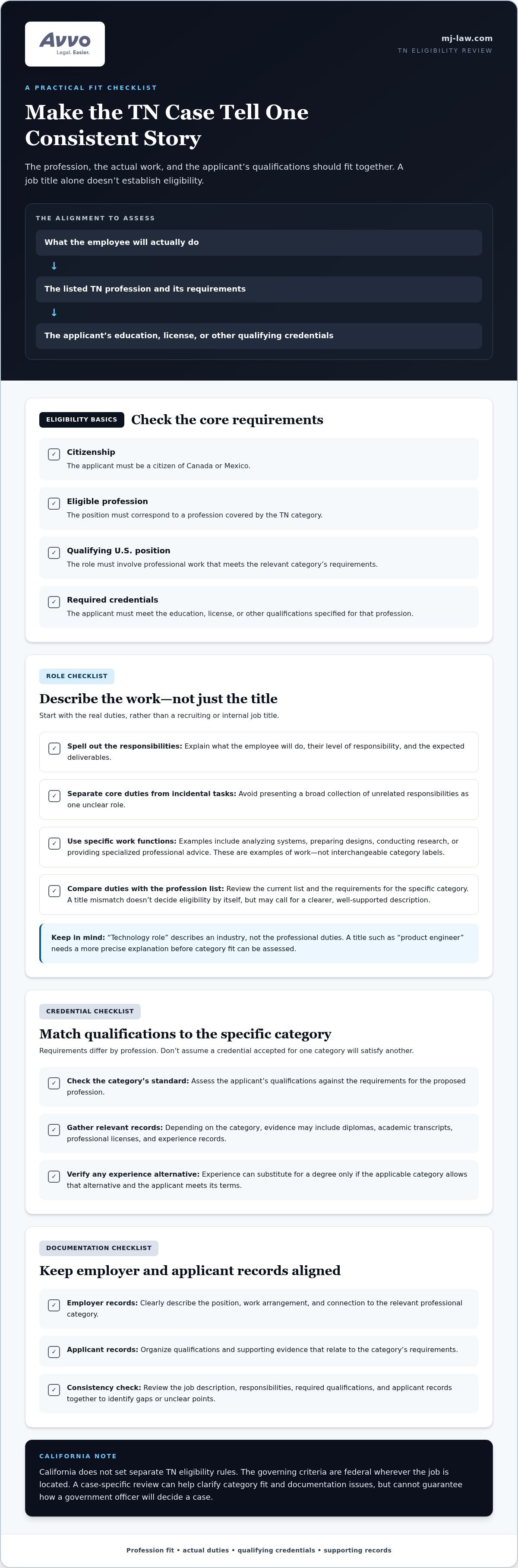
Prepare a Strong TN Application: A Practical Checklist for California Employers
Good preparation helps the employer and applicant present a consistent, well-supported account of the proposed work. Use this sequence to organize the case before following the instructions for the chosen application route. Document requirements can vary by profession, citizenship, filing route, and current agency procedures, so treat this as a planning checklist, not a substitute for route-specific instructions.
- Identify the profession category. Compare the position’s core responsibilities with the current TN profession criteria before settling on a category.
- Write a precise role description. Record day-to-day duties, expected deliverables, work location, and the professional context of the position.
- Match credentials to the category. Identify the specific education, license, or experience evidence relevant to its requirements.
- Choose the filing route. Identify the steps and evidence for the applicant’s citizenship and intended process.
- Review the full record for consistency. Resolve differences in titles, dates, duties, and employment details before submission or presentation.
What should the employer document?
The employer should prepare a clear offer or support letter describing the position and providing enough context to understand the work. Include the role’s duties, employment terms, and why the position fits the selected TN profession. A generic job posting may not explain that connection. For a San Jose or San Francisco employer, focus on the actual U.S. position and responsibilities, rather than relying on the company’s industry or location to establish eligibility.
Review the letter alongside the job description and any other employer records. If one document calls the role an analyst while another describes mostly managerial work, the inconsistency may raise questions. The materials should accurately describe the same position. Don’t adjust duties or credentials simply to make a category appear to fit.
What should the applicant organize?
Gather records that support the applicable category, as relevant to the applicant’s qualifications:
- Education: Diplomas and transcripts that help document the credential and field of study.
- Professional standing: Licenses or similar records, where the category calls for them.
- Experience: Employment records that clearly show relevant roles, dates, and responsibilities when experience is part of the applicable standard.
Check names, dates, titles, and employment details across these records and the employer’s documents. If a résumé uses a different title from a reference letter, prepare an accurate explanation instead of leaving the discrepancy unaddressed. Unsupported qualifications or unclear records can make the case harder to follow.
Questions about an H-1B transfer are separate from TN eligibility and involve different visa rules. Don’t treat one process as a substitute for the other. A TN visa lawyer California employers and professionals consult can review the records and route together. Schedule a TN application consultation to discuss the proposed role and preparation questions.
Working With a TN Visa Lawyer in California: From Case Review to Next Steps
A focused legal review connects the facts of your proposed employment to the TN category, qualifications, employer records, and application route. Rather than treating each document separately, counsel can assess whether they tell a consistent story, identify potential concerns, and clarify which questions need attention before you proceed. The government makes the decision, so legal guidance can help prepare a case but can’t promise an outcome.
What happens during an initial TN case review?
To make the discussion useful, prepare a short summary of your situation. Include your citizenship, the proposed role and employer, your relevant education or experience, and the route you’re considering. Bring the job description and available supporting records, too. If details are still developing, explain what’s known and what may change instead of guessing.
An attorney can use these facts to examine category fit, compare the duties with the profession’s criteria, review the credentials and employer documentation, and discuss which filing route may apply. The review can also flag gaps, such as a job description that doesn’t explain specialized responsibilities clearly or records with inconsistent titles. This gives you a practical starting point for organizing the case and deciding what to address next.
MJ Law is an immigration law firm in San Jose, serving individuals, families, and businesses with immigration matters. The firm handles employment-based visa matters and offers consultations in English and Spanish, so individuals and employers can discuss case details in the language that works for them.
When should you seek legal guidance?
Consider seeking advice before proceeding if the job title doesn’t seem to match a TN profession, your credentials are unusual for the category, you have prior immigration concerns, or the employer is changing the role or work arrangement. A change in employment plans can affect the analysis, so don’t assume documents prepared for one position will automatically support another.
Timing and filing choices deserve attention before you begin work or change employers. A case review can help clarify what the relevant facts mean, which records may need further explanation, and what procedural questions to resolve before taking the next step. It’s a measured assessment, not a prediction of approval.
If you’re ready to discuss your circumstances, schedule a TN visa consultation with a TN visa lawyer California applicants can speak with about their role, qualifications, and route. MJ Law can help you prepare informed questions and consider next steps based on your individual facts.
Take the Next Step With a Clear Plan
Your next move doesn’t need to be a decision about the entire immigration process. Start by putting the essential facts in one place: the proposed position, the employer’s description of the work, your qualifications, and any questions about timing or the filing route. That gives an attorney a practical foundation for assessing the situation and identifying what needs further attention.
A consultation with a TN visa lawyer California professionals and employers can use is an opportunity to discuss the case’s specific details and consider an informed path forward. Legal guidance can help you prepare, but each application depends on its facts, and the government makes the final decision. No outcome can be promised.
To discuss your circumstances, schedule a TN visa consultation with MJ Law. A focused review can help turn uncertainty into clearer questions and next steps.
Frequently Asked Questions
Can a California employer hire a Canadian or Mexican professional on a TN visa?
Yes, if the professional and position meet federal TN requirements. A company’s California location doesn’t broaden the list of qualifying professions or replace the applicant’s need to meet category criteria. For example, a San Jose employer should focus on the employee’s actual responsibilities, not simply the company’s technology industry or the title on its organizational chart. Review the specific position before setting a start date or making travel arrangements.
Does a TN visa require a bachelor’s degree?
Not in every category. The required education or experience depends on the specific TN profession, and a related degree doesn’t automatically meet its standard. Review the category’s requirements against the applicant’s actual records. If the person has a diploma in a different field, professional training, or substantial experience instead of a degree, determine whether that background is relevant under the category’s rules before relying on it.
Can I apply for TN status without a job offer?
Generally, no. TN classification is for qualifying professional work arranged with a U.S. employer, not for entering the country to search for a job. The role and work terms should be established before applying, and self-employment isn’t permitted under the TN rules. If you’re still interviewing, wait until there’s a specific position to assess rather than treating TN status as open-ended authorization to look for work.
How long can TN status last, and can it be extended?
TN status is temporary, and an extension may be possible if the person continues to qualify and follows the applicable procedure. The authorized period and extension steps depend on the case and current agency rules, so don’t rely on a general estimate as your personal deadline. Track the end date shown on your admission or approval record, and seek advice early enough to plan before it expires.
Can a TN visa holder change employers in California?
A TN holder shouldn’t assume existing authorization automatically covers a new employer. A job change may require a new application or petition, and the proper process depends on citizenship, current status, and the proposed position. For instance, a promotion that changes core duties may also affect the category analysis. Review the new employer’s role and the required procedure before beginning work in the changed position.
Can a TN visa holder’s spouse work in the United States?
No, TD dependent status by itself doesn’t authorize a spouse to work. A spouse and eligible unmarried children may seek TD status, but a spouse who plans to take a job needs separate work authorization through an applicable immigration category. Keep that distinction in mind before accepting an offer or making employment plans. Family members should also review current application and travel procedures for their circumstances.
What should I bring to a TN visa lawyer consultation in California?
Bring a clear outline of your citizenship, proposed employer and position, duties, qualifications, and any relevant U.S. immigration history. Useful records may include a draft offer letter, résumé, diplomas, transcripts, licenses, and prior immigration notices. A TN visa lawyer California professionals consult can use this information to frame case-specific questions. For a San Jose or San Francisco matter, note any planned worksite or changes to the role as well.