A family visa case rarely moves through one agency in a single straight line. Consular processing for family visas typically involves handoffs from U.S. Citizenship and Immigration Services (USCIS) to the National Visa Center (NVC), then to a U.S. embassy or consulate abroad. Knowing which agency handles each stage can help you identify what to do next and which instructions to follow.
Missing or inconsistent records and incomplete financial sponsorship materials can prompt additional requests and delay progress. The process also depends on the family relationship and visa category, so a general timeline may not match your case. Keep the latest notices together and compare names, dates, and other details across forms and supporting documents before submitting them.
This 2026 guide explains how consular processing works, what families typically prepare at each stage, and what it means when the NVC marks a case documentarily complete. It also covers how visa availability affects the sequence, how to prepare for the interview, and how to organize practical next steps without relying on a promised timeline.
Key Takeaways
- Consular processing for family visas involves handoffs between agencies, and the path can vary by family relationship and case circumstances.
- Use current, case-specific instructions from the National Visa Center and consular post to organize civil, identity, petition, and sponsor records.
- Visa availability and financial sponsorship can affect when a case moves forward. Understand how they apply before planning around a timeline.
- Prepare for the interview as an eligibility review, and follow the consular officer’s instructions if more documents or further processing are required.
- Legal guidance can clarify stage-specific responsibilities and evidence needs. MJ Law brings more than three decades of immigration experience to its family immigration practice.
What Is Consular Processing for Family Visas, and Who Uses It?
Consular processing for family visas is the route through which an eligible relative applies for an immigrant visa at a U.S. embassy or consulate abroad. The case commonly starts when a U.S. citizen or lawful permanent resident files a family petition with U.S. Citizenship and Immigration Services (USCIS). If USCIS approves the petition, the case can move to visa processing, subject to the applicant’s category and visa availability.
This differs from adjustment of status, which is the process an eligible person may use to apply for permanent residence from within the United States. The appropriate route depends on factors such as where the beneficiary lives and whether they meet the requirements for either process. For general background on the green card process and the consular route, see Green Card: Consular Processing Overview.
Which family relationships may qualify for an immigrant visa?
U.S. immigration law recognizes specific family relationships, not every relationship to a U.S. citizen or permanent resident. A U.S. citizen may petition for a spouse, an unmarried child under 21, or a parent if the citizen is at least 21. These are immediate-relative categories, which aren’t subject to annual numerical visa limits.
Family-preference categories include certain unmarried adult sons and daughters of U.S. citizens, spouses and unmarried children of permanent residents, married sons and daughters of U.S. citizens, and brothers and sisters of U.S. citizens who are at least 21. These categories are subject to numerical limits, so petition approval doesn’t necessarily mean a visa is immediately available. The petitioner’s status and the beneficiary’s relationship determine the category. Check current USCIS family-category guidance and the Department of State’s Visa Bulletin for official information. Don’t assume every relative qualifies or that approval alone determines when an application can proceed.
When does a family member use consular processing?
An eligible beneficiary generally uses this route when applying for an immigrant visa from outside the United States. After the family petition is approved, the case typically proceeds through the National Visa Center and then to the U.S. embassy or consulate handling the interview. The sequence can vary with the visa category, visa availability, and the case’s circumstances.
Being abroad doesn’t, by itself, determine eligibility. A person’s location, immigration history, relationship to the petitioner, and other individual circumstances may affect which process is appropriate. Families should understand the options before acting, especially if the beneficiary is already in the United States or the family relationship falls within a preference category. MJ Law’s Family Immigration Guide offers related context on family-based immigration. An attorney consultation can help clarify how the process applies to a specific family.
How Consular Processing for Family Visas Moves from Petition to Interview
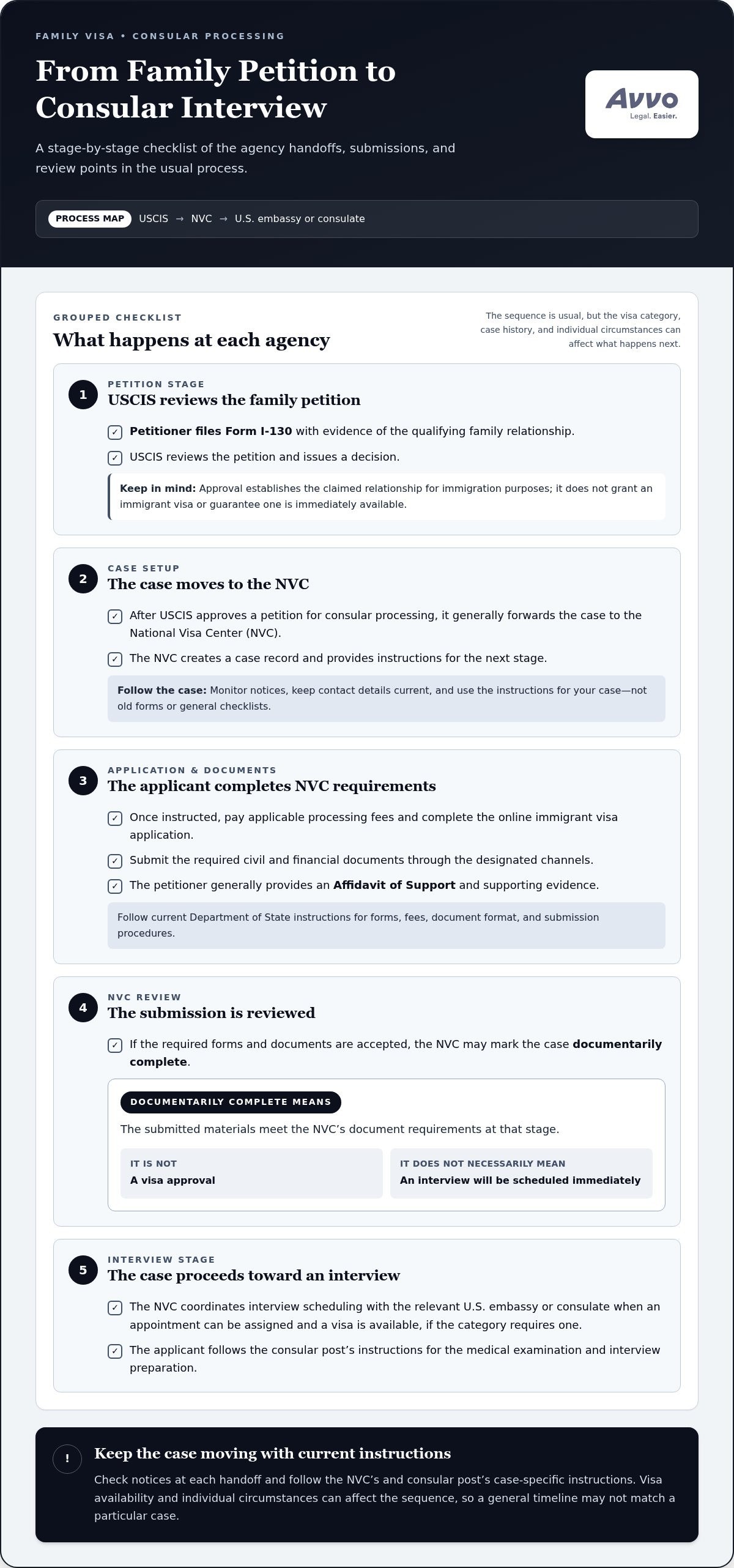
Consular processing for family visas involves several agency handoffs rather than one application. The usual sequence below gives families a practical map, but the visa category, case history, and individual circumstances can affect what happens next.
- The petitioner files Form I-130 with USCIS. The petitioning U.S. citizen or lawful permanent resident submits evidence of the qualifying family relationship. USCIS reviews the petition and issues a decision. Approval establishes the claimed relationship for immigration purposes, but it doesn’t grant an immigrant visa or guarantee that one is immediately available.
- The case moves to the National Visa Center (NVC), when applicable. After USCIS approves the petition for consular processing, it generally forwards the case to the NVC. The NVC creates a case record and provides instructions for the next stage. Monitor notices, keep contact details current, and follow the instructions for your case rather than relying on old forms or general checklists.
- The applicant completes the NVC requirements. Once instructed, the family pays the applicable processing fees, completes the online immigrant visa application, and submits the required civil and financial documents through the designated channels. The petitioner generally provides an Affidavit of Support and supporting evidence. Follow current Department of State instructions for forms, fees, document format, and submission procedures.
- The NVC reviews the submission. If the required forms and documents are accepted, the NVC may mark the case documentarily complete. This means the submitted materials meet the NVC’s document requirements at that stage. It isn’t a visa approval and doesn’t necessarily mean an interview will be scheduled immediately.
- The case proceeds toward an interview. The NVC coordinates interview scheduling with the relevant U.S. embassy or consulate when an appointment can be assigned and a visa is available, if the category requires one. The applicant follows the post’s instructions for the medical examination and interview preparation.
What happens after USCIS approves the family petition?
After approval, the applicant’s role becomes more active: watch for NVC notices, complete each step in the correct order, and keep copies of submissions and correspondence. If a notice is delayed or case details don’t match, use official USCIS or NVC case-status and inquiry channels to find out where the case stands. Petition approval is an important decision, but the immigrant visa is issued only after the remaining requirements are addressed and consular processing is completed.
How do visa availability and interview scheduling affect the case?
For family-preference categories, the priority date and the Department of State’s Visa Bulletin help determine when a visa number is available. A case can be documentarily complete while still waiting for visa availability. Conversely, visa availability doesn’t mean document review or interview scheduling is finished. Check the current Visa Bulletin and official case-status information regularly, since dates and scheduling capacity can change. Avoid planning around a fixed timeline.
Because a missed instruction or incomplete submission can complicate a handoff, an attorney consultation can help clarify responsibilities at each stage. Families can schedule a consultation about their case to discuss how the process applies to their circumstances.
Which Documents and Financial Sponsorship Does a Family Visa Case Need?
Good document preparation means more than collecting records. For consular processing for family visas, each document should support a specific part of the application, and names, dates, and family details should match across forms and records. Use the current case-specific instructions from the National Visa Center (NVC) and U.S. embassy or consulate as your final checklist.
What civil and identity documents should applicants prepare?
Applicants commonly need identity records, civil documents, and evidence connected to the approved family petition. The exact list depends on the applicant’s history, country, and consular post. Organize records by category, then compare each item with the case instructions:
- Identity documents: A valid passport and any other identity records requested in the case instructions.
- Civil records: Birth certificates and, when relevant, marriage certificates, divorce decrees, or death certificates documenting the end of a prior marriage.
- Police and medical records: Police clearance certificates where required, and medical examination results prepared according to the consular post’s directions.
- Petition-related records: The USCIS petition decision and supporting relationship records, along with copies of relevant notices or case correspondence.
Check the rules for each issuing country and the consular post before ordering records. If a document isn’t in English, follow the current official instructions on translation and certification. A translation format accepted in one case or country may not meet another post’s requirements.
How does the Affidavit of Support fit into a family visa case?
When required, Form I-864, Affidavit of Support, is the petitioner’s formal commitment to provide financial support to the intending immigrant. The sponsor generally submits the form with evidence of income and other financial information requested by the NVC. Make sure the supporting evidence clearly corresponds to the sponsor’s information on the form. If income or household details are complex, clarify them before submitting rather than leaving gaps unexplained.
A joint sponsor may be an option when the petitioner’s income doesn’t meet the applicable requirement, but the petitioner must still submit their own I-864. Follow current USCIS and Department of State instructions for the correct form edition and supporting evidence. Requirements can change, so don’t rely on an old checklist or another family’s submission as a template.
Respond carefully to any request for more evidence. Read the notice closely, identify each missing or unclear item, and submit the requested material in the specified format and by the stated deadline. For a request in a marriage-based case, MJ Law’s guidance on responding to a marriage-based green card RFE may also be useful. Across document categories, keep complete copies and review spellings, dates, and translations for consistency before submitting.
What Happens at the Consular Interview, and What Can Delay a Family Visa?
The consular interview is a review of the applicant’s eligibility, application answers, and supporting evidence. The officer may ask about the family relationship, information in the forms, or details in the applicant’s history. Approval of the family petition is an important step, but it doesn’t guarantee visa issuance. The consular officer makes a separate decision on the immigrant visa application.
Consular processing for family visas can involve additional steps after the interview. The officer may request more documents or place the case in administrative processing. These outcomes don’t all mean the same thing, so follow the consular post’s instructions about what to do next.
How can applicants prepare for the family visa interview?
Start with the interview notice and the official instructions for the specific embassy or consulate. Review the forms already submitted so you can answer questions clearly and accurately. Bring the documents identified in the notice, including originals or copies as directed, and organize them so you can find a record promptly if asked.
Listen to each question and answer truthfully, directly, and consistently with the application and supporting records. If you don’t understand a question, ask for clarification rather than guessing. Don’t memorize a script or add details that weren’t requested. Be ready to clarify differences in dates, addresses, or relationship history honestly.
Complete the medical examination according to the post’s instructions. The designated panel physician, required steps, and timing are specific to the case and location. Don’t assume an examination arranged independently or too far in advance will meet the post’s requirements.
What can happen if the officer needs more information?
The officer may give the applicant written instructions to submit particular documents, or the case may require administrative processing before a decision can be made. A refusal under section 221(g) may indicate that further information or processing is needed. It isn’t necessarily a final determination that the applicant can never qualify. The notice should explain what action, if any, the applicant must take.
Read any written notice carefully. Note the documents requested, how and where to submit them, and any deadline stated. If the post requests a missing civil record, for example, submitting an unrelated document won’t address the request. Keep a copy of what you send and follow the post’s instructions for checking status. Don’t rely on general online estimates or assume every case with additional review follows the same path. Delays can reflect different case-specific issues, and the next step depends on the consular post’s directions.
If you’re preparing for an interview or responding to a request and need help assessing how your family’s records fit together, schedule a consultation about your family visa case.
How MJ Law Helps Families Navigate Consular Processing
Consular processing connects several stages, and each requires different steps from the family. USCIS handles the family petition, the National Visa Center (NVC) handles immigrant visa forms and documents, and a U.S. embassy or consulate reviews the applicant’s case. MJ Law helps families understand how these stages apply to their circumstances, identify evidence needs, and prepare for the responsibilities ahead.
MJ Law is an immigration law firm in San Jose, California, serving individuals and families in the San Jose and San Francisco area. The firm has assisted clients with immigration matters for more than three decades, including through its family immigration practice. For families working through unfamiliar instructions or case handoffs, legal guidance can help organize the next steps in consular processing for family visas.
When may a family benefit from case-specific legal guidance?
Some cases call for a closer review before the family submits documents or responds to a notice. Complex family histories, missing civil records, prior immigration issues, or conflicting information across forms and supporting evidence can raise questions about how to proceed. An attorney can assess the facts, identify issues that may need attention, and help organize a plan that reflects the case’s stage and requirements.
Guidance can also clarify who is responsible for each task, from responding to USCIS correspondence to completing NVC submissions or following consular instructions. The focus is careful preparation and clear communication, not a guaranteed approval or faster handling.
What should families prepare before a consultation?
Organizing records ahead of time helps make the conversation more useful. Gather materials that show what has happened so far and note any approaching deadlines or unanswered requests. Useful items may include:
- USCIS petition receipts, decisions, and other notices.
- NVC messages and correspondence from the U.S. embassy or consulate.
- Copies of forms and supporting documents already submitted.
- A concise timeline of key events, including prior applications or immigration matters.
- A list of questions and the applicant’s current case stage, such as awaiting NVC review or an interview.
Bring what you have, even if a record is missing or you’re unsure which agency currently holds the case. A clear account of what’s uncertain can help identify what needs follow-up and which official instructions apply. Don’t alter or recreate records. Explain gaps accurately so they can be assessed in context.
San Jose and San Francisco area families can schedule a family immigration consultation to discuss their circumstances and practical next steps. Consultations are available in English and Spanish.
Take the Next Step With a Clear Plan
Your family’s next move depends on the facts of your case, not a one-size-fits-all checklist. Before acting, identify which agency currently has the case, gather the latest notices, and write down the questions that still need answers. A focused review can help turn uncertainty about consular processing for family visas into a practical plan for the stage ahead.
MJ Law has assisted clients with immigration matters for more than three decades. To discuss how your family’s circumstances may affect the process, schedule a family immigration consultation. Consultations are available in English and Spanish, so you can discuss your questions in the language that feels most comfortable.
Schedule a family immigration consultation and take the next step with greater clarity.
Frequently Asked Questions
Can family members attend the consular interview together?
Sometimes, but attendance requirements depend on the consular post and case instructions. A parent and child applying together may receive instructions covering both applicants, while other family members may have separate appointment details. Check the interview notice for who must appear, including whether children need to attend. Don’t assume a petitioner or other relative can enter the interview area. Access rules are set by the post.
Do documents for a family visa need certified English translations?
Documents not in English may need a complete English translation with a translator’s certification, but exact requirements depend on the document and consular post. A translation should accurately reflect the full record, including stamps and annotations, rather than only its main text. Review the current instructions for the specific case and country. Keep the original document and translation together for submission or presentation as directed.
Can a family visa case be transferred to a different U.S. consulate?
A transfer may be possible, but it isn’t automatic. The case’s assigned post, the applicant’s residence, and the reason for the request can affect whether another consulate can handle it. Follow the National Visa Center’s or post’s current instructions for requesting a transfer, and explain the circumstances clearly. Don’t make travel plans around a transfer until the case record and appointment arrangements reflect the change.
What happens if a family visa applicant has a prior immigration violation?
A prior violation can affect eligibility, but the consequences depend on the specific facts, such as what happened, when it occurred, and whether there were later immigration actions. Some issues may raise inadmissibility concerns, and any available waiver depends on the applicable law and circumstances. Disclose the history accurately on forms and at the interview. For consular processing for family visas, an attorney can assess the records before the applicant responds.
Can applicants correct a mistake on a submitted DS-260 form?
Yes, but applicants generally can’t edit a DS-260 themselves after submitting it. If you notice an error, contact the embassy or consulate handling the case and follow its directions. Some corrections may be addressed at the interview, while others may require action beforehand. Don’t submit a second application to try to fix the first unless the post instructs you to do so. Keep a clear note of the incorrect and correct information.
What happens if a visa is issued but the family member cannot travel before it expires?
An immigrant visa generally must be used before its printed expiration date, and the expiration date usually can’t be extended. If travel becomes impossible, contact the issuing consular post promptly for case-specific instructions rather than waiting until the visa expires. The applicant may need to apply for a new visa, and additional steps could be required. Don’t assume the original visa remains valid after its expiration or that it can be reissued automatically.