
The right employment-based green card path may depend less on your job title than on who can sponsor you and what your records show. That distinction matters when you compare EB-1, EB-2, and EB-3 or try to understand whether you or your employer leads the petition. An employment based green card attorney can assess how your qualifications, role, and sponsorship structure fit together.
It’s understandable to feel uncertain about the steps. PERM labor certification, Form I-140, priority dates, and the later green card application each serve a different purpose, and visa availability can affect when you move forward. This guide explains the main employment-based routes, the facts and documents that may influence category selection, and how the filing stages connect. It also covers why an approved I-140 isn’t the same as receiving a green card and what to prepare for a focused discussion with an immigration attorney. MJ Law assists individuals and businesses with employment immigration matters in Silicon Valley.
Key Takeaways
- Compare EB-1, EB-2, and EB-3 by qualifications, sponsorship structure, and labor certification requirements, not by category name alone.
- Map the filing sequence for your route. PERM may be required, but it isn’t part of every employment-based case.
- Gather education, work history, job duties, employer details, and category-specific records to support a focused case plan.
- An employment based green card attorney can help assess category fit, sponsorship responsibilities, filing stages, and evidence needs.
- For a Silicon Valley case, consider how employer needs, your professional record, and visa availability may affect strategy and timing.
What Is an Employment-Based Green Card, and Who Can Pursue One?
An employment-based green card is a route to U.S. lawful permanent residence through an employment-related immigrant category. Permanent residence differs from temporary work authorization. A temporary work visa or employment authorization document may allow someone to work under specific conditions, but it does not by itself grant permanent resident status. A green card, once issued, gives its holder the right to live and work permanently in the United States, subject to immigration law.
The employment-based system isn’t one employer-led process. It includes preference categories with different eligibility standards, evidence requirements, and sponsorship structures. Some cases require an employer to offer a qualifying permanent position and take part in the petition process. Other routes may allow an individual to petition on their own behalf. The key question isn’t simply, “Which category sounds like my job?” It’s how the worker’s background, proposed work, and sponsorship fit the category’s requirements.
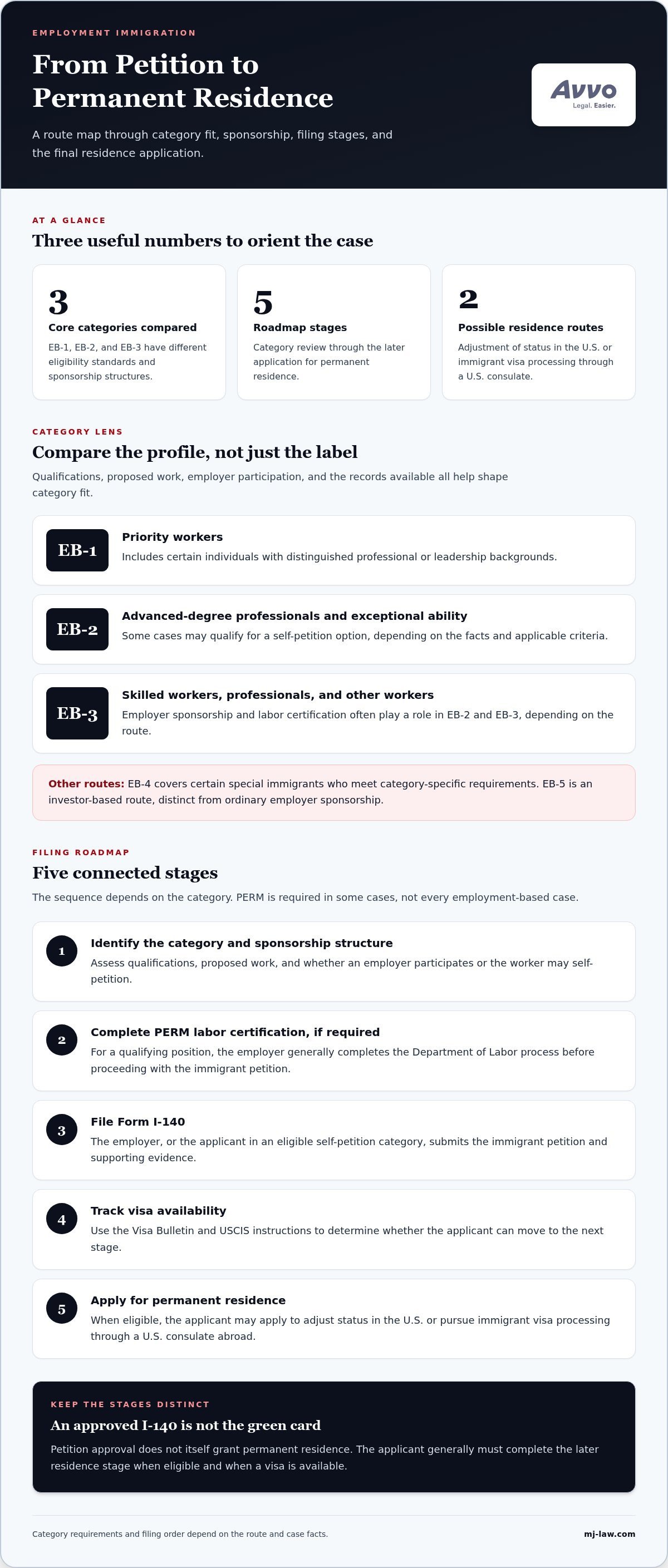
Keep the separate stages in view. An approved immigrant petition, often Form I-140 in employment-based cases, does not itself grant permanent residence. The applicant generally must still take the next step, such as applying to adjust status in the United States or pursuing an immigrant visa through a U.S. consulate. Visa availability and the requirements of the selected category affect when that step may happen. An employment based green card attorney can explain how these parts relate to your circumstances.
How EB-1, EB-2, and EB-3 differ at a high level
These categories cover different broad professional profiles, but their labels alone don’t determine eligibility. EB-1 is for priority workers, a broad category that includes certain individuals with distinguished professional or leadership backgrounds. EB-2 covers advanced-degree professionals and people with exceptional ability. Some EB-2 cases may qualify for a self-petition option, depending on the facts and applicable criteria.
EB-3 includes skilled workers, professionals, and other workers, subject to the requirements for the particular classification. Employer sponsorship and labor certification often play a role in EB-2 and EB-3 cases, but the rules depend on the route. A worker’s degree and experience, the offered position, and the employer’s role may all matter. Treat a category comparison as a starting point, not a decision based on job title alone.
When EB-4 and EB-5 may enter the conversation
EB-4 covers certain special immigrants who meet category-specific requirements. EB-5 is an investor-based immigration route, not ordinary employer sponsorship. Its rules are distinct, so this overview doesn’t cover detailed investment requirements. If your circumstances involve a special immigrant classification or investment, they may call for a different analysis from a conventional employer-sponsored case.
For an initial discussion, organize a brief summary of your education, work history, current immigration status, and whether an employer is involved. These facts help identify which categories may warrant closer review. The next step is to match them to the relevant criteria and consider the petition and residence application as connected but separate parts of the process.
How the Employment-Based Green Card Process Moves from Petition to Residence
Think of an employment-based green card case as a sequence of connected steps, not one application. The order depends on the category. Some cases require labor certification, while others may bypass PERM or allow an individual to self-petition. Petition approval also doesn’t automatically make the applicant a permanent resident. The applicant must complete the later residence stage when eligible and when a visa is available.
A typical roadmap may include:
- Identify the category and sponsorship structure. Assess the worker’s qualifications, proposed work, and whether an employer must participate or the worker may self-petition.
- Complete PERM labor certification, if required. For a qualifying position, the employer generally completes the Department of Labor process before proceeding with the immigrant petition.
- File Form I-140. The employer, or the applicant in an eligible self-petition category, submits the immigrant petition and supporting evidence.
- Track visa availability. Use the Visa Bulletin and USCIS instructions to determine whether the applicant can move to the next stage.
- Apply for permanent residence. Depending on eligibility and circumstances, the applicant may file Form I-485 in the United States or pursue immigrant visa processing through a U.S. consulate abroad.
This is a framework, not a universal checklist. An employment based green card attorney can help align the sequence with the selected category and the facts of the case.
Where PERM and Form I-140 fit
PERM is a Department of Labor labor certification process used in certain employer-sponsored cases. It addresses position and labor-market requirements for that route, but it isn’t required in every employment-based category. Where PERM applies, the employer is responsible for key steps, including defining the job opportunity and pursuing certification before the related immigrant petition.
Form I-140 is a petition asking U.S. Citizenship and Immigration Services to classify the worker under an employment-based immigrant category. It is not the green card application itself. An approved I-140 can establish the immigrant classification and priority date, but the applicant still needs to complete the residence stage when permitted.
A priority date is the date used to determine an applicant’s place in line for an employment-based immigrant visa. Its basis depends on the category and case, including whether labor certification is required. The Visa Bulletin’s Final Action Dates and Dates for Filing charts serve different purposes, and USCIS specifies which chart applicants seeking adjustment of status may use. Because cutoffs can change, check the current monthly instructions before planning a filing.
Adjustment of status or consular processing
Adjustment of status allows eligible applicants in the United States to apply for permanent residence without leaving to complete immigrant visa processing abroad. Consular processing involves applying for an immigrant visa through a U.S. consulate outside the country. Eligibility, procedure, and the appropriate route depend on individual circumstances and current rules.
Before choosing a filing sequence, map the category, any PERM requirement, petition stage, priority date, and intended residence process. To discuss how those pieces may fit your circumstances, you can schedule an immigration consultation.
How to Compare Employment-Based Green Card Categories for Your Situation
Compare possible routes using the same practical questions: what qualifications must the worker show, what role does an employer play, and is labor certification part of the route? A job title alone won’t answer them. The duties behind the title, the worker’s credentials, the offered position, and the available evidence all contribute to the assessment.
The table is a starting point, not a determination of eligibility. Requirements can vary within a category, especially when a specialized option or exception applies.
| Category | Broad profile | Employer sponsorship | Labor certification | Self-petition possibility |
|---|---|---|---|---|
| EB-1 | Priority workers | Depends on the EB-1 classification; some routes involve an employer. | Generally not required. | Possible for EB-1A when its requirements are met. |
| EB-2 | Advanced-degree professionals or people with exceptional ability | Often employer-sponsored, depending on the route. | Often relevant to employer-sponsored cases. | Possible for a qualifying National Interest Waiver case. |
| EB-3 | Skilled workers, professionals, and other workers | Generally tied to an employer and qualifying job offer. | Generally required for the standard employer-sponsored route. | Not generally an employer-independent route. |
Category selection depends on both eligibility and the filing path. A strong professional record doesn’t replace a required job offer, and an available employer doesn’t by itself establish that the worker qualifies for a category.
Employer-sponsored routes and the role of the job offer
In a sponsored case, the employer may offer a qualifying permanent position and file or support the petition. The job’s actual duties and requirements matter, as do the employer’s information and any labor-certification steps. The employee must separately provide evidence that they meet the category’s criteria. Employer participation and worker qualifications are related, but they are not interchangeable.
A worker in temporary status, such as H-1B, should treat that status as a separate part of planning. It may authorize employment under its terms, but it doesn’t automatically establish eligibility for a particular green card category. Review current status and the proposed permanent role alongside the category analysis.
Self-petition possibilities and specialized routes
Some EB-1A and EB-2 National Interest Waiver cases may allow the individual to file without an employer sponsor if the applicable requirements are met. These options focus the petition on the individual’s qualifications and record, and, for an NIW, the relevant case-specific showing. They don’t make the evidentiary standard automatic or remove the need for careful category analysis.
By contrast, many standard EB-2 and EB-3 cases rely on an employer and may involve labor certification. An employment based green card attorney can compare the worker’s credentials and evidence with the employer’s needs and the requirements of each route. For a useful first review, organize the job description, education and experience records, and a clear summary of the worker’s accomplishments.
What Evidence and Case Planning Can Help Address Common Concerns?
There isn’t one document checklist for every employment-based green card case. Evidence should address the requirements of the chosen category and the facts being presented. A degree certificate may help establish an educational qualification, for example, but it won’t by itself explain how a worker’s experience relates to an offered position or satisfy a different category’s criteria.
Start by organizing records into practical groups:
- Education and credentials: degrees, transcripts, licenses, and relevant evaluations or translations, if applicable.
- Work history: résumés, employment letters, dates, job titles, and records that support claimed experience.
- Position details: the job description, duties, and stated requirements for the offered role.
- Employer information: details relevant to the sponsoring organization and its role in the case.
- Category-specific records: evidence tied directly to the selected route’s eligibility criteria.
Use the file to tell a consistent story. Compare dates, job titles, duties, and qualifications across forms, letters, and supporting documents. If a résumé describes different responsibilities from an employer letter, flag the difference and clarify it accurately before filing. The goal isn’t to submit the largest possible stack of documents. It’s to provide relevant, organized evidence that addresses the category’s requirements.
Build an evidence file around the chosen category
Create a simple evidence map: list each relevant criterion, the document or explanation that supports it, and any gaps that need attention. Employer records and employee credentials may need to work together, particularly in a sponsored case. A self-petition may place the emphasis elsewhere. Requirements differ by category and individual circumstances, so another person’s checklist is no substitute for case-specific preparation.
USCIS may issue a Request for Evidence if it needs additional information, but an RFE isn’t inevitable, and its content depends on the case. A clear record can help identify missing or inconsistent information before filing. Respond carefully to any notice, follow its instructions, and address the issues it raises rather than sending unrelated documents.
Plan for employer changes and case developments
A change in job duties, employer, or employment plans can affect a case differently depending on its category and stage. Don’t assume a change automatically ends a case or that an approval carries over unchanged. Before making a material employment change, review how it may interact with the petition and any later residence application. Keep copies of relevant notices and filings so the case history can be assessed accurately.
Employer sponsorship isn’t the only possible route in every category. Some EB-1A and EB-2 National Interest Waiver cases may allow self-petitioning when requirements are met, while other paths generally depend on an employer and may require labor certification. An employment based green card attorney can assess the evidence, sponsorship structure, and filing stage together. If your employer plans to change your role or you’ve received a USCIS notice, schedule a consultation to discuss your case before deciding how to respond.
How an Employment-Based Green Card Attorney Can Guide a Silicon Valley Case
For employees and employers in Silicon Valley, a green card strategy involves more than a worker’s credentials. The offered role, the employer’s plans, the worker’s current immigration status, and the available evidence can all shape the analysis. An employment based green card attorney can review these factors together, compare potential categories, and help map a filing sequence that fits the case rather than relying on a category label alone.
This coordination can be especially useful when a worker’s temporary status and long-term residence plans overlap. MJ Law works with individuals and businesses on employment immigration, including work visa matters such as H-1B and L-1 cases. The firm serves San Jose and San Francisco and has been assisting individuals, families, and businesses with immigration matters for over three decades. A careful legal review can clarify which questions to resolve, which records to gather, and which decisions may need attention before filing. It can’t guarantee a particular outcome.
What to prepare before discussing a case
You don’t need to arrive with a complete filing packet. A concise, accurate overview can make an initial conversation more useful. Gather or outline:
- Your immigration history, current status, and any relevant application or petition notices.
- Your education, credentials, work experience, and a current résumé.
- Your present role and, if different, the proposed permanent position, including its duties and requirements.
- For an employer-sponsored case, the employer’s name, the position being considered, and the anticipated employment structure.
- Any prior discussions about sponsorship, labor certification, or a possible category.
These details can help counsel identify which facts need closer review without assuming that one route or document list fits everyone. Keep original records organized, note questions as they arise, and don’t send sensitive documents through unsecured channels. Follow the firm’s intake guidance for sharing private information.
Discuss your employment-based green card options with MJ Law
In a consultation, an attorney can review the worker’s background alongside the employer’s needs, consider how sponsorship and category requirements may interact, and identify issues that could affect the filing sequence. The discussion can also help distinguish what is already documented from what may need clarification or additional records. MJ Law assists individuals and businesses with employment immigration planning and representation.
Consultations are available in English and Spanish. Whether you’re an employee assessing possible routes or an employer planning a sponsorship strategy, a focused conversation can help define practical next steps without promising an outcome. Organize the basic facts first, then schedule an employment immigration consultation.
Take the Next Step With a Clearer Case Plan
Your next move doesn’t need to be a complete application plan. Start by writing down the questions that matter most: what you want to achieve, what may change in your employment, and which parts of your immigration history or professional record need clarification. That outline can make a legal discussion more focused and help you identify practical issues to address.
An employment based green card attorney can review how your circumstances fit together and help you understand the options and considerations that may apply. The aim is an informed strategy grounded in your individual facts, not assumptions based on someone else’s case. If you’re ready to explore your situation, schedule a consultation about your employment-based green card options.
Frequently Asked Questions
Do I need an employer to sponsor an employment-based green card?
Not in every category. Many cases involve an employer, a qualifying job offer, or labor certification, while certain routes may allow self-petitioning if the applicant meets the requirements. An employer’s willingness to sponsor is only one part of the assessment. Clarify which category may fit and what evidence it requires. An employment based green card attorney can help employees and employers in San Jose and San Francisco assess those factors together.
Can I apply for an employment-based green card without an employer?
Possibly. Some applicants may self-petition through routes such as EB-1A or EB-2 National Interest Waiver, but they must still meet the applicable legal criteria and support the petition with relevant evidence. Working independently doesn’t by itself establish eligibility. Other routes generally involve employer participation. Compare your qualifications and proposed work with the current category requirements before deciding whether a self-petition is a realistic option.
How long does an employment-based green card take?
There’s no single timeline for every case. The category, whether labor certification is needed, government processing, visa availability, country of chargeability, and case-specific issues can all affect the wait. A priority date may not be eligible for the next filing step just because an earlier petition was approved. Check the latest Visa Bulletin and USCIS instructions for the relevant month rather than relying on an estimate from another case.
Can I file Form I-485 while my I-140 is pending?
Sometimes, if the category and visa availability allow concurrent filing under current USCIS instructions. In other cases, an applicant must wait until the applicable priority-date requirements are met before filing Form I-485. USCIS may change the chart designated for adjustment applicants, so confirm the instructions for the filing month. If you’re preparing both forms, verify eligibility and supporting materials before submitting them together.
Can I keep working in H-1B status while pursuing a green card?
Potentially, if you continue to maintain valid H-1B status and work authorization under its requirements. The green card process is separate: a pending immigrant petition alone doesn’t authorize employment. A change in employer, job duties, or work arrangement may raise questions about your temporary status as well as your long-term plan. Review the proposed change and current status requirements with counsel before acting.
Can my spouse and children receive green cards through my employment-based case?
In many cases, a spouse and eligible unmarried children may apply as derivatives, but eligibility and timing depend on the principal applicant’s category and circumstances. Each family member may need to complete separate forms and provide supporting records. Visa availability can also affect when family applications proceed. If you’re planning a move or coordinating travel, confirm the applicable rules and filing sequence before making arrangements around the principal applicant’s case.