
What must a company prove when its U.S. office is still taking shape? An L-1 new office petition must connect three parts of the case: a qualifying relationship between the foreign and U.S. companies, the employee’s work history and proposed role, and a credible plan for the new office to begin operating.
A young U.S. business may have little operating history, but the petition can still present a persuasive case with organized evidence of launch readiness. This includes adequate physical premises and a realistic business plan explaining how the office will develop during its first year. The employee must also meet the applicable L-1 requirements, including the required qualifying employment abroad.
This guide explains how the requirements fit together, what evidence can support each part of the case, and how to prepare for filing and the first year of operations. Because initial approval for a new office is limited to one year, plan for the next filing from the outset. MJ Law, an immigration law firm in San Jose, helps employers organize business facts, role requirements, and supporting documents into a coherent petition.
Key Takeaways
- An L-1 new office petition must connect the company relationship, the employee’s qualifying work history, and the proposed U.S. role.
- Build evidence around the business plan, linking premises, funding, market activity, staffing, and projected operations.
- Align the petition narrative, forms, and exhibits so they present a consistent account of the new office and the employee’s role.
- Plan for the first-year filing from the outset by tracking progress against the business plan and retaining relevant operating records.
- Legal guidance can help organize the evidence and address case-specific gaps, but cannot guarantee an outcome.
What Is an L-1 New Office Petition, and Who Can Use It?
An L-1 new office petition asks USCIS to authorize a qualifying multinational company to transfer an employee to help establish or work in a U.S. office that has been doing business in the country for less than one year. This differs from a transfer to an established U.S. operation, which can show an existing record of business activity. Forming a U.S. company alone is not enough: the U.S. petitioner must have a qualifying relationship with a foreign organization, and the employee and proposed U.S. role must meet the applicable L-1 requirements.
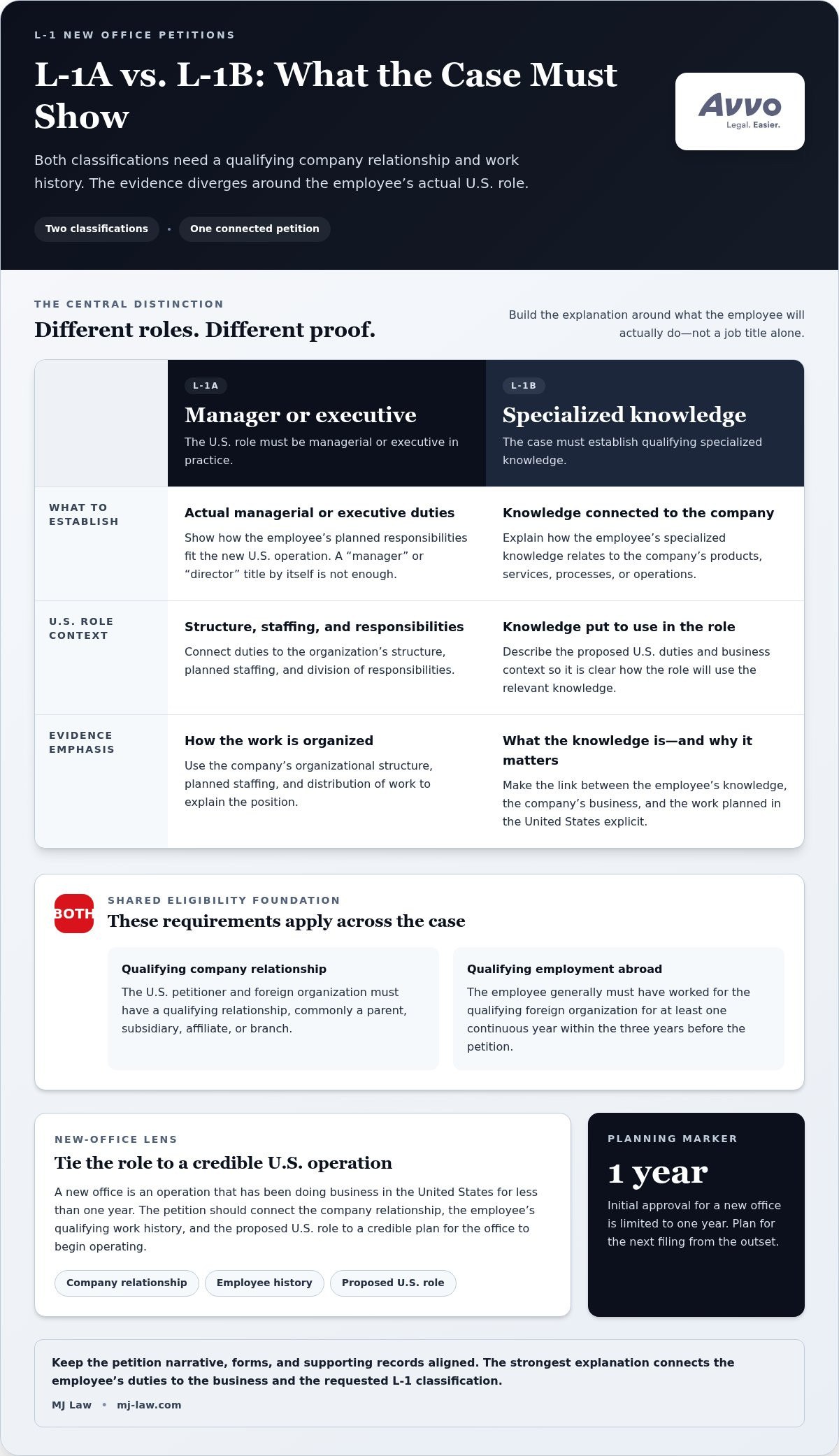
The L-1 category has two classifications. L-1A is for qualifying managers and executives; L-1B is for employees with qualifying specialized knowledge. Both require an eligible company relationship and qualifying employment history abroad. The L-1 visa overview introduces these classifications, but eligibility depends on the specific employer, employee, duties, and evidence.
What makes a U.S. office a new office?
USCIS defines a new office by its U.S. business-operation history, not simply by its incorporation date. The relevant organization must have been doing business in the United States through a parent, branch, affiliate, or subsidiary for less than one year. “Doing business” generally means regularly, systematically, and continuously providing goods or services. Having a U.S. agent or office alone does not establish that activity.
The proposed office’s physical premises and credible plans for actual business activity therefore matter. A startup and a foreign company opening a U.S. branch may have different launch circumstances, but each must show how the U.S. operation will function and support the employee’s proposed role.
How do L-1A and L-1B new-office cases differ?
For L-1A, the evidence should show that the employee’s actual U.S. duties are managerial or executive, not just that the job title says “manager” or “director.” The company’s organizational structure, planned staffing, and division of responsibilities help explain how the role fits the new operation.
For L-1B, the case must establish that the employee’s knowledge qualifies as specialized and explain how it relates to the company’s products, services, processes, or operations. The U.S. duties and business context should make that connection clear. For either classification, the employee generally must have worked for the qualifying foreign organization for at least one continuous year within the three years before the petition. Check current USCIS instructions for classification-specific requirements and evidence.
Eligibility is assessed across the case: the company relationship, the employee’s history, the proposed position, and the supporting documents must align. A strong explanation connects those facts rather than relying on a newly formed U.S. entity or a job title alone.
L-1 New Office Petition Requirements: Company, Employee, and U.S. Role
An L-1 new office case rests on three connected questions: Does the U.S. petitioner have a qualifying relationship with the foreign organization? Does the employee meet the required foreign-work history and role criteria? Do the proposed U.S. duties fit the business and the requested L-1 classification? A persuasive petition answers each question with consistent facts and supporting records.
What must the employer show about the company relationship?
The U.S. petitioner and foreign organization must have a qualifying relationship, commonly as a parent, subsidiary, affiliate, or branch. These terms describe ownership and control structures, not simply a business partnership or shared brand. For example, a U.S. subsidiary may be owned or controlled by its foreign parent, while a branch is part of the same legal organization rather than a separate company.
Useful records may include incorporation documents, ownership ledgers, organizational charts, operating agreements, and records showing who has authority over each entity. Names, ownership percentages, and dates should align across the records and petition. If documents use different names or describe the corporate structure differently, explain the discrepancy and provide records that clarify it.
How does the employee’s foreign work history fit?
The employee generally must have worked abroad for the qualifying organization for at least one continuous year within the three years preceding the petition. The foreign employment must also have been in a qualifying managerial, executive, or specialized-knowledge capacity. Check how the timing rule applies to the employee’s circumstances against current USCIS instructions, including any relevant periods spent in the United States.
Employment records establish when and where the person worked. Payroll records, personnel files, and employer letters can help document that history. Separate evidence should explain what the employee actually did. A title or payroll entry may show employment, but does not necessarily establish that the prior position met the relevant L-1 criteria.
Does the proposed U.S. position fit?
Describe the employee’s planned duties in enough detail to show how the role fits the U.S. operation. For a manager or executive, connect responsibilities to the organization’s structure and the work of other employees or business functions. For a specialized-knowledge employee, explain the relevant knowledge and how the U.S. role will use it. Job titles alone do not substitute for duties and business context.
USCIS provides classification-specific guidance, including new-office considerations, on its USCIS L-1A New Office Requirements page. Because the company structure, employee history, and U.S. role must fit together, employers developing an evidence strategy can schedule a discussion about L-1 petition planning.
Build an L-1 New Office Evidence Package Around the Business Plan
A persuasive L-1 new office petition relies on more than incorporation papers. The evidence should show how the U.S. operation will become active, how it relates to the foreign company, and why its planned work supports the employee’s proposed role. Use the business plan as the organizing thread, connecting each important statement to relevant records. The examples below are starting points, not a universal checklist or a promise of approval.
| What the petition needs to explain | Evidence that may help |
|---|---|
| Qualifying relationship between the foreign and U.S. organizations | Ownership records, formation documents, operating agreements, and organizational charts |
| Readiness to operate in the United States | Lease or other premises records, funding documentation, and applicable business licenses or setup records |
| Planned business activity | Relevant contracts, customer communications or pipeline information, service plans, and market research |
| Staffing and the employee’s proposed role | Hiring plans, organizational charts, job descriptions, and a detailed breakdown of expected duties |
Which documents can show the U.S. office is ready to operate?
Choose records that match the company’s actual launch stage. A signed lease may help establish that premises are secured; funding records can support the financial plan; and contracts or a documented client pipeline may illustrate intended activity, if available. A company preparing to provide services might explain what it will offer, who it expects to serve, and what steps are underway to begin operations. Make the plan concrete instead of submitting every possible document without explaining its relevance.
How should the petition explain the proposed position?
Show how the role fits the projected work and staffing structure. For an L-1A case, explain how the planned duties support a managerial or executive role as the office develops, using current USCIS standards and evidence about responsibilities and organizational context. For L-1B, identify the employee’s specialized knowledge and explain how the U.S. operation will use it. In either case, broad titles or generic job descriptions leave important questions unanswered.
Keep the narrative, business plan, and supporting records consistent. If the plan projects hiring, explain how that timeline relates to the employee’s responsibilities rather than presenting a staffing chart without context. A coherent package lets the reviewer follow the path from launch activity to the proposed role. Tailor the evidence to the company’s facts, and do not rely on a single document to establish the entire case.
How to Prepare and File an L-1 New Office Petition
A disciplined filing process helps keep the employer’s business plan, petition narrative, forms, and exhibits consistent. Prepare the case in sequence: confirm the facts, identify gaps, organize evidence, draft the explanation of the business and role, then review the complete package before submission. The goal is a clear account supported by records, not a collection of documents that leaves the reviewer to connect the dots.
What should the employer organize before drafting?
Start by gathering corporate and ownership records for both organizations, documents about the U.S. premises and launch, the employee’s foreign employment records, and a detailed description of the proposed U.S. duties. Build one timeline covering company formation, the U.S. office launch, the employee’s qualifying work history, and the proposed transfer. Resolve gaps or conflicting dates before drafting rather than filling them with assumptions.
Before filing, review this checklist:
- Confirm company names, addresses, ownership details, and organizational relationships across records.
- Check that the employee’s work-history dates and role descriptions match supporting personnel and payroll records.
- Align the U.S. job duties with the business plan, staffing projections, and operational needs.
- Verify the current USCIS form edition, filing instructions, required initial evidence, filing location, and fees.
Then review the petition narrative against every form and exhibit. If the business plan describes a role differently from the job description, or company records use inconsistent names, address the discrepancy clearly. USCIS may deny a petition when required initial evidence is missing, so a complete, orderly submission matters.
What should happen after filing and during the first year?
After filing, monitor case communications and respond to any USCIS request for additional evidence by the stated deadline. A request may seek clarification or supporting records. Address the issues raised directly rather than submitting unrelated documents.
Plan for the next filing from the beginning. An initial new-office petition approval period is one year, so retain records showing what the company actually did as it developed. These may include premises and operating records, contracts or other evidence of business activity, hiring and payroll records, and documentation of the employee’s actual duties. Compare progress with the business plan and keep explanations for material changes. Before an extension or later filing, verify current USCIS requirements, forms, and any applicable reporting obligations.
For help organizing the company facts, role evidence, and filing materials, schedule an L-1 petition planning discussion.
Plan the New Office L-1 Case With Counsel in San Jose
A well-prepared new-office case depends on how its parts fit together. The qualifying relationship between the foreign and U.S. organizations, the employee’s work history, the U.S. premises, and the proposed duties should tell one consistent story about the business and its plans. Reviewing each item in isolation can miss gaps, such as an ownership record that conflicts with the petition or job duties that do not match the launch plan.
For employers establishing operations in San Jose or San Francisco, immigration counsel can assess the company structure, employee qualifications, proposed role, and supporting records as a connected case. Counsel can identify where the narrative needs clearer documentation or a more precise explanation, then help shape an evidence strategy around the employer’s actual business stage. This preparation can strengthen the presentation, but no review or filing can guarantee an outcome.
What can an immigration attorney help the employer assess?
Case review can focus on whether company records support the stated relationship, whether employee documents establish both the work history and qualifying role, and whether the proposed U.S. duties make sense for the new operation. An attorney can also flag inconsistent names, dates, ownership details, or job descriptions before they create confusion in the filing. Employers seeking broader L-1A background can review an intracompany transferee guide alongside case-specific advice.
What should an employer prepare for an initial discussion?
A concise overview can make an initial discussion more focused. Gather or outline:
- The foreign and U.S. company structure, including ownership and control.
- The U.S. office launch plan, premises, expected business activity, and staffing timeline.
- The employee’s foreign role history and proposed U.S. duties.
- Key filing dates, business milestones, and questions about the transfer.
These details help counsel understand what the business intends to do and where supporting records may be needed. MJ Law has assisted individuals, families, and businesses with immigration matters for more than three decades, including L-1 and other employment-based visa matters. Employers planning a transfer can schedule an immigration consultation to discuss their circumstances and next steps.
Move Forward With a Clear L-1 Filing Plan
A strong L-1 new office petition connects the qualifying company relationship, the employee’s work history, and the proposed U.S. role to a credible plan for the office. Organize evidence around those requirements, keep company records and petition details consistent, and plan from the outset for the first-year filing. These steps help present a coherent case, though approval depends on the facts and applicable requirements.
For employers preparing to launch or expand in the United States, case-specific legal guidance can help identify evidence gaps and bring business plans, role requirements, and supporting records together. MJ Law has assisted clients with immigration matters for more than three decades and handles L-1 and other employment-based visa matters. Consultations are available in English and Spanish.
Schedule a consultation about your L-1 new office petition to discuss your company’s circumstances and potential next steps. With careful preparation and a clear plan, you can approach the filing and the office’s first year with greater confidence.
Frequently Asked Questions
What is an L-1 new office petition?
An L-1 new office petition requests approval to transfer an eligible employee from a qualifying foreign organization to a related U.S. operation that has been doing business in the country for less than one year. The company must establish the qualifying relationship, the employee must meet the applicable work-history and role criteria, and the proposed U.S. office must be supported by credible business plans and evidence.
Can a startup qualify for an L-1 new office petition?
Yes, a startup may qualify if it is connected to a qualifying foreign organization and meets the relevant employer and employee requirements. Incorporating a U.S. company alone is not enough. The petition should also explain how the business will operate, support the employee’s proposed role, and develop during its first year. Premises, funding plans, anticipated activity, and staffing projections may help show the launch is credible.
How long must an employee have worked abroad for an L-1 petition?
Generally, the employee must have worked for the qualifying organization abroad for at least one continuous year within the three years preceding the petition. The prior employment must also have been in a qualifying managerial, executive, or specialized-knowledge capacity. Personnel records and payroll evidence can help establish dates of employment, while detailed role descriptions and organizational information can explain the employee’s responsibilities abroad.
What evidence is needed for an L-1 new office petition?
Evidence depends on the company’s structure, launch plans, and the employee’s role. It may include ownership and entity records, documents for the U.S. premises, funding information, a business plan, staffing projections, and records of planned business activity. The employee’s foreign work history and proposed U.S. duties also need support. Employers in San Jose and San Francisco should organize documents around their specific operations, not rely on a generic checklist.
How long is an initial L-1 new office approval valid?
An initial approval for a new office is valid for one year. The employer should plan for that limited period from the start by keeping records of actual business activity, staffing, premises, and the employee’s duties as the operation develops. These records can help show how the office progressed in relation to its business plan. Check extension requirements and filing procedures against current USCIS guidance.
What happens if USCIS requests more evidence for a new office petition?
If USCIS issues a Request for Evidence, the employer should read the notice carefully, identify each question, and submit a focused response with supporting documents by the stated deadline. The response should clarify the specific gaps raised and remain consistent with the original petition. A request does not determine the final outcome, so assess the notice and available records before preparing a response.
Can an L-1 new office petition be filed for an L-1A or L-1B employee?
Yes. A new-office petition may seek L-1A classification for a qualifying manager or executive, or L-1B classification for an employee with qualifying specialized knowledge. The case must explain how the employee’s actual duties fit the chosen category and the needs of the U.S. operation. A title alone does not establish eligibility. Verify the applicable classification requirements and evidence under current USCIS instructions.