What if the strongest part of your résumé still leaves an O-1A petition short on proof? A list of awards, publications, or leadership roles may look impressive, but each achievement needs evidence that shows its relevance and significance. This O-1A visa evidence checklist will help you turn a collection of credentials into a clear, supported case.
It can be difficult to tell which documents fit each criterion or whether an accomplishment carries enough weight. Start by matching each claim to the regulatory criteria, then gather records that establish what happened and provide context for why it matters. This guide offers a practical way to organize evidence, assess what it demonstrates, and identify gaps before filing.
You’ll find a checklist mapped to the O-1A criteria, guidance on documenting impact, and a review of key petition components. A careful assessment can clarify what your record supports and where more context may be needed.
Key Takeaways
- Use the O-1A visa evidence checklist to map achievements to the applicable criteria and identify records that support each claim.
- Pair primary documents with independent corroboration to show the context, significance, and impact of your work.
- Review the eight evidence categories and the major internationally recognized award alternative against current regulatory requirements.
- Check that the proposed work, petitioner details, agreement, itinerary where applicable, and consultation evidence are consistent.
- Legal review can help assess evidence gaps and organize a petition. MJ Law provides immigration guidance from its San Jose office.
O-1A visa evidence checklist: start with the eligibility framework
The O-1A is a temporary, employment-based nonimmigrant classification for individuals with extraordinary ability in the sciences, education, business, or athletics. A petition must show that the person has sustained national or international acclaim and is coming to the United States to continue work in the area of extraordinary ability. For a general overview of the category and how it differs from O-1B, see this explanation of the O-1 visa.
In most cases, the evidence must establish either a major, internationally recognized award or at least three of the eight evidentiary criteria in the regulation. Meeting three criteria is an evidence threshold, not an automatic finding of eligibility. USCIS also considers whether the record as a whole supports the required level of acclaim and the petition’s proposed work. The O-1A visa evidence checklist is a tool for organizing proof against the legal framework, not a prediction or guarantee of approval.
Who may use the O-1A evidence checklist?
This checklist is for people whose work falls within science, education, business, or athletics, as well as the U.S. employer or agent preparing a petition on their behalf. O-1A covers these fields; O-1B has separate standards for work in the arts and in motion picture or television productions. A U.S. employer or agent generally files the petition, rather than the beneficiary filing independently. The petitioner, proposed work, and supporting evidence therefore need to align.
What does extraordinary ability mean in an O-1A petition?
Extraordinary ability requires more than a record of strong performance. The evidence should help show sustained recognition in the relevant field. A major achievement may establish what the person accomplished, but the petition must also explain why it matters and how others in the field recognize its significance. For example, records identifying a person’s role in a technical contribution, combined with independent evidence of its importance or adoption, can help establish both points.
Keep two questions distinct: What did the person achieve? and What does the record show about recognition and standing in the field? The checklist helps organize evidence for both, but the weight and relevance of each item depend on the specific case. Readers comparing related extraordinary-ability options can also consult MJ Law’s published EB-1A extraordinary-ability guide. O-1A and EB-1A are separate immigration pathways, so evidence or eligibility for one shouldn’t be treated as automatic qualification for the other.
The eight O-1A evidence criteria: documents to gather for each
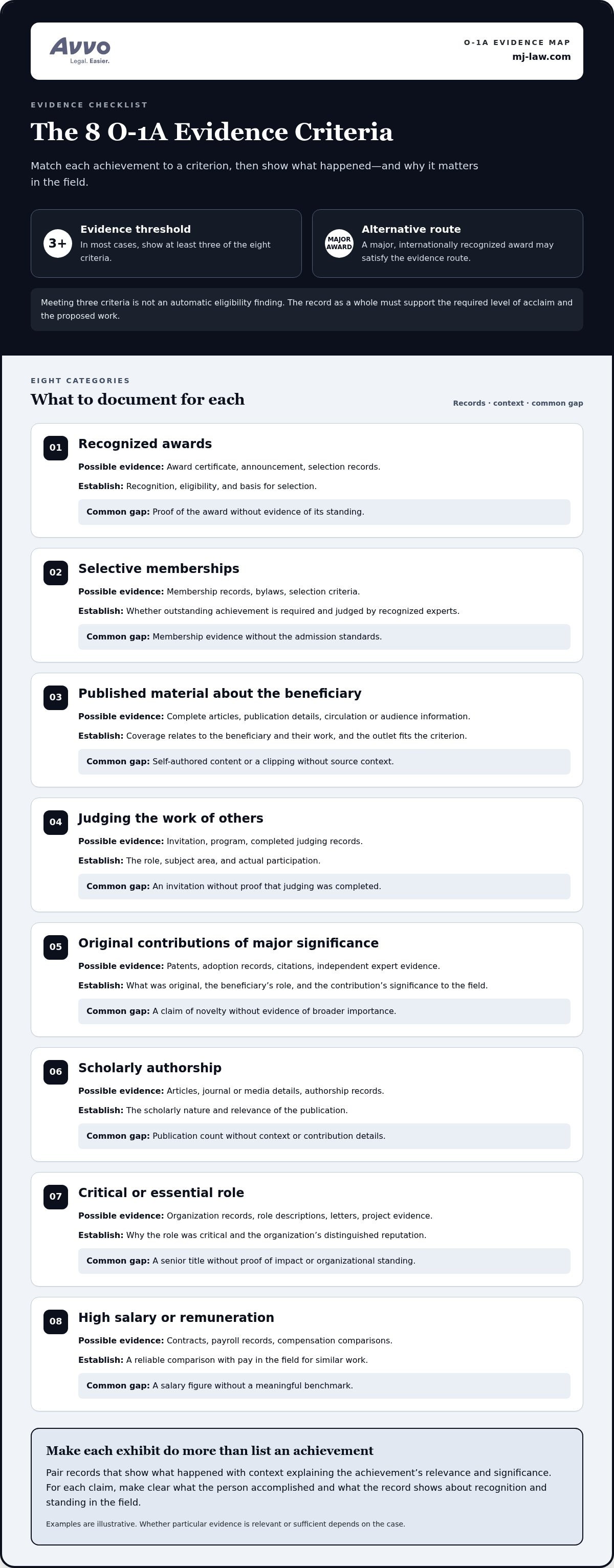
The O-1A regulation lists eight types of evidence. The official O-1A eligibility criteria describe the categories. Use the table to match each claimed achievement with records and the context needed to explain its significance. These examples are illustrative, and whether particular evidence is relevant or sufficient depends on the case.
| Criterion | Possible evidence | Context to establish | Common gap |
|---|---|---|---|
| Recognized awards | Award certificate, announcement, selection records | Recognition, eligibility, and basis for selection | Proof of award without evidence of its standing |
| Selective memberships | Membership records, bylaws, selection criteria | Whether membership requires outstanding achievement judged by recognized experts | Membership alone, without admission standards |
| Published material about the beneficiary | Complete articles, publication details, circulation or audience information | Coverage relates to the beneficiary and their work; outlet fits the criterion | Self-authored content or a clipping without source context |
| Judging others’ work | Invitation, program, completed judging records | Role, subject area, and actual participation | Invitation without proof judging was completed |
| Original contributions of major significance | Patents, adoption records, citations, independent expert evidence | What was original, the beneficiary’s role, and significance to the field | Novelty claimed without evidence of broader importance |
| Scholarly authorship | Articles, journal or media details, authorship records | Scholarly nature and relevance of the publication | Publication count without context or contribution details |
| Critical or essential role | Organization records, role descriptions, letters, project evidence | Why the role was critical and the organization’s distinguished reputation | Senior title without proof of impact or organizational standing |
| High salary or remuneration | Contracts, payroll records, compensation comparisons | Reliable comparison with pay in the field for similar work | Salary figure without a meaningful benchmark |
Awards, memberships, published material, and judging
For these categories, keep original records and evidence that explains how the recognition was earned. A membership certificate, for example, may establish membership but not selectivity. Include the criteria and review process. For media coverage, retain the full article and publication details so the reader can assess its author, outlet, and relevance. For judging, document the event or process and completed participation, not only an invitation.
Original contributions, scholarly work, critical roles, and high remuneration
Show the connection between the beneficiary’s work and its importance. Citations or publication records can document scholarly output, but raw counts don’t establish major significance. Adoption records may show that a contribution was used, while organizational documents can clarify why a role was critical. Compensation records need reliable comparisons. Company or project metrics also need context linking them to the beneficiary’s own work.
Organizing records this way can expose gaps between an achievement and the proof supporting it. To discuss your evidence strategy, schedule an immigration consultation.
How to prove impact: make each O-1A exhibit persuasive
Impressive credentials alone don’t explain how a particular criterion is met. Each exhibit should connect a specific claim to evidence, then show why that evidence matters in the beneficiary’s field. Evidence of impact needs context because a document can confirm an achievement without showing its significance.
Use a repeatable sequence: state the claim, provide the primary record, add independent validation, explain the field context, and connect the evidence to the petition. For example, a product launch record establishes that the launch occurred. Dated project documents may clarify the beneficiary’s role, while independent adoption records or field coverage can help show the work’s broader relevance.
Contemporaneous materials can make that sequence clearer. Keep dated drafts, project records, correspondence, conference programs, or implementation documents created during the work, rather than relying only on summaries prepared later. The University of Washington’s O-1A document checklist is another reference for organizing petition materials. Your evidence strategy still needs to fit the individual record.
Build an evidence matrix before drafting
Before writing the petition narrative, create a row for each claimed criterion. Record the achievement, primary documents, independent corroboration, field context, and unresolved questions. This matrix helps identify thin claims and organize exhibits around what they demonstrate, rather than their format.
- Check for gaps: Flag unsupported descriptions such as “leading” or “groundbreaking,” unclear dates, missing source information, and documents that need translation.
- Review overlap: One exhibit may support distinct claims for different reasons. Explain each connection. Don’t assume a document proves multiple criteria simply because it appears in multiple places.
- Keep the record traceable: Use consistent exhibit labels and retain enough source details for a reviewer to understand where each item came from.
This is the practical value of an O-1A visa evidence checklist: it helps reveal whether each claim has supporting evidence and whether the petition explains what that evidence establishes.
Use letters and comparable evidence carefully
Expert letters are most useful when they explain specific work, the beneficiary’s contribution, and why the result matters, using details that can be checked against records. General praise without concrete examples is less informative. Treat letters as context and corroboration, not substitutes for objective documents that independently record the achievement.
The regulation also allows comparable evidence when a listed criterion does not readily apply to the beneficiary’s occupation. This isn’t a general shortcut around the criteria. Explain why the standard category does not fit and how the alternative evidence demonstrates comparable eligibility. Legal review can help assess that fit and identify gaps before filing.
O-1A petition readiness checklist: review the record before filing
A well-organized evidence record is only one part of a complete petition. Before filing, check that the petitioner, proposed work, supporting documents, and filing materials tell a consistent story. Use this sequence to review the packet, then confirm current requirements with USCIS instructions and regulations before submission.
Check the petitioner, work, and required supporting materials
- 1. Confirm the petitioner and proposed work. Identify the U.S. employer or agent filing the petition. Make sure the beneficiary’s role and proposed activities are described consistently in the petition, agreements, itinerary, and supporting letters.
- 2. Review the agreement. Include the written contract between the petitioner and beneficiary, or a summary of the terms of an oral agreement, as applicable. Check that it reflects the actual working arrangement and matches the petition’s description of the work.
- 3. Check the itinerary where required. If the petition involves events or activities at multiple locations, review the itinerary and related evidence against current regulatory requirements. Dates, locations, and activities should fit the proposed work and contract.
- 4. Confirm consultation evidence. Review whether a written advisory opinion from the appropriate peer group, labor organization, or expert is required for the case. Include the applicable evidence or address an applicable exception under current rules.
- 5. Verify filing details. Before submission, check the current Form I-129 edition, filing instructions, filing location, fees, and timing requirements. These details can change, so don’t rely on an older checklist or a previously filed petition.
Audit exhibits for clarity and consistency
Make the record easy to follow. Create a numbered exhibit index with descriptive labels and a short note explaining what each item supports. The index should let a reviewer move from a claim in the petition to the document that supports it without searching through unrelated material.
- 6. Check names, dates, and roles. Compare spellings, employment dates, titles, and organizational descriptions across letters, contracts, publications, and other records. Resolve differences or explain them clearly.
- 7. Review document quality. Confirm that each exhibit is legible, complete, and traceable to its source. Include required translations and any necessary translator certification, and make sure the translated material corresponds to the original.
- 8. Run a final consistency check. Confirm that the petition narrative, itinerary, agreements, and evidence describe the same proposed work and beneficiary role. Remove duplicate or outdated versions that could create confusion.
A final review can uncover gaps that are easy to miss during document collection. For a case-specific review of your evidence and filing structure, schedule an O-1A consultation.
When O-1A legal guidance can strengthen your evidence strategy
A completed checklist can organize the record, but it can’t determine by itself whether each document supports the criterion you’re relying on or whether the petition presents a coherent case. Legal review can help assess how achievements fit the applicable criteria, where evidence needs stronger context or independent corroboration, and whether the proposed work and petitioner structure are described consistently.
What a focused O-1A evidence review can address
A focused review looks beyond whether documents are present. It can examine how the evidence supports each claim, whether the petition explains the beneficiary’s individual role, and whether the record tells a consistent story. For example, if a letter describes a contribution as influential, related project records or independent evidence may clarify what changed and why it mattered.
Review can also surface gaps that are easier to address before filing, such as missing dates, unclear sources, or materials that describe the beneficiary’s role differently. The goal is to identify what the current record establishes, what may need more explanation, and whether the proposed work aligns with the supporting documents. No review can promise a particular USCIS decision.
Discuss your O-1A evidence checklist with MJ Law
For a productive discussion, prepare your résumé, a concise summary of the proposed U.S. work, and a preliminary evidence matrix linking achievements to possible criteria. Include questions about documents you’re unsure how to frame. These materials provide a practical starting point, while eligibility and strategy depend on the specific facts and current law.
MJ Law is an immigration law firm in San Jose serving individuals, families, and businesses with immigration matters, including work visas and entertainment and artist visas. The firm’s history dates to 1985, and consultations are available in English and Spanish. A legal review can help assess how your O-1A visa evidence checklist fits the petition’s overall structure and where further context may be useful.
To discuss your evidence record and possible next steps, schedule a consultation with MJ Law.
Turn your evidence into a clear next step
A strong O-1A petition does more than list career milestones. It connects each claimed criterion to reliable evidence, explains the achievement’s significance, and presents a consistent account of the proposed work. Use the O-1A visa evidence checklist to organize documents and spot gaps, then review the record as a whole before filing.
Legal guidance can help assess criterion fit, identify where context or corroboration may be needed, and check that the petitioner and supporting materials align. MJ Law serves clients in San Jose and San Francisco and has more than three decades of experience assisting individuals, families, and businesses with immigration matters. Consultations are available in English and Spanish.
Every petition depends on its individual facts. Careful preparation can help you understand the strengths and open questions in your record. To discuss your evidence and next steps, schedule an O-1A consultation.
Frequently Asked Questions
What evidence is needed for an O-1A visa?
An O-1A petition generally documents a major, internationally recognized award or evidence meeting at least three of eight regulatory categories. These include recognized awards, selective memberships, published material about the beneficiary, judging others’ work, original contributions of major significance, scholarly authorship, critical roles, and high salary or remuneration compared with others in the field. Gather primary records and corroboration, then explain what each item establishes. The O-1A visa evidence checklist can help organize the record.
How many O-1A criteria do you need to meet?
Generally, the petition must establish at least three of the eight evidentiary criteria, unless the beneficiary has received a major, internationally recognized award that qualifies as an alternative. Meeting the numerical threshold doesn’t resolve the entire eligibility question. USCIS considers the evidence as a whole, including whether it supports the required level of extraordinary ability and recognition. Select criteria your documents genuinely support, rather than stretching evidence to fit a category.
Can a startup founder qualify for an O-1A visa?
Yes, a startup founder may qualify if the evidence demonstrates the required extraordinary ability and satisfies the applicable O-1A framework. A founder’s title or company ownership alone doesn’t establish eligibility. Evidence might document an original contribution, a critical role, or other criteria, but it must clarify the founder’s individual work and its significance. The petition also needs an eligible U.S. petitioner, such as an employer or agent, and a defined proposed work arrangement.
What happens if my achievements do not fit the listed O-1A criteria?
The regulation allows comparable evidence to be considered when the listed criteria don’t readily apply to the beneficiary’s occupation. This isn’t a blanket exemption from demonstrating extraordinary ability. Explain why a particular criterion doesn’t fit and how the alternative evidence is comparable in showing eligibility. The relevance of this approach depends on the occupation and evidence, so assess the regulatory fit carefully rather than assuming any impressive achievement can substitute.
Do recommendation letters count as O-1A evidence?
Yes, recommendation or expert letters can support an O-1A petition by explaining the beneficiary’s role, contribution, and standing in the field. Strong letters give specific examples and verifiable context rather than relying on general praise. They’re most useful alongside objective records, such as project documents, publications, adoption evidence, or judging records. A letter may help interpret an achievement, but it shouldn’t replace documents that independently establish what happened.
Does meeting three O-1A criteria guarantee approval?
No. Meeting three criteria doesn’t guarantee approval or automatically establish overall eligibility. USCIS evaluates the petition’s evidence in context, including how persuasive and relevant it is and whether the record supports the required extraordinary ability. A packet may cite enough categories but still need clearer evidence of the beneficiary’s role, recognition, or the significance of achievements. A careful review can help identify weak links and improve the explanation, but no evidence strategy can promise an outcome.
What documents should I bring to an O-1A lawyer consultation?
Bring your résumé, a concise summary of the proposed U.S. work, and a preliminary evidence matrix connecting achievements with possible criteria. Add key supporting records, such as award documentation, articles, contracts, project evidence, compensation records, or expert letters, plus questions about unclear items. You don’t need a finished petition to begin discussing the case. MJ Law serves immigration clients in San Jose and San Francisco, with consultations available in English and Spanish.