Your competition calendar is set, but one question remains: does your record show the international recognition a U.S. petition requires? For athletes planning to compete in or near Silicon Valley, a P-1 athlete visa attorney San Jose can assess how your achievements relate to a specific U.S. competition and identify gaps in the supporting record.
It’s understandable to feel uncertain. Awards, rankings, media coverage, and career history may all be relevant, but the P-1A standard focuses on whether an athlete has achieved recognition substantially above what is ordinarily encountered. An athlete cannot file the petition alone. A U.S. employer, agent, or sponsoring organization must petition on the athlete’s behalf, so the proposed competition and petitioner are important parts of the case.
This guide explains the P-1A process, the petitioner’s role, and evidence that may help establish eligibility. You’ll learn how to assess strengths and gaps in your record, prepare for timing concerns, and evaluate legal counsel for relevant immigration experience and clear communication. The goal is a more informed plan for competing in the United States.
Key Takeaways
- Learn how P-1A differs from P-1B and why the distinction matters when identifying the right visa path.
- Assess whether your recognition evidence supports eligibility and connects clearly to the proposed U.S. competition.
- Organize competition plans, petitioner information, contracts, and a career chronology before discussing your case.
- Evaluate a P-1 athlete visa attorney San Jose based on relevant experience, evidence strategy, and communication.
- Understand how local counsel can support communication while keeping expectations realistic about USCIS decisions.
What a P-1 Athlete Visa Attorney in San Jose Can Help You Assess
A P-1A case is not simply a request to work in the United States. It must connect an athlete or team’s international recognition to a defined U.S. competition and a qualifying petitioning arrangement. An initial case review considers the athlete’s record alongside the event, the petitioner, and the documents supporting the planned activity.
Quotable definition: P-1A is a temporary U.S. classification for internationally recognized athletes and teams coming to compete. It is not a general work visa granted solely because someone has a strong reputation or wants to work in the United States.
P-1A is distinct from P-1B, which applies to qualifying members of internationally recognized entertainment groups. A broader overview of the categories is available in P Visa Classifications. For eligibility and filing requirements, athletes and petitioners should consult current USCIS guidance.
Who may qualify for P-1A classification?
For an individual athlete, “internationally recognized” means more than being known within a local club or having an impressive résumé. The standard focuses on a high level of achievement and recognition substantially above that ordinarily encountered in the sport. A team’s case centers on the team’s international recognition. The relevant evidence and criteria depend on the facts, so review the detailed requirements against current USCIS guidance.
Achievements need context. A ranking, championship result, or media profile may support the case, but it should help explain the athlete’s standing and relevance to the proposed competition. No single credential establishes eligibility in every case.
What does an attorney review at the outset?
A P-1 athlete visa attorney San Jose can assess whether the athlete’s evidence, competition, and petitioner form a coherent case. An initial review may consider:
- Competition plans: What event or season is proposed, and what activities will the athlete perform?
- Petitioner identity: Which U.S. employer, agent, or sponsoring organization would file the petition?
- Contracts and itinerary: Do available agreements and schedule details support the planned competition?
- Existing evidence: What records document recognition, and where are there gaps or unanswered questions?
This assessment helps identify information that needs clarification or additional support. It cannot guarantee USCIS approval or replace a review of the full facts under current rules. For athletes and representatives in San Jose and Silicon Valley, MJ Law offers immigration consultations in English and Spanish. A consultation can help clarify the case before competition or travel plans depend on it.
How a P-1A Attorney Builds an Athlete’s Evidence Record
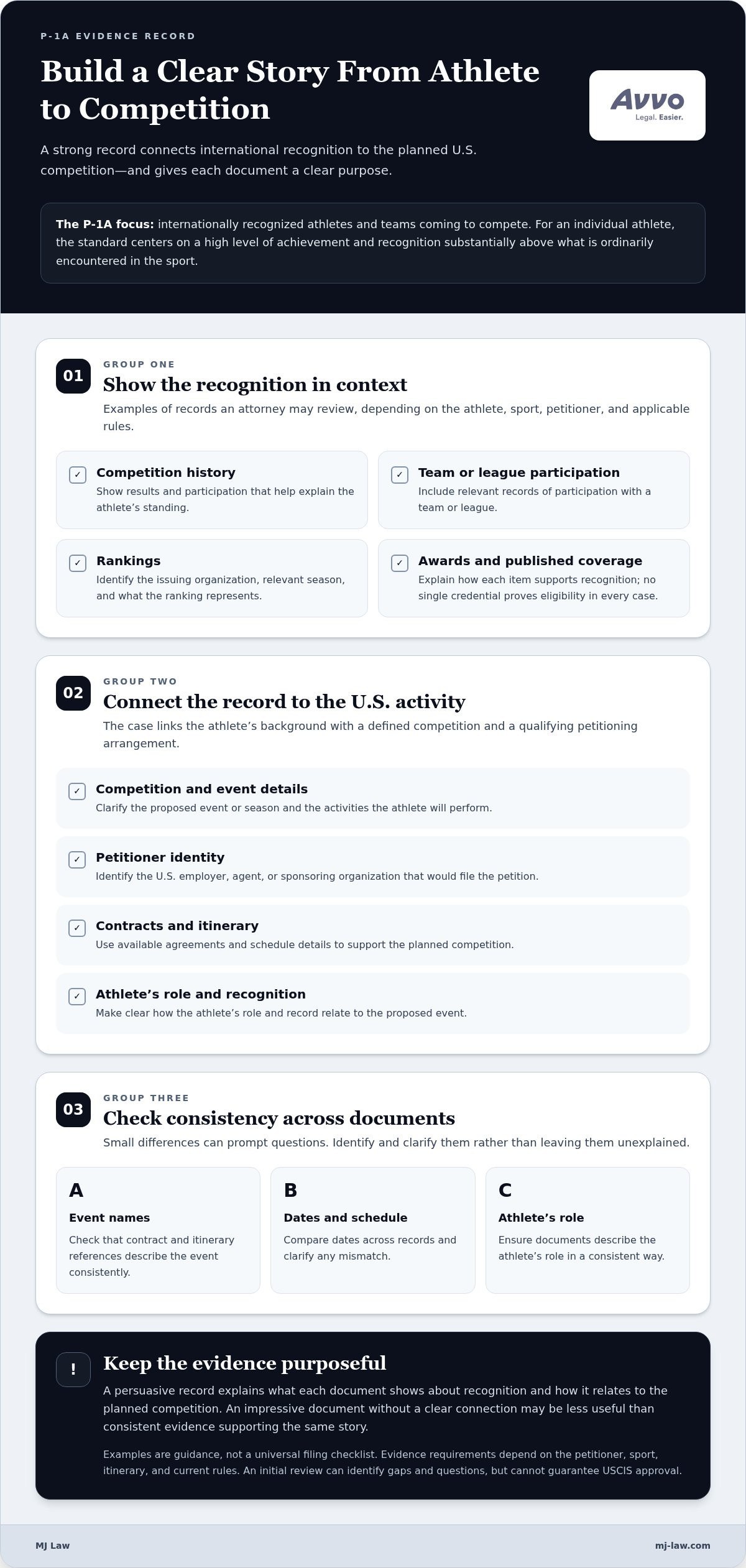
A persuasive P-1A record does more than collect awards and press coverage. It explains what each document shows about the athlete’s recognition and how that recognition relates to the planned U.S. competition. Contracts, event details, itinerary information, and career records may all be relevant, but there is no universal document list for every case.
Quotable takeaway: Consistent evidence that supports the same story is more useful than an impressive document with no clear connection to the athlete’s eligibility or proposed competition.
Which records may support international recognition?
Depending on the athlete, sport, petitioner, and applicable rules, an attorney may review competition history, participation with a team or league, rankings, awards, and published coverage. The value of each item depends on its context. For example, a ranking is easier to assess when the record identifies the issuing organization, the relevant season, and what the ranking represents.
No single award, article, or result should be treated as automatic proof of eligibility. The Official P-1A Athlete Requirements explain the current government criteria. Consult them when reviewing evidence categories and any applicable consultation requirements. Those requirements can depend on the case, so confirm them against current USCIS guidance before filing.
How should the petition connect evidence to the event?
The record should let a reviewer follow the case from the athlete’s background to the proposed U.S. activity. Counsel may compare the athlete’s role and recognition with the event details, competition dates, petitioner, contracts, and itinerary, where applicable. Each document should have a clear purpose in that account.
Small inconsistencies can prompt questions. A contract may use a different event name from the itinerary, dates may not align across records, or documents may describe the athlete’s role differently. These issues aren’t necessarily decisive, but identify and clarify them rather than leaving them unexplained. Evidence requirements vary with the petitioner, sport, itinerary, and current rules, so treat examples as guidance, not a filing checklist.
A P-1 athlete visa attorney San Jose can help organize the record, identify missing information, and explain which questions need attention before filing. An initial review assesses the materials, but does not promise an outcome. Athletes and representatives can arrange an immigration consultation to discuss their circumstances and next steps.
P-1A, P-1B, or Another Visa: Which Route Fits an Athlete?
Visa categories can sound similar while addressing different kinds of work and evidence. Start with the actual U.S. activity, the athlete’s record, and the proposed petitioner, rather than assuming one route will be easier to obtain. This comparison is a starting point, not an eligibility decision. Individual circumstances and current law matter.
| Route | General focus | Question to consider |
|---|---|---|
| P-1A | Qualifying internationally recognized individual athletes or athletic teams | Does the evidence support the relevant recognition standard and connect to the planned competition? |
| P-1B | Qualifying members of internationally recognized entertainment groups | Is the proposed work part of an eligible entertainment group rather than an individual athletic competition? |
| O-1 | Individuals whose work may fit the O-1 classification’s distinct standards | Do the person’s qualifications and planned U.S. activity align with O-1 requirements? |
| EB-1A | A potential longer-term immigration option for individuals who may qualify under its separate criteria | Is longer-term planning relevant, in addition to permission for a specific period of competition? |
How does P-1A differ from P-1B?
P-1A addresses qualifying athletes and teams; P-1B concerns qualifying entertainment groups. Their similar labels do not make their eligibility standards interchangeable. An individual athlete shouldn’t consider P-1B simply because an event includes performers or entertainment elements. The legal framework sets out category-specific terms in the Federal Regulations for P-1 Visas, which should be read alongside current agency guidance.
When should an athlete compare P-1A with O-1?
Comparing O-1 may be useful when an athlete’s qualifications and proposed U.S. activities raise questions about more than one category. P-1 and O-1 have distinct standards and petition considerations, so neither is universally better. A P-1 athlete visa attorney San Jose can assess the athlete’s evidence, event, and petitioner against the requirements instead of treating perceived approval odds as a selection strategy.
For longer-term planning, an EB-1A extraordinary-ability guide may help explain a separate employment-based option. It does not replace an assessment of the immediate competition plan, and potential eligibility must be reviewed independently. Compare each route’s requirements with the athlete’s record and goals, then confirm the analysis under current law.
What to Prepare Before Hiring a P-1 Athlete Visa Attorney
Being organized can make an initial conversation more productive. You don’t need a finished petition or to decide which visa category applies. The goal is to give counsel a clear picture of the athlete, the planned competition, and the questions that need review. Use this sequence to prepare for discussion, not as legal advice or a filing checklist.
- Write a concise athlete biography. Include the sport, teams or leagues, major competitions, awards, rankings, and relevant published coverage. Add dates and context where possible so counsel can understand how the career has developed.
- Outline the U.S. competition plans. List proposed events, locations, dates, the athlete’s expected role, and travel needs. Mark what’s confirmed and what remains tentative.
- Identify the potential petitioner. Note the U.S. employer, agent, team, or other organization involved, along with the person who can explain the arrangement and planned activities.
- Gather existing supporting materials. Collect copies of relevant contracts, event information, itinerary drafts, and career records. Keep originals secure and ask counsel how to share documents rather than sending original records unnecessarily.
- Summarize current immigration context and questions. Note relevant status or travel details, upcoming deadlines, and uncertainties you want addressed. A dated timeline can help connect competition plans with travel and preparation needs.
Which questions help you evaluate prospective counsel?
Use the discussion to understand both the legal analysis and the working relationship. Ask who would manage the petition, how counsel evaluates evidence gaps, what information may still be needed, and how you’ll receive updates. Clarify the responsibilities of the athlete, petitioner, and legal team.
Ask how counsel will approach timing, including what depends on the petitioner, event schedule, and available documents. Don’t rely on processing estimates without checking current information. You can also ask how risks and possible options will be explained, and what happens if plans or dates change. Clear answers should help you understand the next steps without implying a guaranteed decision.
For athletes and representatives in San Jose and Silicon Valley, a local consultation can make it easier to discuss plans and documents directly. Preparing this information helps a P-1 athlete visa attorney San Jose assess the specific case rather than offer a general answer. When you’re ready to discuss competition plans and petitioner details, schedule an immigration consultation.
Choosing a P-1 Athlete Visa Attorney in San Jose and Taking the Next Step
The right legal fit is about more than finding someone who handles immigration matters. Look for counsel who can discuss P-visa experience, explain how the athlete’s evidence relates to the planned competition, and clarify what the athlete, team, agent, and U.S. petitioner each need to do. A P-1 athlete visa attorney San Jose should explain case-specific questions clearly, including what remains uncertain and what information may be needed.
How can you assess whether an attorney is the right fit?
Ask how the attorney approaches eligibility, evidence gaps, petitioner roles, and potential issues in a case like yours. Find out who will manage the petition and how the attorney will coordinate with the athlete, team, agent, or proposed U.S. petitioner. Clear answers about communication, updates, and responsibilities help you decide whether the working relationship suits your needs.
Ask about consultation language options and how questions will be handled during the matter. MJ Law offers consultations in English and Spanish and handles P visa matters. The firm has assisted immigration clients for more than three decades, and Gabriel Jack handles P visas.
Firm profiles and client reviews can provide background, but they can’t predict how USCIS will decide an individual petition. MJ Law’s profile has reported more than 400 Google reviews and a 4.8 rating. Treat reviews as one point of reference, not evidence of a likely case outcome.
What are the next steps for San Jose athletes and petitioners?
Before reaching out, prepare a concise summary of the competition plan, likely petitioner, key dates, travel needs, and available evidence. Then ask how counsel would assess the facts, identify questions to resolve, and explain each party’s responsibilities. Local counsel in San Jose can make communication more accessible for athletes and representatives in Silicon Valley, but location alone doesn’t establish legal fit.
An attorney can assess individual circumstances and explain possible options, but no lawyer can promise USCIS approval or processing times. To discuss your athlete’s plans and circumstances, schedule a P-1 consultation with MJ Law.
Plan Your Next Step With a Clearer P-1A Strategy
A sound P-1A plan connects the athlete’s recognition, the proposed U.S. competition, and the petitioner. The evidence should tell a consistent story, and the visa category should fit the athlete’s circumstances, not a perceived shortcut. Choosing a P-1 athlete visa attorney San Jose also means looking for relevant experience, a clear evidence strategy, and communication that makes responsibilities and uncertainties understandable.
MJ Law handles P visa matters for internationally recognized athletes and performers and offers consultations in English and Spanish. The firm profile has reported more than 400 Google reviews and a 4.8 rating. Reviews don’t predict the outcome of an individual case.
Before a conversation, gather your competition plans, petitioner details, timeline, and available records. Then discuss how those facts may shape your options and what questions remain. Schedule a consultation to discuss your P-1 athlete visa situation with MJ Law.
Frequently Asked Questions
Can an individual athlete qualify for a P-1A visa?
Yes, P-1A classification may cover an individual athlete or a qualifying team, provided the applicable international-recognition standard is met. Relevant evidence depends on the athlete’s record, proposed competition, and petitioning arrangement. A ranking, award, or other single achievement doesn’t guarantee eligibility on its own. An attorney can assess how the available facts fit together, and athletes should confirm current eligibility criteria with U.S. Citizenship and Immigration Services (USCIS).
Does a P-1A petition require a U.S. employer or petitioner?
Generally, a P-1A case requires a qualifying U.S. petitioner, such as an employer, agent, or sponsoring organization, depending on the arrangement. Who files and which contracts or event details are relevant can vary by case. Identify the proposed petitioner early and have counsel review the structure before filing. Confirm current petitioner rules and filing requirements with USCIS rather than relying on a general description.
What evidence is needed for a P-1A athlete visa?
Potential evidence includes contracts, competition details, an itinerary, and records supporting the athlete’s recognition and participation history. The exact documents depend on the circumstances and current USCIS requirements, so there isn’t one checklist for every athlete. Organize records to consistently identify the athlete, their role, events, and petitioner. An attorney can review the materials, explain which evidence may be relevant, and flag gaps to address.
How long can a P-1A athlete stay in the United States?
The permitted stay depends on the petition, planned competition or event, and current immigration rules. A duration stated in an older article shouldn’t be treated as a promise for an individual case. Before setting travel or competition plans, confirm the requested period, admission documents, and any extension rules with qualified counsel and current USCIS or consular guidance. Review the petition and travel documents in light of the athlete’s specific plans.
Can a P-1A athlete bring a spouse and children to the United States?
Certain spouses and unmarried children may qualify to seek dependent P status, depending on current requirements and their individual circumstances. Their status is separate from the athlete’s petition, and work authorization rules may differ from those for the principal athlete. Families should confirm eligibility, application steps, and current work restrictions with an attorney or official government guidance before making travel or employment plans. Don’t assume dependent status is automatic.
How is a P-1A visa different from a P-1B visa?
P-1A is the classification for qualifying athletes and athletic teams, while P-1B concerns qualifying members of internationally recognized entertainment groups. These categories aren’t interchangeable, even though both are part of the P visa framework. Athletes should assess the facts and evidence relevant to P-1A rather than relying on a broad description of P visas. Confirm current category requirements before filing, since eligibility depends on the specific circumstances.
Why hire a P-1 athlete visa attorney in San Jose?
An attorney can review the athlete’s circumstances, petitioner, competition plan, and supporting evidence, then explain responsibilities and potential gaps. For people searching “P-1 athlete visa attorney San Jose,” local access may make communication more convenient, but it can’t guarantee an outcome. Ask about P-visa experience, case management, and how risks will be explained. MJ Law handles P visa matters and offers consultations in English and Spanish.