
An O-1 approval is a useful starting point, not a green card forecast. If you’re considering an O-1 to EB-1A transition, your existing record may contain evidence relevant to an EB-1A petition, but it must be assessed against that category’s requirements. Prior approval alone doesn’t establish that you qualify.
It’s understandable to see overlap between the two categories and wonder whether your O-1 materials can carry over. Some may be relevant, but the strength, context, and documentation behind each achievement matter. You may also need to address evidence gaps and consider how your status and timing fit into a broader plan.
This article explains how to assess O-1 evidence against EB-1A criteria, where closer review may be needed, and what questions to raise with immigration counsel. It also explains why an O-1 approval doesn’t guarantee an EB-1A outcome and how to prepare for a focused discussion of possible next steps based on your individual record.
Key Takeaways
- An O-1 approval can help frame an O-1 to EB-1A transition, but it doesn’t establish eligibility for an EB-1A green card.
- Assess how your achievements fit EB-1A’s evidentiary framework, including whether your record supports a criteria-based path or a one-time achievement.
- Separate materials from your O-1 case from newer achievements and updated documentation to identify what may need stronger support.
- Compare the classifications’ purposes and petitioner structures before deciding how to use evidence from your O-1 case.
- Prepare questions about evidence gaps, timing, and filing circumstances for an individualized discussion with immigration counsel.
O-1 to EB-1A Transition: What Changes When You Seek a Green Card?
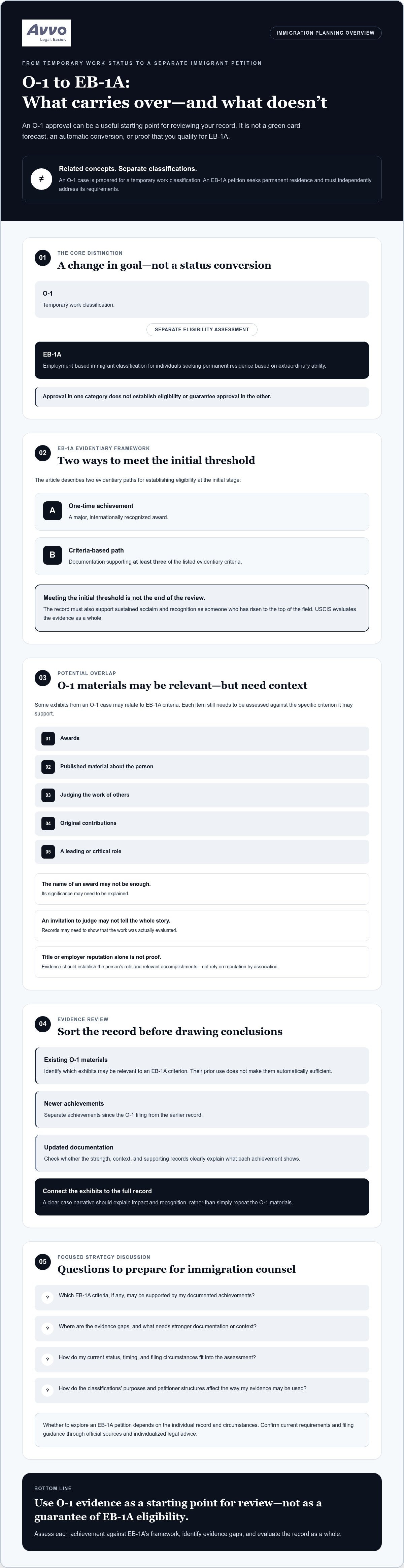
An O-1 approval is an important part of your immigration history, but it doesn’t automatically move you toward a green card. O-1 is a temporary work classification. EB-1A is an employment-based immigrant classification for individuals seeking permanent residence based on extraordinary ability. An O-1 to EB-1A transition means assessing whether your record may support a separate immigrant petition, not converting one status into another.
This distinction matters for planning. Your O-1 case was prepared for a temporary work classification, while an EB-1A petition requires its own eligibility assessment and supporting evidence. Approval in one category doesn’t establish eligibility or guarantee approval in the other. The classifications have related concepts, but they aren’t interchangeable.
What does an O-1-to-EB-1A transition actually involve?
It’s a change in immigration goal, not an automatic change in classification. A person holding O-1 status may explore an EB-1A petition, but the petition must independently address the applicable requirements. Whether and how to file depends on individual circumstances, including current status and the procedures in effect. Confirm current filing and status guidance through official sources and individualized legal advice.
This overview focuses on that planning distinction. It isn’t a full comparison of every O-1 and EB-1A criterion. Those details require a closer review of the evidence and applicable rules. For general background on the classifications, see this Alien of Extraordinary Ability overview.
Why Silicon Valley professionals consider this pathway
Founders, researchers, engineers, and other accomplished professionals in Silicon Valley may want to understand whether their achievements could support a permanent-residence strategy. For example, a founder may have built a company and received industry recognition, while a researcher may have developed a record of influential work. These examples can prompt a review, but they don’t establish eligibility by themselves.
Exploring EB-1A is one possible path, not the only option for every O-1 holder. The practical question is whether the person’s documented record and circumstances make a separate petition worth considering. An individualized review can clarify what evidence is available, what needs closer examination, and which next steps to discuss with immigration counsel.
EB-1A Eligibility After O-1: How USCIS Reviews the Evidence
An O-1 petition can provide useful documentation, but USCIS assesses an EB-1A petition under its own evidentiary framework. Under the regulations, a petitioner may establish eligibility with a one-time achievement that is a major, internationally recognized award, or by documenting at least three of the listed evidentiary criteria. Meeting that initial threshold isn’t the end of the analysis. The record must also support the required level of sustained acclaim and recognition as someone who has risen to the top of the field. Review the USCIS Policy Manual guidance on extraordinary ability and confirm current requirements before filing.
Which EB-1A criteria may overlap with an O-1 record?
Some O-1 exhibits may also relate to EB-1A criteria, depending on what they show and how they’re documented. Examples include awards, published material about the person, judging the work of others, original contributions, or a leading or critical role. The O-1 filing may organize similar material, but the categories and legal tests aren’t identical. USCIS’s O-1 visa requirements provide context for that classification, not a shortcut through EB-1A review.
Assess each item against the specific criterion it may support. An award’s name alone may not explain its significance. A judging invitation may need records showing that the work was actually evaluated. Likewise, a job title or a well-known employer isn’t, on its own, proof of extraordinary ability. Evidence should establish the person’s role and relevant accomplishments, not rely on reputation by association.
Evidence that supports a criterion helps satisfy one part of the framework. Evidence that strengthens the overall record shows why the achievements demonstrate sustained acclaim and distinction in the field.
How does the final merits review affect the case?
After considering the claimed criteria, USCIS evaluates the evidence as a whole under the applicable standard. A file can document several qualifying categories and still need a clear, well-supported explanation of the person’s impact and recognition. The case narrative should connect the exhibits and explain their context, rather than simply repeat materials from an O-1 petition.
For an O-1 to EB-1A transition, organize each exhibit by the criterion it may support, then ask what it demonstrates about the broader record. Because agency guidance and filing procedures can change, check current USCIS materials and discuss case-specific questions with immigration counsel. A focused review of your evidence record can help clarify which documents warrant closer assessment.
O-1 vs. EB-1A Evidence: What Carries Over and What Needs More Support?
Some documents assembled for an O-1 case may also help explain an EB-1A record. But the classifications have distinct criteria, and each document must be reassessed for the specific EB-1A requirement it is meant to support. An O-1 approval is useful context, not a shortcut to EB-1A approval.
| Area | O-1 | EB-1A |
|---|---|---|
| Purpose | Temporary work classification for qualifying individuals in the sciences, arts, education, business, athletics, or motion picture and television industries. | Employment-based immigrant classification for individuals who meet the extraordinary-ability standard and seek permanent residence. |
| Evidence focus | Evidence is assessed under the applicable O-1 requirements. See the USCIS O-1 policy guidance. | Evidence must meet the EB-1A framework and support the claimed criteria and overall eligibility. See the USCIS EB-1A policy guidance. |
| Petitioner structure | A U.S. employer or agent generally files the petition. | The individual may self-petition; a job offer isn’t required for this classification. |
| Existing documents | The O-1 filing can provide a starting collection of records and context. | Relevant items may be reused, but should be mapped and assessed under EB-1A requirements. |
Which O-1 documents can be useful starting points?
Review the O-1 file for recommendation letters, contracts, press coverage, awards, judging records, and documentation of professional contributions. For a published article, check what it says about your work and whether the context is clear. For a letter, look for specific examples that corroborate its claims. Check whether records are current, independent, and clearly connected to the criterion being asserted. A document’s relevance depends on its content, not simply on whether it appeared in the approved O-1 filing.
What gaps can emerge in an EB-1A evidence review?
Participation isn’t always the same as recognition or field-level significance. A conference program may establish that someone spoke, but may not show the event’s selectivity or the speaker’s wider impact. Similarly, company growth can show organizational success without establishing the individual’s role in it. For each record, identify whose achievement it documents and what it supports.
Evidence doesn’t carry over by label. It must be reassessed to show how it meets EB-1A criteria and contributes to the overall record. No single letter, award, or other document guarantees a favorable outcome. A careful O-1 to EB-1A transition review considers the evidence together, including what needs updating or stronger corroboration.
How to Prepare for an O-1-to-EB-1A Strategy Review
A well-organized record helps counsel assess the evidence and practical filing questions involved in your O-1 to EB-1A transition. Before a strategy review, separate what was included in the O-1 petition from what has changed since then. Prepare a concise timeline of your status, work, travel, and relevant filing dates. This gives the discussion a clear starting point without assuming that the same filing sequence or timeline applies to every case.
Build a clear record of achievements and supporting documents
Create a dated inventory of significant achievements. For each item, note your specific role, the supporting documents you have, and why you think it may be relevant. Keep the underlying records together, not just summaries or descriptions.
- Prior petition materials: Gather the O-1 petition and supporting exhibits, approval notices, and any available correspondence. Mark which evidence was submitted previously.
- New and updated records: Add achievements since that filing, current versions of relevant documents, and evidence that clarifies the context or impact of earlier work.
- Supporting sources: Where applicable, collect independent coverage, award criteria, judging invitations or records, and documentation of professional contributions.
- Open items: List missing documents, records you’ve requested, and claims that may need independent corroboration or a clearer link to your individual role.
Relevance depends on the facts and the criterion being considered. An award announcement, for instance, may identify a recipient, while the award criteria may help explain the recognition’s context. Neither document should be treated as conclusive on its own. A clear inventory lets counsel see what the record establishes and what remains uncertain.
Coordinate petition strategy with current status and work plans
Prepare a separate timeline for immigration and employment events. Include your current status and its end date, petition and approval dates, work authorization details, planned travel, and any upcoming changes to your role or employer. Bring relevant notices and travel records if available. Don’t assume an immigrant petition automatically changes your current status or resolves travel and work questions.
Petition planning and maintaining lawful status are related, but distinct issues. Ask counsel to review how your circumstances may affect filing options, work plans, and travel, and to verify current USCIS procedures and visa availability. General processing estimates may not reflect your case or current agency information, so confirm details against official sources.
Once your documents and questions are organized, you can schedule an O-1-to-EB-1A strategy consultation to discuss your individual record and possible next steps.
Plan Your O-1 to EB-1A Path with Immigration Counsel
A practical review starts with three questions: What does your record establish? Which evidence gaps need attention? How do your current status, work plans, travel, and filing circumstances affect potential next steps? Immigration counsel can assess those facts and discuss possible strategies, but no attorney can promise EB-1A eligibility or approval. The goal is a clearer, individualized plan, not a guaranteed result.
What to discuss in an initial legal consultation
Bring records that help counsel understand both your history and your goals. A focused consultation can be more useful when you arrive with:
- Copies of your current and prior petition materials, including O-1 supporting evidence and notices.
- A concise, dated timeline of achievements, roles, and supporting documentation.
- Questions about how specific evidence may relate to EB-1A criteria and what facts may need further development.
- Relevant details about your status, employment, travel plans, and any filing dates or upcoming changes.
Ask counsel to distinguish evidence that is already well documented from claims that need more context or corroboration. You can also discuss which current USCIS procedures and visa availability information should be checked for your circumstances. An O-1 petition and a plan for maintaining lawful status are connected considerations, but they aren’t the same question.
Why individualized guidance matters for Silicon Valley professionals
Work in startups, research, technology, and creative fields can produce complex records. A company’s success, for example, may not by itself explain an individual founder’s contribution. A research record may need context about the work’s influence, while creative achievements may be documented through different kinds of recognition. Counsel can help identify what the documents show, where context is missing, and which questions deserve further review.
MJ Law is based in San Jose and handles employment-based immigration matters. The firm has assisted individuals, families, and businesses with immigration matters for over three decades, and consultations are available in English and Spanish. For professionals in San Jose, San Francisco, and the wider Silicon Valley community, a consultation can provide an opportunity to review a record and clarify possible next steps. No firm’s experience determines the outcome of an individual case.
If you’re considering an O-1 to EB-1A transition, organize your questions and records, then schedule a consultation with MJ Law to discuss your circumstances and potential path forward.
Take the Next Step with a Clearer Strategy
An O-1 record can provide useful context for an EB-1A strategy, but it isn’t a shortcut to approval. Assess the evidence against EB-1A requirements, including what each document shows and where the record may need further support. Your status, work plans, travel, and filing circumstances also deserve individual review.
A thoughtful O-1 to EB-1A transition begins with an organized record and practical questions for immigration counsel. No review can guarantee eligibility or an outcome, but it can help you understand possible options and clarify what to consider next.
MJ Law is a San Jose-based immigration law firm serving the Silicon Valley community, including San Francisco. The firm has assisted individuals, families, and businesses with immigration matters for over three decades, with consultations available in English and Spanish. If you’re ready to discuss your circumstances and evidence, schedule a consultation with MJ Law.
With careful preparation and individualized guidance, you can approach your next decision with greater clarity.
Frequently Asked Questions
Does an O-1 visa automatically qualify someone for an EB-1A green card?
No. An O-1 approval doesn’t automatically establish eligibility for EB-1A or guarantee approval. The categories have separate requirements, and an EB-1A petition must be assessed on its own evidence. Your O-1 record may provide useful context, but USCIS will evaluate whether the EB-1A evidence meets the applicable standard. Treat the O-1 to EB-1A transition as a separate eligibility and planning question, not an automatic upgrade.
Can O-1 evidence be used in an EB-1A petition?
Yes, documents from an O-1 case may also support an EB-1A petition if they’re relevant to the EB-1A criteria. Examples could include award records, published material, judging documentation, recommendation letters, or evidence of contributions. Reassess each item: it may need updating, independent corroboration, or additional context showing your role and the significance of the work. Reusing an exhibit doesn’t mean it automatically satisfies an EB-1A requirement.
What is the difference between O-1 and EB-1A?
O-1 is a temporary work classification, while EB-1A is an employment-based immigrant classification for people who qualify under the extraordinary-ability standard and seek permanent residence. O-1 petitions generally require a U.S. employer or agent to petition. EB-1A allows an individual to self-petition. Although some evidence may overlap, the categories have distinct eligibility criteria, so an O-1 approval doesn’t predict the outcome of an EB-1A petition.
Can I self-petition for an EB-1A while I have O-1 status?
Generally, yes. EB-1A permits an individual to file a petition on their own behalf, without an employer petitioner or job offer. Filing that petition doesn’t automatically change your O-1 status or authorize different work. You’ll need to consider your current status and any separate steps for seeking permanent residence. Discuss filing options and status implications with immigration counsel based on your circumstances and current procedures.
How long does the transition from O-1 to EB-1A take?
There’s no single timeline for an O-1 to EB-1A transition. USCIS processing estimates change, and the green card stage may depend on visa availability and whether you can file an adjustment application. Based on the October 2026 information in this article, premium processing for an EB-1A petition provides an initial USCIS action within 15 business days, not a guaranteed approval or completed green card. Check current USCIS processing times and visa availability.
Can I keep working while my EB-1A petition is pending?
An EB-1A petition alone doesn’t grant work authorization. If you continue working in O-1 status, your work must remain consistent with the authorization and conditions that apply to that status. Some applicants may have a separate option to apply for work authorization after filing an eligible adjustment-of-status application, but filing alone doesn’t authorize work. Confirm your current status, any pending applications, and work plans with counsel before making changes.
Should I file an EB-1A petition immediately after receiving O-1 approval?
Not necessarily. The date of O-1 approval alone doesn’t determine whether an EB-1A petition is ready to file. Consider whether your evidence supports the EB-1A requirements, whether key documents need updating or stronger context, and how your status, work, travel, and filing circumstances affect the plan. An individualized review can help identify possible gaps and next steps. MJ Law, based in San Jose and serving the San Francisco and Silicon Valley community, offers consultations in English and Spanish.