
With Department of Labor PERM processing times stretching to roughly 372 days, a single recruitment discrepancy can instantly erase an entire year of workforce planning. For Bay Area employers and sponsored professionals, securing permanent residency requires far more than routine paperwork; it demands rigorous compliance against demanding regional prevailing wages and unpredictable visa bulletin retrogression. Choosing an experienced EB-3 visa lawyer San Francisco companies and candidates can rely on is the critical first step to protecting your petition.
You already know the anxiety of managing lengthy government backlogs while trying to keep executive leadership and foreign talent on the same page. In this 2026 buying guide, you’ll learn exactly how to evaluate and select the right San Francisco EB-3 immigration attorney for your permanent residency pathway. We’ll examine the legal criteria that matter most, explore proven strategies to audit-proof your labor certification, and outline what transparent communication should look like at every stage.
Key Takeaways
- Understand how EB-3 subcategories, including Professionals, Skilled Workers, and Other Workers, map to specific job requirements and organizational hiring plans.
- Master the three sequential phases of permanent residency sponsorship to accurately forecast milestones around prevailing wages, recruitment, and visa availability.
- Identify the core criteria for selecting an EB-3 visa lawyer San Francisco employers and foreign professionals can rely on for direct partner oversight and technical precision.
- Protect your petition against costly Department of Labor audits and technical denials through proactive job description drafting and airtight recruitment documentation.
- Establish transparent, collaborative communication between corporate stakeholders and sponsored talent to navigate multi-year visa queues with confidence.
Understanding the EB-3 Visa: Classifications and Bay Area Eligibility
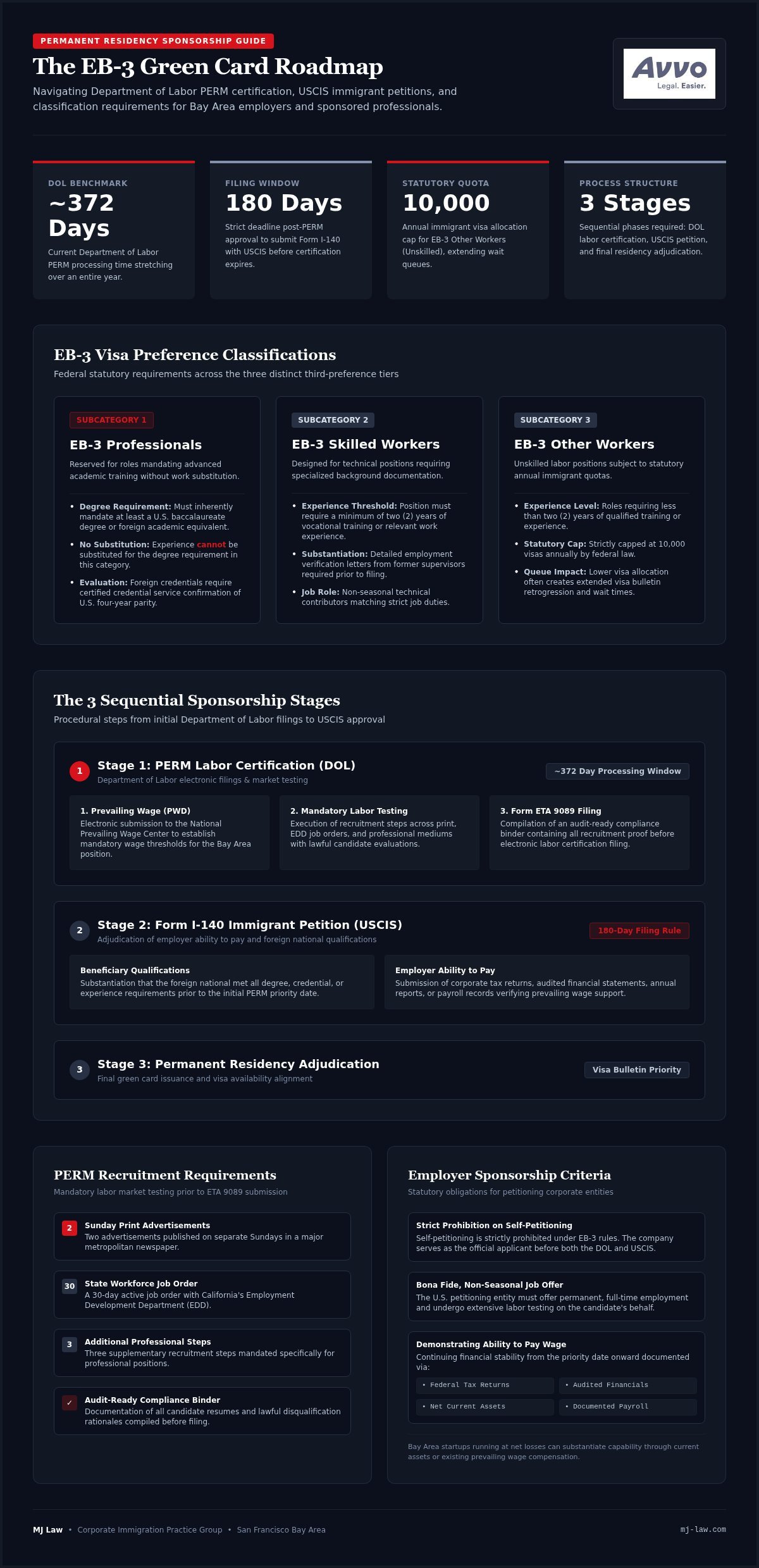
The EB-3 visa preference category grants lawful permanent residence through full-time, permanent employment sponsorship. Across the San Francisco Bay Area, technology firms, healthcare networks, and research labs rely on this pathway to retain critical personnel, from software engineers and systems analysts to specialized clinical staff. Unlike temporary work classifications, the EB-3 pathway requires a bona fide, non-seasonal job offer from a U.S. entity willing to undergo extensive labor testing on behalf of the candidate.
Securing counsel from an experienced EB-3 visa lawyer San Francisco organizations trust helps determine the exact classification tier that aligns with the corporate role and the worker’s credentials before initiating filings.
EB-3 Professionals vs. Skilled Workers vs. Other Workers
Federal regulations divide the third preference quota into three distinct classifications, each with strict evidentiary requirements:
- EB-3 Professionals: The position must inherently mandate at least a U.S. baccalaureate degree or its foreign academic equivalent. Experience cannot be substituted for the degree requirement in this subcategory. Foreign credentials must be evaluated by a certified credential service to confirm parity with a U.S. four-year bachelor’s degree.
- EB-3 Skilled Workers: The job role must require a minimum of two years of specific vocational training or relevant work experience. Relevant documentation, including detailed employment verification letters from former supervisors, must substantiate this background prior to the petition’s filing date.
- EB-3 Other Workers (Unskilled): This category encompasses positions requiring less than two years of qualified training or experience. Annual immigrant visa allocations for this group are statutorily capped at 10,000 visas, which often creates longer visa bulletin wait times.
While individuals with extraordinary credentials might pursue an EB-1A petition without labor market testing, the EB-3 category remains the practical, reliable avenue for core technical and professional contributors.
The Crucial Role of U.S. Employer Sponsorship
Self-petitioning is strictly prohibited under EB-3 statutory rules. The petitioning company acts as the official applicant before both the Department of Labor and U.S. Citizenship and Immigration Services. Consequently, the employer must establish its financial stability from the priority date onward.
USCIS requires concrete proof of the employer’s continuing ability to pay the proffered wage. Petitioners typically submit federal corporate tax returns, audited financial statements, or annual corporate reports. For early-stage Bay Area startups that operate at an initial net loss, an EB-3 visa lawyer San Francisco teams rely on can leverage alternative documentation, such as net current assets or documented payroll records confirming the beneficiary is already being compensated at or above the prevailing wage.
The 3-Stage EB-3 Green Card Process: Timeline and Procedures
The journey to permanent residency moves sequentially through Department of Labor certification, USCIS immigrant petition adjudication, and final green card issuance. Because an oversight in the initial labor phase can invalidate months of work and jeopardize a candidate’s priority date, partnering with an EB-3 visa lawyer San Francisco employers rely on ensures that every procedural benchmark meets strict regulatory standards.
Stage 1: PERM Labor Certification and DOL Regulations
The process begins by submitting an electronic request for a Prevailing Wage Determination (PWD) to the National Prevailing Wage Center. Once received, the employer must test the local labor market through mandatory recruitment steps. These include placing two Sunday print advertisements in a major metropolitan newspaper, posting a 30-day job order with California’s Employment Development Department (EDD), and conducting three additional professional recruitment steps for professional roles. Every step, resume review, and lawful disqualification reason must be compiled into an audit-ready compliance binder before filing Form ETA 9089.
Stage 2: Form I-140 Immigrant Petition with USCIS
Employers have exactly 180 days from PERM approval to submit Form I-140 to USCIS. This filing establishes two legal realities: the foreign national satisfies the educational and experience requirements stated on the labor certification, and the employer possesses the continuous financial capacity to pay the offered wage. Standard processing takes 5 to 14 months, but petitioners can elect premium processing for $2,805 to receive an adjudication within 45 business days. Form I-140 carries a base filing fee of $715, along with the applicable Asylum Program Fee based on company headcount.
Stage 3: Adjustment of Status or Consular Processing
The final phase culminates in Adjustment of Status (Form I-485) for individuals residing lawfully within the United States, or consular processing (Form DS-260) for beneficiaries abroad. Eligibility to file depends entirely on whether the applicant’s priority date is current under the Department of State Visa Bulletin. Given historic backlogs for high-demand countries, workers often need to maintain their underlying nonimmigrant status for multiple years. Consulting an H-1B transfer attorney San Jose talent relies on helps safeguard work authorization during critical job transitions while your green card queue matures.
If you’re mapping out your company’s sponsorship calendar, you can schedule a strategic consultation to review your filings and establish clear timelines.
How to Choose an EB-3 Visa Lawyer in San Francisco: Key Criteria
Evaluating an employment-based immigration practice requires looking past polished websites and media appearances. Because labor certification rules are strictly enforced under federal law, companies and candidates need counsel capable of designing defensible recruitment programs while offering direct legal oversight. Selecting the right EB-3 visa lawyer San Francisco organizations trust comes down to auditing specific operational metrics before signing an engagement agreement.
Assessing PERM Audit Defense and Compliance Experience
A reputable practitioner must demonstrate extensive experience in audit defense under 20 CFR 656. Inquire directly about the attorney’s history with Department of Labor targeted audits, supervised recruitment orders, and Requests for Evidence (RFEs). Counsel should handle both technical roles, such as cloud architecture or data science, and non-tech classifications with equal proficiency, ensuring job requirements reflect genuine business necessity rather than tailored candidate resumes.
Communication, Case Management, and Legal Fee Transparency
Permanent residency filings span several years. Your legal partner must provide a sustainable communication model that serves corporate leadership and foreign talent without creating operational friction. Prioritize firms that offer:
- Transparent Flat-Fee Staging: Clear, predictable billing allocated across the PERM labor certification, Form I-140 petition, and eventual adjustment phases.
- Direct Partner Oversight: Confirmation that strategy, job duty crafting, and compliance reviews remain with senior attorneys rather than being entirely handed off to junior paralegals.
- Direct Beneficiary Access: Dedicated channels that allow sponsored employees to check priority date developments and status updates without placing an administrative burden on corporate HR teams.
Local Bay Area and Silicon Valley Knowledge
Regional context matters during the permanent residency journey. An experienced EB-3 visa lawyer San Francisco teams partner with understands how the local tech and service ecosystems impact prevailing wage assessments and recruitment responses. They know how to anticipate wage determinations across San Francisco, Alameda, and Santa Clara counties, preventing budget surprises later in the process.
Local experience also ensures seamless coordination with the USCIS San Francisco Field Office should an in-person adjustment interview be required. For organizations managing multilingual operations, firms offering bilingual consultations in English and Spanish ensure clearer alignment across executive staff, hiring managers, and diverse candidates throughout the sponsorship journey.
Common EB-3 Pitfalls and How Experienced Counsel Mitigates Risk
Permanent labor certification rules are strictly regulatory. The Department of Labor operates under a zero-tolerance standard for procedural defects, meaning minor typographical inconsistencies or missed advertising windows cannot be cured retroactively after filing Form ETA 9089. An error discovered during adjudication results in an outright denial, forcing employers to restart recruitment and establish a brand new priority date. Working with an EB-3 visa lawyer San Francisco companies trust ensures these costly oversights are identified and resolved before publication.
Preventing Prevailing Wage Determination and Job Description Flaws
San Francisco’s metropolitan wage rates are among the highest in the nation. Selecting an overly broad or misaligned Standard Occupational Classification (SOC) code can inadvertently assign an entry-level software engineer to a high-tier wage level that exceeds corporate budgets. Similarly, drafting requirements that appear tailored to the sponsored worker’s unique resume invites scrutiny. Counsel must establish objective business necessity under 20 CFR 656.17, proving every skill requirement represents an operational minimum rather than an artificial barrier to U.S. applicants.
Navigating Audit Triggers and Supervised Recruitment
Audit flags can emerge even when applications are technically sound. The DOL routinely audits filings involving:
- Foreign language requirements not customary for the occupation
- Beneficiaries holding an ownership interest in the sponsoring company
- Experience gained entirely with the sponsoring employer under similar job duties
- Recent company layoffs within the same occupational classification and geographic area
When audits occur, counsel must produce a comprehensive audit file within 30 days. This documentation requires contemporaneous tear sheets, recruitment logs, and lawful, non-discriminatory interview memos explaining precisely why each domestic applicant failed to satisfy the objective job criteria.
Managing Priority Date Retrogression and Maintaining Nonimmigrant Status
Visa availability fluctuates significantly. While the September 2026 Visa Bulletin set EB-3 final action dates at September 1, 2024, for worldwide applicants, backlogs extend back to January 1, 2022, for China and January 1, 2014, for India. These multi-year queues require a proactive status maintenance strategy.
A seasoned EB-3 visa lawyer San Francisco candidates depend on will leverage American Competitiveness in the Twenty-First Century Act (AC21) provisions. This allows qualifying H-1B professionals to secure extensions beyond their standard six-year limitation while awaiting priority date availability. Retaining lawful underlying status ensures candidates can bridge the gap until their Form I-485 and employment authorization document (EAD) applications are formally approved.
To evaluate your workforce strategy or audit your ongoing permanent residency pipeline, you can book a compliance strategy session directly with experienced legal counsel.
Strategic Corporate Immigration: Partnering with MJ Law in San Francisco
Permanent residency filings demand precision, strategic consistency, and an ongoing commitment to corporate compliance. For employers and professionals across the Bay Area, securing reliable representation means working with attorneys who view immigration not as a mechanical filing exercise, but as a critical driver of business stability and career growth. As an EB-3 visa lawyer San Francisco organizations rely on, MJ Law provides the high-level legal oversight necessary to guide petitions from initial intake through final approval.
With firm roots dating back to 1985 and a partnership established in 2000, MJ Law brings more than three decades of focused experience to California’s business community. Operating across San Francisco, San Jose, and Silicon Valley, the firm is led directly by partners Gabriel Jack and Michael Muston. Unlike high-volume practices that hand critical labor certifications down to junior staff, MJ Law ensures every client receives direct partner involvement at every stage.
A Collaborative, Full-Lifecycle Approach to Employment Petitions
Retaining top global talent requires alignment across human resources, technical managers, and sponsored employees. MJ Law balances corporate rigor with personal, accessible counsel. This full-lifecycle approach includes:
- Feasibility and Prevailing Wage Analysis: Evaluating job duties, corporate organizational charts, and educational backgrounds to establish an airtight case theory before filing prevailing wage requests.
- Recruitment and Labor Certification Compliance: Overseeing mandatory recruitment campaigns with strict adherence to Department of Labor regulations, building audit-proof documentation.
- Cross-Functional Communication: Offering bilingual legal consultations in English and Spanish, bridging communication gaps across diverse engineering, research, and operational teams.
This methodical structure provides corporate leadership with clear forecasting while offering international candidates the stability they need to focus on their work.
Schedule Your Initial EB-3 Legal Consultation
Every successful immigration strategy begins with a thorough evaluation of corporate needs, candidate credentials, and timeline realities. Whether your organization is sponsoring its first professional or managing an expanding international workforce, having an EB-3 visa lawyer San Francisco teams depend on makes all the difference.
Take the next step in securing your company’s workforce future. You can schedule your consultation with MJ Law today to discuss your permanent residency petitions and establish a compliant path forward.
Building a Clear Pathway to Permanent Residency
Navigating the EB-3 immigration process requires a methodical strategy from day one. By proactively planning around regional prevailing wages, maintaining strict recruitment compliance, and closely monitoring monthly visa bulletin movements, employers can protect their international workforce while avoiding costly procedural delays. Sponsoring critical talent doesn’t have to be an unpredictable ordeal when you have structured guidance in your corner.
Choosing an experienced EB-3 visa lawyer San Francisco employers and foreign professionals rely on brings clarity to a complex federal process. Serving Bay Area employers and families since 1985, MJ Law provides direct, hands-on oversight from partners Gabriel Jack and Michael Muston. With bilingual legal representation available in English and Spanish, our practice supports leadership teams and individual candidates through every milestone. Take the next step toward workforce stability and schedule a consultation with MJ Law today to move your permanent residency petitions forward with confidence.
Frequently Asked Questions
Can an employee pay for the EB-3 PERM labor certification fees?
No, federal law strictly mandates that the sponsoring employer must pay all costs associated with the PERM labor certification process. Under 20 CFR 656.12, employers cannot require, permit, or accept reimbursement from the foreign employee for legal fees, mandatory newspaper ads, or job postings. Employees may, however, pay for their own Form I-485 adjustment of status legal fees and government filing fees if their employer’s policy permits.
How much does an EB-3 visa lawyer cost in San Francisco?
Legal fees for an EB-3 visa lawyer San Francisco businesses and employees hire vary depending on case complexity, company size, and whether the petition requires specialized audit responses. Most reputable Bay Area business immigration firms structure representation on a predictable flat-fee basis divided into phases: PERM recruitment, Form I-140 petition, and Form I-485 adjustment. During an initial consultation, counsel will evaluate your corporate structure and provide a tailored scope of representation with clear fee schedules.
How long does the entire EB-3 process take in 2026?
The total timeline depends on government agency backlogs and country-of-chargeability visa bulletin movement. In 2026, PERM labor certification takes approximately 12 months (roughly 372 days), while Form I-140 adjudication takes 5 to 14 months unless expedited via premium processing. For candidates subject to worldwide priority date cutoffs, the entire process generally spans two to three years. Applicants from backlogged countries like India or China face multi-year queues before filing for adjustment.
What happens if a sponsored employee changes jobs during the EB-3 process?
Changing employers during the early stages typically requires restarting the labor certification process with the new company. However, once Form I-140 is approved, the worker retains their established priority date for future filings. If the candidate reaches the final stage and Form I-485 remains unadjudicated for at least 180 days, AC21 portability allows them to change employers without restarting, provided the new position is in the same or a similar occupational classification.
Is an EB-3 green card guaranteed once the PERM labor certification is approved?
No, an approved labor certification does not guarantee permanent residency. PERM approval merely confirms that no qualified U.S. workers were available for the role. USCIS independently reviews Form I-140 to verify the company’s continuous ability to pay the prevailing wage and assess candidate credentials. An experienced EB-3 visa lawyer San Francisco employers consult will audit every document beforehand, but final approval also depends on visa bulletin availability and candidate admissibility during adjustment.
Can foreign workers sponsor spouses and children under an EB-3 petition?
Yes, an approved principal applicant can include their legally married spouse and unmarried children under age 21 as derivative beneficiaries. Family members are eligible to submit Form I-485 or undergo consular processing simultaneously when the principal worker’s priority date becomes current. Once approved, derivative family members receive lawful permanent resident status, giving spouses open-market work authorization and children the freedom to attend school in the United States without independent visas.