
Your E-2 business plan isn’t actually a business document; it’s a high-stakes legal brief in disguise. While you see a roadmap for commercial growth, a consular officer sees a series of tests to determine if your investment is substantial or merely marginal. You’ve likely put your life savings on the line, and the thought of a denial due to a technical financial error is overwhelming. It’s a valid concern, especially as 2026 processing fees for standard I-129 petitions sit at $1,015 and premium processing has climbed to $2,965.
We understand that you aren’t just looking for a visa; you’re building a legacy. This is why partnering with a specialized E-2 visa business plan lawyer is the most critical step in your journey. In this 2026 investor guide, you’ll learn how a legal expert translates your commercial vision into a winning argument for U.S. residency. We’ll break down the latest USCIS requirements, analyze recent approval trends from the 55,324 visas issued in 2024, and show you how to bridge the gap between Silicon Valley innovation and immigration law.
Key Takeaways
- Discover why a standard bank business plan is insufficient and how to structure your document as a legal argument that meets strict USCIS evidentiary standards.
- Learn the specific strategies used to overcome the “marginality” test by proving your enterprise will provide a significant economic contribution beyond supporting your family.
- Understand the critical risks of using generic templates and why an E-2 visa business plan lawyer is essential for anticipating legal hurdles and avoiding costly Requests for Evidence.
- Identify the core components required for a 2026 application, including detailed legal structures and comprehensive market analyses tailored to the current regulatory landscape.
- Explore how MJ Law leverages 30 years of experience to bridge the gap between Silicon Valley innovation and U.S. immigration requirements through a bilingual, partnership-driven approach.
The Role of a Business Plan in Your E-2 Visa Application
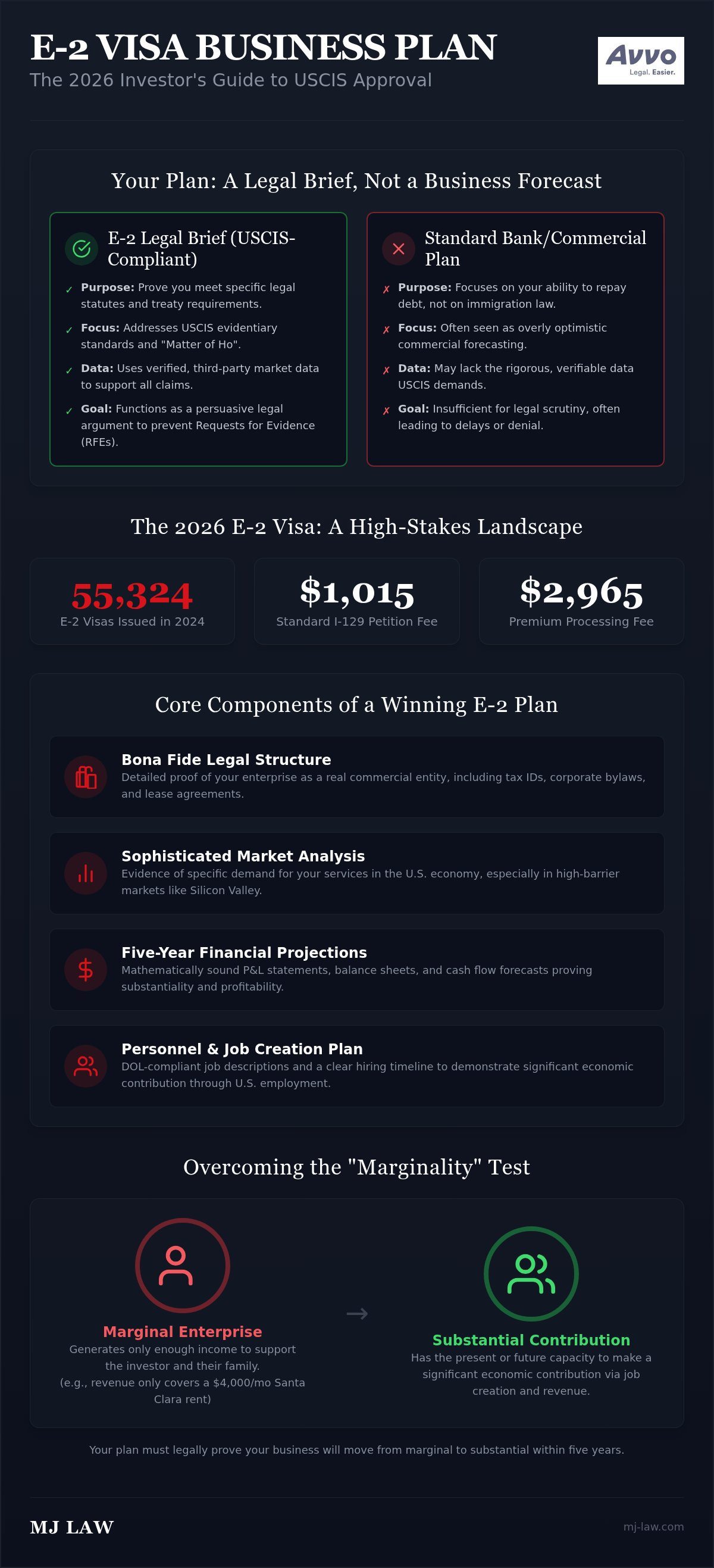
The business plan is the central evidentiary document for your E-2 investor visa application. It serves as the primary tool for a consular officer to assess if your venture is a “real and operating” commercial enterprise and whether your investment is “substantial” relative to the business’s total cost. While many entrepreneurs assume a standard business plan used for bank loans will suffice, this is a common misconception that often leads to delays. A bank plan focuses on your ability to repay debt; a USCIS-compliant plan must prove you meet specific legal statutes and treaty requirements.
Your business plan acts as a binding roadmap for your first five years in the United States. It connects your personal investment to the regulatory requirements of the treaty, detailing how the business will grow, hire U.S. workers, and generate enough revenue to be more than “marginal.” Working with an E-2 visa business plan lawyer ensures that every financial projection and operational goal is framed within this legal context rather than just commercial optimism. This strategic alignment is what transforms a simple forecast into a persuasive legal argument.
Legal Brief vs. Commercial Forecast
A successful E-2 plan follows the “Matter of Ho” standards, which require the document to be comprehensive and credible. In 2026, USCIS officers are increasingly skeptical of generic or overly optimistic projections. Your plan should function as a legal brief, incorporating citations to current immigration law to justify your business model. It requires the use of verified, third-party market data to support your claims about industry trends and growth potential. An E-2 visa business plan lawyer understands how to weave these legal requirements into your financial forecast, making it difficult for an officer to find grounds for a Request for Evidence (RFE).
The 2026 Landscape for Silicon Valley Investors
For those targeting San Jose or San Francisco, the 2026 economic environment presents unique challenges. High costs of living in Silicon Valley mean that your financial projections must be exceptionally robust to pass the marginality test. If your business only generates enough to cover a $4,000 monthly rent in Santa Clara County, it may be deemed marginal because it fails to provide a significant economic contribution beyond supporting the investor. We help investors address these local pressures by highlighting the innovative nature of their startups and their capacity for rapid job creation. For more specific insights on local requirements, see our E-2 Visa Attorney San Jose: 2026 Treaty Investor Guide. MJ Law bridges the gap between your innovation and the rigorous standards of U.S. immigration law.
Essential Components of a USCIS-Compliant E-2 Business Plan
A USCIS-compliant business plan isn’t merely a collection of financial spreadsheets. It’s a structured evidentiary packet that must satisfy the strict USCIS E-2 requirements. To succeed in 2026, your document must provide a granular description of the enterprise’s legal structure, ensuring it’s a bona fide commercial entity. This includes your tax identification numbers, lease agreements, and corporate bylaws. Beyond the legal shell, you must present a sophisticated market analysis. This analysis shouldn’t just list competitors; it needs to prove there’s a specific demand for your services in the current U.S. economy, especially within high-barrier markets like Silicon Valley.
Your financial projections, including profit and loss statements, balance sheets, and five-year cash flow forecasts, must be mathematically sound. They need to demonstrate that the business will generate more than enough income to sustain the investor and their family. If you’re unsure how to frame these figures, it’s often helpful to discuss your projections with a specialist who understands the legal threshold for profitability. An E-2 visa business plan lawyer will ensure these numbers align with the narrative of your legal petition.
The Personnel Plan: Proving Job Creation
The personnel plan is your primary tool for proving job creation. You must draft job descriptions that align with Department of Labor (DOL) standards to demonstrate that the roles are necessary and professional. The timeline for these hires is vital. Consular officers focus heavily on the first two years of operations to see if the business can scale quickly. You must clearly distinguish between W-2 employees, who count toward your economic contribution, and 1099 contractors, who generally don’t satisfy the hiring requirement.
Marketing and Operational Strategies
For tech ventures in San Jose, defining your customer acquisition cost (CAC) is essential. It shows you understand the competitive landscape and have a realistic budget for growth. Your operational strategy must also detail your physical office space. In a post-remote world, USCIS still looks for a dedicated physical footprint that suits your business type. Operational readiness requires that the business premises are fully leased, equipped, and capable of beginning commercial activities immediately upon visa approval. An E-2 visa business plan lawyer helps you document this readiness through photographs, floor plans, and signed contracts.
Overcoming “Marginality”: The Legal Strategy Behind the Numbers
The “marginality” test is often the most significant hurdle for treaty investors. Under E-2 visa requirements, your business cannot exist solely to provide a minimal living for you and your family. It must possess the present or future capacity to make a significant economic contribution. An E-2 visa business plan lawyer approaches this by framing your financial projections not just as profit, but as a catalyst for local growth. In 2026, legal precedents continue to emphasize that even if a business isn’t immediately profitable, it can avoid a marginality finding if it demonstrates a clear path to hiring U.S. workers and supporting local vendors.
Silicon Valley presents a unique challenge due to its high cost of living. If your projections show a founder salary that barely covers San Jose’s median rent, USCIS may flag the enterprise as marginal. We mitigate this risk by highlighting the “Significant Economic Contribution” argument. This strategy is particularly effective for tech startups that prioritize scaling and market share over immediate dividends. By documenting your intent to hire specialized engineers or sales staff at competitive local wages, we prove the business’s impact extends far beyond the investor’s personal bank account.
Proving Substantial Investment in San Jose
Determining what constitutes a “substantial” investment requires understanding the “Inverted Sliding Scale.” This legal principle means that for a lower-cost business, the investment must represent a higher percentage of the total value. For a Silicon Valley consulting firm, a $100,000 investment might be 100% of the startup cost, satisfying the requirement. Conversely, a large-scale manufacturing plant might require a much higher dollar amount to be considered substantial. For a deeper dive into these thresholds, read our E-2 Visa Substantial Investment: 2026 Guide. Our team ensures your capital commitment is weighted correctly against your specific industry standards.
Mitigating the Risk of “Passive” Investment
Your business plan must clearly demonstrate that you’re in the U.S. to “develop and direct” the enterprise. USCIS is wary of passive investments where the applicant acts as a mere shareholder. An E-2 visa business plan lawyer uses a detailed organizational chart to show your active management role. For tech founders, this means providing evidence of your involvement in product development, strategic partnerships, and day-to-day operations. We help you document your decision-making authority, proving that the success of the U.S. entity depends directly on your specialized expertise and active leadership.
E-2 Lawyer vs. Business Plan Writer: Making the Right Choice
Many investors hire a general business plan writer to save costs, but this often creates a legal blind spot. A professional writer might create a document that looks excellent to a commercial lender but fails to address the specific “Matter of Ho” requirements used by USCIS. An E-2 visa business plan lawyer views your document through a legal lens. They don’t just ask if the business is viable; they ask if it satisfies the specific statutes in the Code of Federal Regulations. This distinction is vital because a plan that is commercially sound can still be legally insufficient.
Templated plans are a major red flag for consular officers. These documents often use generic market data and boilerplate job descriptions that don’t reflect the reality of your specific venture. When an officer sees a plan that looks identical to others they’ve reviewed, it triggers immediate skepticism. A lawyer integrates the plan into the broader legal petition, ensuring that the narrative in your cover letter matches the financial data in your plan. If the government challenges your projections, your lawyer is the person who defends that data and drafts the legal response.
The Risk of the Request for Evidence (RFE)
An RFE can delay your application by several months and significantly increase your stress. Common triggers in plans drafted by non-lawyers include vague personnel plans or financial projections that don’t account for local economic realities. For example, failing to account for the latest 2026 fee increases or the high operational costs in San Jose can signal a lack of preparation. The cost of a visa denial, both in lost time and investment, far outweighs the expense of professional legal oversight. A legal review pre-empts these objections by addressing them before the petition is even filed.
Strategic Collaboration: The Lawyer-Investor Partnership
At MJ Law, we treat the business plan as a collaborative partnership rather than a one-off transaction. We work with your existing financial data to create a customized narrative that respects the specific requirements of your treaty country. Whether you’re applying from Japan, Canada, or South Korea, each consulate has unique preferences that your plan must reflect. We also ensure your E-2 strategy aligns with potential future goals, such as a transition to an EB-5 green card. If you want to ensure your business plan is legally sound, schedule a consultation with our team today to discuss your vision.
Strategic Legal Support for Your Silicon Valley Venture
MJ Law provides more than just technical drafting; we offer a partnership-driven approach that leverages over 30 years of San Jose local expertise. Navigating the E-2 process requires a steady hand, and our team, led by Gabriel Jack and Michael Muston, understands the specific nuances of the Silicon Valley tech ecosystem. We offer bilingual consultations in both English and Spanish, ensuring that international investors can communicate their commercial vision clearly without language barriers. This collaborative process ensures your business plan isn’t just a static document, but a dynamic legal argument for your residency.
The journey from your initial investment to visa approval involves several critical steps. We begin by analyzing your existing financial data and business goals, then work to frame them within the context of current U.S. immigration laws. By acting as the bridge between your innovation and the legal requirements of the treaty, we help you avoid the common pitfalls that lead to denials. Our goal is to ensure that your first five years in the U.S. are built on a foundation of legal compliance and commercial readiness.
Tailored Solutions for San Francisco Founders
Founders in the San Francisco Bay Area face unique regulatory and economic pressures that don’t exist in other parts of the country. High operational costs and a competitive talent pool mean your business plan must be exceptionally precise to survive scrutiny. By working with an E-2 visa business plan lawyer, you gain access to our deep network of local professionals who understand the complexities of the California market. This local insight is crucial for justifying your financial projections and personnel needs to a skeptical consular officer. We invite you to book a consultation with MJ Law to begin tailoring your strategy to these specific local conditions.
Protecting Your American Dream
Professional legal representation provides a sense of security during what is often a stressful life transition. We take the burden of regulatory compliance off your shoulders, allowing you to focus on growing your enterprise. Before your application is submitted, we perform a comprehensive final review to ensure your plan is submission-ready. A successful package must include signed lease agreements, a five-year hiring schedule with professional job descriptions, and clear evidence of the irrevocable commitment of your investment funds. The 2026 outlook for E-2 treaty investors remains positive, with stable approval rates and a growing recognition of the economic value provided by international entrepreneurs.
Securing Your Future in the U.S. Market
Building a successful U.S. enterprise starts with a document that satisfies both commercial logic and complex immigration statutes. Your business plan must serve as a persuasive legal argument that proves your investment is substantial and your enterprise is far from marginal. By framing your financial projections within the context of the 2026 regulatory landscape, you position your venture for long-term success and growth. This strategic preparation is the difference between a simple application and a compelling case for residency.
Partnering with an E-2 visa business plan lawyer ensures that every detail, from your hiring schedule to your operational readiness, meets the high standards of USCIS and consular officers. At MJ Law, our San Jose-based experts bring over 30 years of Silicon Valley immigration success to your case. Our bilingual legal team provides the steady hand you need to navigate this transition with confidence, providing professional authority and client-centered warmth. We’re committed to turning your commercial vision into a lasting legacy.
Schedule your E-2 strategy session with MJ Law today to take the first step toward your American dream. We look forward to partnering with you on this journey and helping you build a successful future in the United States.
Frequently Asked Questions
Do I need a separate business plan for the E-2 visa if I already have one for investors?
Yes, a standard investor deck or bank plan is rarely sufficient for immigration purposes. While a venture capital plan focuses on return on investment, a USCIS-compliant document must satisfy specific legal criteria such as the “Matter of Ho” standards. It needs to include detailed personnel hiring schedules and prove the business isn’t marginal. Professional legal oversight ensures your commercial goals align with these strict requirements, transforming a financial forecast into a persuasive evidentiary document.
Can I write my own E-2 business plan to save on legal fees?
You can technically draft your own plan, but it’s a high-risk strategy that often leads to a Request for Evidence (RFE). Most self-drafted plans lack the “legal lens” required to survive scrutiny by consular officers who look for specific regulatory compliance. Mistakes in financial projections or job descriptions can result in a denial. Professional legal oversight provides the security of knowing your document functions as a persuasive legal brief that protects your initial investment.
What is the “Marginality” requirement for an E-2 visa business plan?
Marginality is a legal test to ensure your business does more than just support you and your family. Your plan must demonstrate that the enterprise has the present or future capacity to make a significant economic contribution. In the high-cost San Jose market, this means showing robust revenue and a clear five-year hiring schedule for U.S. workers. Proving your business isn’t marginal is a core task for your E-2 visa business plan lawyer.
How long should an E-2 visa business plan be in 2026?
In 2026, most successful plans range between 30 and 50 pages, though quality and legal compliance are more important than page count. The document must be comprehensive enough to include a five-year financial forecast, a detailed personnel plan, and a thorough market analysis. It should provide enough evidence to prove the business is a real and operating commercial enterprise without including unnecessary filler that might distract a busy consular officer during their review process.
Does a lawyer or a business writer actually write the E-2 plan?
While some firms outsource this to general writers, MJ Law takes a partnership-driven approach where the attorney directly oversees the narrative. This ensures that every commercial claim is backed by a legal argument. A business writer might understand market trends, but an E-2 visa business plan lawyer understands how to ensure those trends meet USCIS evidentiary standards. This collaboration transforms your financial data into a cohesive legal strategy that supports your entire visa petition.
What happens if USCIS issues an RFE regarding my business plan?
If you receive a Request for Evidence (RFE), you must provide specific documentation to address the officer’s concerns. This often involves clarifying financial projections or providing more proof of “operational readiness,” such as lease agreements or equipment invoices. Having a seasoned legal team is vital during this stage. We can draft a formal response that directly counters the government’s objections with credible data and legal citations to protect your status and your business’s future.
How much investment is considered “substantial” for a San Jose business?
There is no fixed dollar amount for a “substantial” investment. It depends on the total cost of establishing your specific business. In the San Jose and San Francisco markets, operational costs are often higher, which may influence what an officer considers sufficient for a new venture. Generally, the investment must be enough to ensure the business’s success and show your financial commitment. We help you apply the “inverted sliding scale” to justify your capital commitment.
Can a tech startup with no initial revenue qualify for an E-2 visa?
Yes, a startup with no current revenue can qualify if the business plan demonstrates a credible path to profitability and job creation. You must prove the business is “real and operating,” which often means having a physical office in Silicon Valley and being ready to start operations immediately. By emphasizing your projections for significant economic contribution and future hiring, we can build a strong case even for early-stage ventures that haven’t yet generated their first sales.