
The path that seems the most convenient might actually be the one that keeps you grounded for months without the ability to visit your family abroad. When deciding between adjustment of status vs consular processing, many applicants assume the choice is simply a matter of location. However, in 2026, the stakes have changed significantly. Recent shifts in USCIS policy mean that your decision impacts everything from your immediate right to work to your protection against sudden international travel restrictions.
It’s natural to feel anxious about the threat of family separation or confused by the conflicting processing times reported across different jurisdictions. You deserve a steady, professional partner to help you navigate these complex life transitions. This guide compares the two primary pathways to a U.S. Green Card so you can discover which strategy minimizes your wait time and maximizes your legal security. We’ll provide a clear breakdown of the fastest path, the implications of the new 18 month EAD validity periods, and how to navigate the latest USCIS discretionary guidelines. You’ll gain the clarity needed to maintain your ability to work and travel while building a secure future for your family.
Key Takeaways
- Understand the fundamental differences between adjustment of status vs consular processing to determine which path aligns with your current location and residency goals.
- Compare 2026 processing timelines and total costs, including the impact of updated filing fees and the new 18 month EAD validity periods.
- Learn to navigate the “90-Day Rule” and avoid the risks of preconceived intent that can lead to visa denials or removal proceedings.
- Discover how to maintain your ability to work and travel legally while your application is pending to minimize the anxiety of family separation.
- Identify why a personalized strategy is essential to handle the discretionary nature of modern immigration benefits and prevent costly procedural delays.
Adjustment of Status vs Consular Processing: Defining the Two Paths
Choosing between adjustment of status vs consular processing is often the most critical decision in your immigration journey. While both paths lead to the same result, a permanent resident card, they involve different government agencies and distinct procedural rules. If you’re currently in the United States, you might have the luxury of choice. However, even those eligible to stay in the U.S. sometimes opt for processing abroad to avoid specific domestic backlogs or to resolve complex entry issues. Understanding these distinctions helps reduce the anxiety often associated with complex legal transitions.
The primary difference lies in which government entity manages your case. U.S. Citizenship and Immigration Services (USCIS) oversees domestic applications. The Department of State handles cases processed through U.S. embassies and consulates abroad. This division of labor means the rules for travel, work, and even the interview format will vary significantly based on your chosen path.
What is Adjustment of Status (Form I-485)?
Adjustment of status allows you to change your immigration category to “permanent resident” without leaving the United States. When you file Form I-485, it effectively freezes your ability to remain in the country legally while the government reviews your case. This status, known as a “period of authorized stay,” provides a significant sense of security for families who fear being separated during the process.
To qualify, you generally must have entered the U.S. with a valid visa or through a visa waiver program. Maintaining your current non-immigrant status until you file is also vital. This Adjustment of Status Process is highly valued because it allows you to continue your life in the U.S. while you wait. In many cases, you can also apply for temporary work and travel permits to maintain your career and family connections.
What is Consular Processing (DS-260)?
Consular processing is the standard route for anyone residing outside the U.S. It begins after USCIS approves your initial petition and transfers the case to the National Visa Center (NVC). The NVC acts as a gatekeeper. They collect your fees and civil documents before scheduling your final interview at a U.S. Embassy or Consulate in your home country.
The process concludes with a high-stakes interview where a consular officer makes the final determination. While this path requires you to be abroad for the final steps, it’s a structured, methodical journey. Some individuals already in the U.S. choose this route if they don’t meet AOS eligibility requirements or if they believe their local consulate is processing cases faster than domestic field offices. It’s a path that requires careful coordination across different time zones and agencies.
Direct Comparison: Which Path is Right for You?
Deciding between adjustment of status vs consular processing requires a careful look at your specific priorities and tolerance for risk. While one path offers immediate domestic benefits, the other might provide a more predictable timeline depending on the specific embassy’s queue. Referencing the Legal Definition of Adjustment of Status clarifies that this domestic route is a discretionary benefit, which is a critical distinction to keep in mind as you weigh your options in 2026.
The Speed and Cost Framework
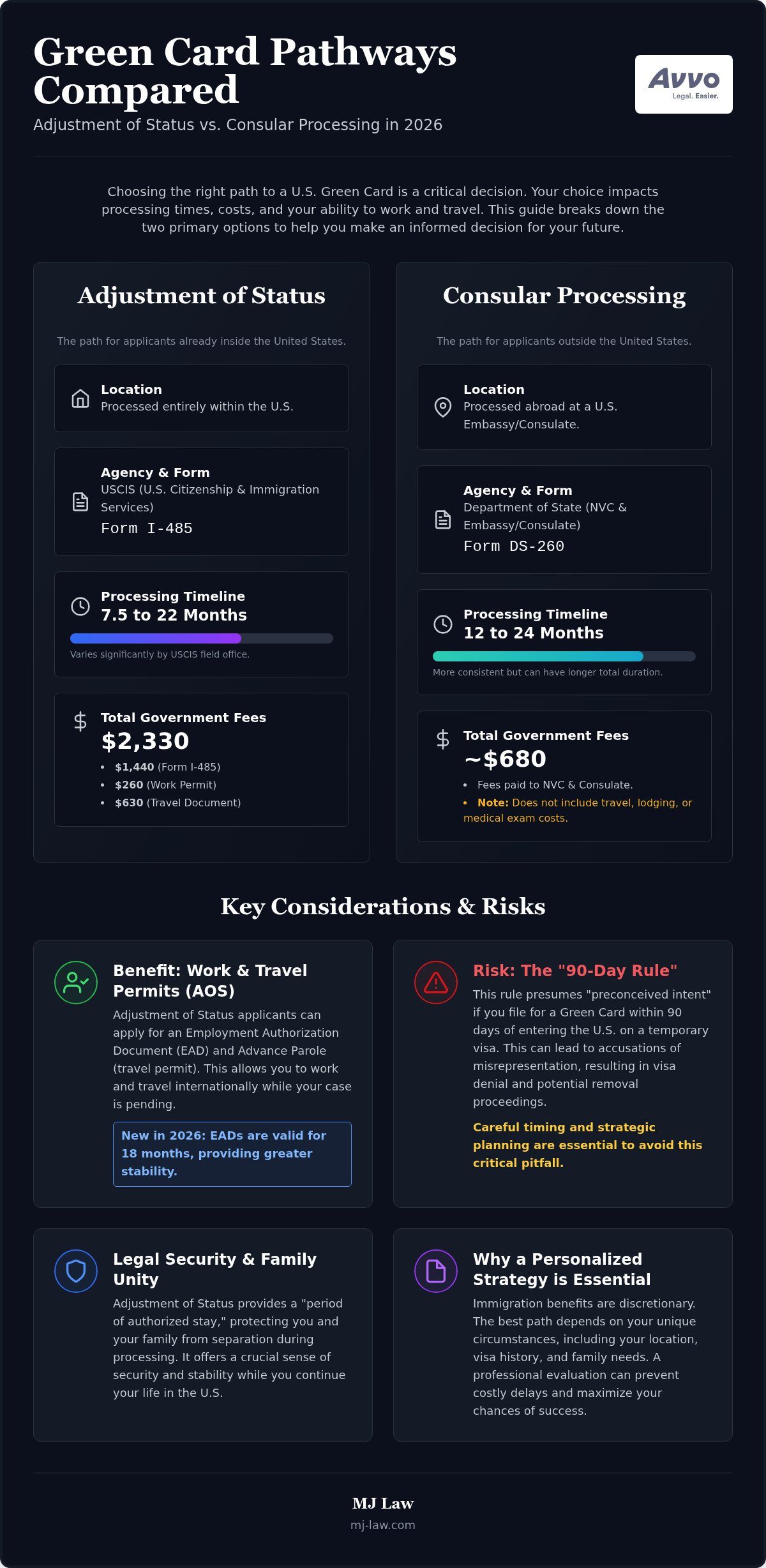
Processing times for domestic applications currently range from 7.5 to 22 months, depending on the specific USCIS field office. In contrast, consular processing for spouses of U.S. citizens typically takes between 12 and 24 months from the initial filing. While the consular path might seem slower, it’s sometimes more consistent for specific visa categories that aren’t subject to the same local field office backlogs found in major tech hubs like San Jose.
From a financial perspective, domestic filing is generally more expensive upfront. The $1,440 filing fee, combined with the $260 work permit fee and $630 travel document fee, represents a larger initial investment than the approximately $680 required for consular fees. However, the domestic path allows you to work and travel legally with permits that are now valid for 18 months. Consular processing might appear cheaper on paper, but you must factor in the “hidden” costs of international flights, lodging for the interview, and local medical exams in your home country.
Rights and Protections: The Legal Difference
Legal protection is where these two paths diverge most sharply. Inside the U.S., you have access to a more robust system of appeals and judicial review. If a domestic application is denied, you may have the opportunity to present your case before an immigration judge. Consular officers, by contrast, have broad authority. Their decisions are often final under the doctrine of consular non-reviewability, which offers very little recourse if your visa is refused.
There is also the risk of the “administrative processing” black hole, known as a 221(g) hold, which can stall a consular case for months without a clear explanation. If you face complications or receive a Request for Evidence, working with a marriage green card RFE lawyer in San Jose ensures your response is technically sound and minimizes the risk of a denial that could lead to removal proceedings. If you’re feeling overwhelmed by these choices, scheduling a consultation can help you determine which path provides the most security for your unique situation.
Eligibility and the 90-Day Rule: Critical Risks
The decision between adjustment of status vs consular processing isn’t just about convenience; it’s about the legality of your intent. If you enter the U.S. on a non-immigrant visa while secretly planning to file for a green card, you risk a finding of “preconceived intent.” This can lead to a permanent bar from the U.S. for visa fraud. USCIS officers, guided by the 2026 memorandum PM-602-0199, now treat adjustment as a discretionary benefit. They’ll scrutinize whether your actions after arrival align with the visa you used to enter the country.
The 90-day rule acts as a critical benchmark for this scrutiny. If you engage in “inconsistent conduct,” such as getting married or filing an I-485 within 90 days of entry, the government may presume you misrepresented your intentions to the border officer. While this isn’t an automatic denial, it shifts the burden of proof to you. You must provide clear, documented evidence that your plans changed only after you arrived. This risk is virtually non-existent for H-1B or L-1 holders, as these visas allow for “dual intent,” meaning you can legally enter with the plan to stay permanently.
Navigating Visa Intent in Silicon Valley
For tech professionals on B-1/B-2 or F-1 visas, the pressure to adjust status quickly is often high. However, these specific visas don’t allow for dual intent. To protect your future, you must document your journey carefully and avoid rushing the filing process. Building a strong foundation starts with a comprehensive I-130 evidence checklist to prove the bona fides of your relationship without triggering intent red flags. It’s about demonstrating that your life in the U.S. evolved naturally rather than following a predetermined plan to circumvent the system.
When Consular Processing is the Only Option
In some cases, the choice of adjustment of status vs consular processing is taken out of your hands. If you entered the U.S. without inspection or have accrued significant unauthorized employment, you’re generally ineligible to adjust status domestically. You’ll likely need to process through a consulate abroad to rectify your status.
This path often requires an I-601A provisional waiver to address unlawful presence before you leave for your interview. Without this waiver, you could face a three or ten year bar from re-entering the U.S. Furthermore, the January 21, 2026, Department of State public-charge visa freeze has added new hurdles for nationals of 75 countries. Navigating these inadmissibility grounds requires a methodical approach to ensure you don’t find yourself separated from your family for an extended period.
The journey toward permanent residency follows a methodical, multi-step progression. Whether your path involves adjustment of status vs consular processing, the process starts by establishing your eligibility through Form I-130. This initial petition serves as the legal foundation for your entire case. Once this foundation is laid, your strategy shifts based on whether you’re working with USCIS domestically or the Department of State through the National Visa Center (NVC).
Timeline for Adjustment of Status
For those eligible to file within the U.S., concurrent filing offers a streamlined start. This allows you to submit your residency application alongside the initial petition if you’re an immediate relative of a U.S. citizen. In 2026, domestic processing times at field offices vary, often ranging from 7.5 to 22 months. During this wait, you’ll visit the San Jose Application Support Center for biometrics and background checks. You’ll also receive a work permit, though it’s important to remember that new EADs are now capped at an 18 month validity period. The process culminates in a formal interview. Preparing for the marriage green card interview in San Jose requires deep attention to detail, as local officers look for clear, documented evidence of a shared life.
Timeline for Consular Processing
Applicants residing outside the U.S. move from USCIS approval to the National Visa Center. This intermediary stage requires you to become “documentarily qualified” by submitting financial affidavits and civil records. This phase typically takes 2 to 6 months. Interview wait times fluctuate significantly at high-volume posts like Ciudad Juarez, Manila, or Mumbai, often pushing the total timeline to between 12 and 24 months. Before the interview, you must complete a medical exam with a designated physician. Upon approval, you’ll receive a sealed visa packet. You must present this packet, unopened, to the Customs and Border Protection officer at the port of entry.
The final step for both paths is the arrival of your physical Green Card. For AOS applicants, the card usually arrives by mail within a few weeks of the approval notice. For those using the consular path, the card is produced after you pay the USCIS Immigrant Fee and officially enter the country. This physical card represents the successful conclusion of your journey and the beginning of your permanent stay in the U.S. If you’re ready to map out your specific filing strategy, schedule a consultation with our San Jose experts to move forward with a clear, professional plan.
Strategic Selection: Why Expert Guidance Matters
The decision between adjustment of status vs consular processing is often the most significant legal choice a family makes. A “one-size-fits-all” approach frequently ignores the nuanced discretionary guidelines updated in 2026. This oversight leads to Requests for Evidence (RFEs) that can stall a case for months or even result in a denial. When the stakes involve your ability to remain in the country with your loved ones, a generic filing strategy is a risk you can’t afford to take.
For those in Silicon Valley, the San Jose USCIS field office has its own unique adjudication rhythm. Having a local attorney who can physically attend your interview provides a layer of procedural protection that remote or generic services cannot match. While an attorney’s role at a consulate is mostly observational, their presence at a domestic interview allows them to clarify legal points and ensure the officer adheres to current policy manuals. This proactive representation is often the difference between a smooth approval and a complex legal battle.
We often work with “split” families where the petitioner lives in San Jose while the beneficiary remains abroad. Managing these cases requires a dual-pronged strategy that coordinates with both domestic agencies and the global consular network. An expert audit of your specific case identifies the path that offers the most legal security while minimizing the time you spend separated from your loved ones. We focus on creating a steady, predictable journey through an often intimidating field.
The MJ Law Advantage for Silicon Valley Families
With over three decades of experience, we’ve guided countless families through the complexities of Silicon Valley immigration. We specialize in the intricate “dual intent” issues that tech professionals on H-1B or O-1 visas face. Our team understands how to document your case to satisfy the 90-day rule and the latest discretionary standards. We act as a reliable anchor, providing you with a composed, results-driven partnership that prioritizes your individual success story.
Take the Next Step Toward Your Green Card
Building a secure future in the U.S. starts with understanding every available option. We encourage you to review our Family Immigration Lawyer San Jose guide for a deeper look at reunification strategies. Every case is unique, and a personalized analysis is the only way to determine the fastest, safest path for your family. Once you’re ready to move forward, schedule a consultation with MJ Law today to begin your journey with a steady, expert hand.
Securing Your Future in the United States
Deciding between adjustment of status vs consular processing is a pivotal step that shapes your immediate future and long-term security. Whether you choose to process domestically through USCIS or navigate the Department of State’s global network, your success depends on a methodical approach to the latest 2026 regulations. We’ve explored how timing, travel restrictions, and the critical 90-day rule influence this journey. Understanding these nuances helps you avoid the procedural delays that often separate families.
With over 30 years of immigration expertise and a deep familiarity with the San Jose field office, MJ Law provides the steady hand you need. Our bilingual team offers sophisticated legal support right from the heart of Silicon Valley to ensure your family remains united. It’s vital to have a partner who understands both the local landscape and the global system. Schedule your immigration strategy session with MJ Law to audit your specific case and move forward with confidence. You don’t have to face these complex transitions alone; a clear path to your green card is within reach.
Frequently Asked Questions
Adjustment of Status vs Consular Processing: Which is Faster in 2026?
Speed depends on your specific category and the current backlog at the San Jose field office or your home country’s consulate. In 2026, adjustment of status can take anywhere from 7.5 to 22 months, while consular processing for spouses averages 12 to 24 months. While domestic processing allows you to stay in the U.S., consular queues are sometimes more predictable for certain employment-based categories. We’ll help you audit current timelines to choose the most efficient path.
Can I Travel Abroad While My Adjustment of Status is Pending?
You shouldn’t leave the United States without an approved Advance Parole travel document while your application is pending. Leaving without this authorization typically results in the government treating your case as abandoned. However, individuals maintaining valid H-1B or L-1 status can often travel and re-enter without a separate permit. It’s vital to verify your specific visa rules before booking international travel to avoid accidentally jeopardizing your entire green card process.
What Happens if My Consular Interview is Denied?
If a consular officer denies your visa, you face significant challenges because there’s no formal appeal process for these decisions. This is known as the doctrine of consular non-reviewability. You might receive a 221(g) notice requesting additional documentation, which pauses the case rather than ending it. Because a final refusal can lead to long-term family separation, preparing a technically perfect application with professional guidance is the best way to minimize this risk.
Is it Possible to Switch from Consular Processing to Adjustment of Status?
You can switch to adjustment of status if you’re already in the U.S. after a lawful entry and meet all eligibility requirements. This often happens when someone starts the process abroad but later enters on a dual-intent visa like an H-1B. You must formally notify the National Visa Center of your intent to adjust status domestically to prevent conflicting processing. We’ll guide you through the necessary notifications to ensure a smooth transition.
Should I Have a Lawyer Present for My San Jose Green Card Interview?
While you aren’t legally required to have an attorney, having local representation at the San Jose field office provides a significant advantage. An experienced lawyer ensures that the officer follows proper procedures and can clarify complex legal points on the spot. Our team has over 30 years of experience attending these interviews in the Silicon Valley area. This support reduces anxiety and helps ensure that your testimony is presented clearly and accurately.
What are the Total Fees for Adjustment of Status vs Consular Processing?
The total government filing fees for adjustment of status vs consular processing differ significantly in 2026. Domestic filing usually costs more upfront, with the I-485 fee at $1,440 plus additional costs for work and travel permits. Consular processing fees total approximately $680 across various stages. However, you must also account for international travel, lodging, and medical exams required for the interview abroad, which can make the all-in costs surprisingly similar.
How Does the 90-Day Rule Affect My Adjustment of Status Case?
The 90-day rule is a guideline USCIS uses to evaluate whether you misrepresented your intentions when entering the U.S. on a non-immigrant visa. If you file for a green card or get married within 90 days of arrival, the government may presume you had preconceived intent to circumvent the system. You’ll then need to provide clear evidence that your plans changed only after you entered. This rule doesn’t apply to dual-intent visas like H-1B or L-1.
Can I Work in the U.S. While Waiting for My Consular Visa?
Consular processing doesn’t grant you the right to work in the United States while your case is pending. You must remain outside the country or hold a separate, valid work visa to maintain employment. This is a primary reason many applicants prefer adjustment of status, which allows you to apply for an Employment Authorization Document. If your priority is maintaining your career in Silicon Valley, we’ll help you evaluate if a domestic path is viable.