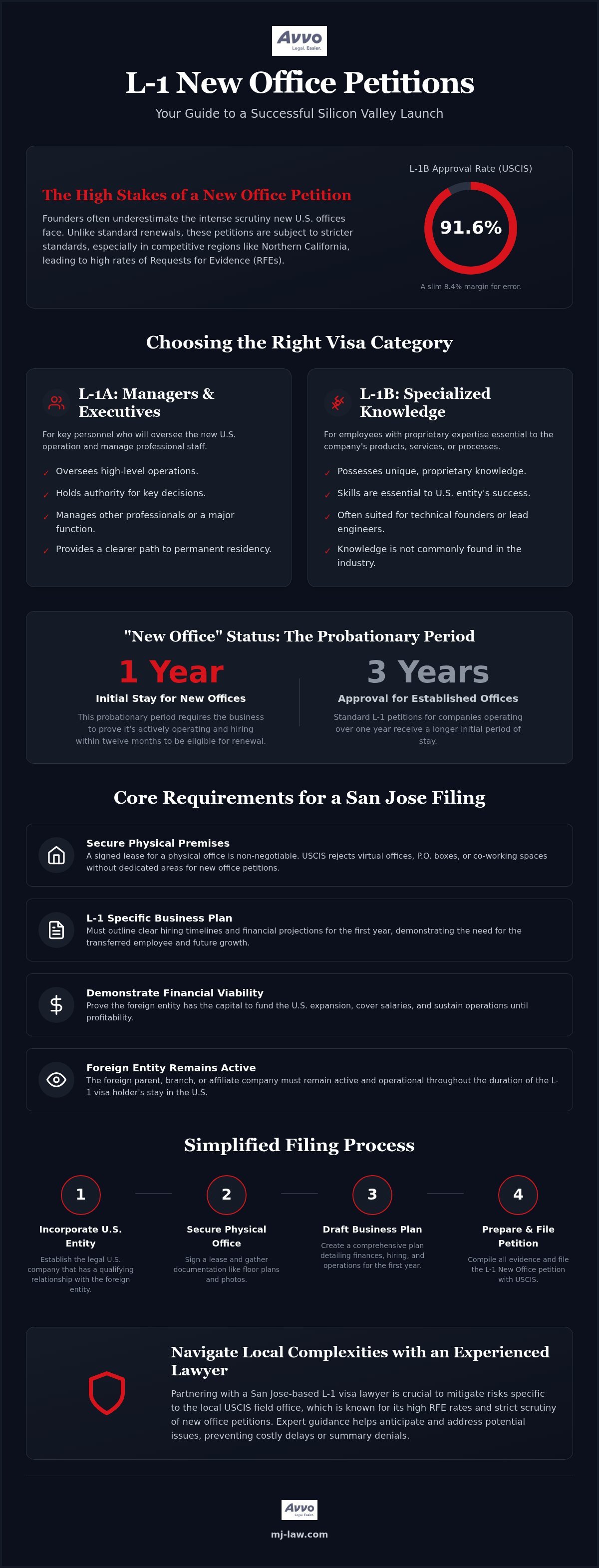
Establishing a Silicon Valley presence is often the most ambitious move a global company can make; however, many founders don’t realize that a “new office” petition is scrutinized far more strictly than a standard renewal. With USCIS approval rates for L-1B petitions currently at 91.6 percent, the margin for error remains slim, especially when facing the high Request for Evidence (RFE) rates common in Northern California. Partnering with an experienced L-1B visa lawyer San Jose can help you navigate these local complexities with confidence. You’ve likely heard that San Jose is the land of opportunity, but the administrative hurdles, from securing compliant real estate to defining “specialized knowledge,” can feel like an intense uphill battle.
This guide simplifies the path to a successful U.S. branch launch, ensuring you meet every requirement for your initial one year stay. We’ll break down the updated 2026 fee structure, including the $1,385 base filing fee for standard employers, and clarify the distinctions between managerial and specialized roles. By addressing Bay Area real estate requirements and preparing a robust petition that anticipates USCIS scrutiny, you’ll gain the clarity needed to transition your talent to the heart of the tech world.
Key Takeaways
- Understand the critical differences between L-1A for managers and L-1B for specialized knowledge to ensure your petition aligns with your key talent’s specific role.
- Learn why a physical San Jose lease is a non-negotiable requirement for a new office petition and how to secure premises that satisfy strict USCIS standards.
- Discover how to draft an L-1 specific business plan that outlines clear hiring timelines and financial projections for your first year of Silicon Valley operations.
- Consulting with an experienced L-1B visa lawyer San Jose helps you mitigate the high risk of summary denials and navigate the specific scrutiny of the local field office.
- Master the step-by-step incorporation and filing process to successfully launch your U.S. branch with a valid one-year initial period of stay.
What is an L-1 New Office Petition?
The L-1 visa category allows international companies to transfer key personnel to a U.S. parent, branch, subsidiary, or affiliate. When that U.S. entity has been in operation for less than one year, it’s classified as a “new office.” This distinction is vital because USCIS imposes specific evidentiary standards to ensure the startup is legitimate and capable of supporting a foreign professional. For a foundational understanding of the program, you can review this L-1 visa overview. In 2026, San Jose continues to be a primary destination for these petitions. Despite the competitive real estate market, the density of venture capital and technical talent makes Silicon Valley the logical choice for global tech firms. Unlike established offices that receive three-year approvals, a new office petition only grants an initial stay of one year. This probationary period requires the business to prove it’s actively operating and hiring within twelve months.
L-1A vs. L-1B: Which Path for Your New Office?
Selecting the correct classification is the first strategic hurdle. L-1A petitions are designed for managers and executives who will oversee the new U.S. operation. These individuals must demonstrate they have the authority to make high-level decisions and manage professional staff. Conversely, the L-1B category focuses on specialized knowledge, which refers to proprietary expertise regarding the company’s products, services, or international processes. If you’re transferring a lead engineer to set up a technical hub, an L-1B visa lawyer San Jose can help document how that individual’s unique skills are essential to the U.S. entity’s success. Choosing correctly is critical. While an L-1A provides a clearer path to permanent residency, an L-1B is often more suitable for technical founders who possess deep, proprietary knowledge of their core product. Many tech leaders find that understanding the L-1B specialized knowledge requirements and 2026 RFE trends is essential before deciding which classification best fits their role.
Qualifying as a ‘New Office’ in Silicon Valley
To qualify, the foreign company must maintain a qualifying relationship with the new San Jose entity, such as being a parent company or a sister affiliate. USCIS requires proof that the U.S. office is a viable business, not just a shell company. This involves showing a secured physical space and the financial capacity to pay the transferee. In the San Jose market, this is particularly complex due to strict zoning and high commercial lease costs. A seasoned L-1B visa lawyer San Jose understands that your business plan must reflect these local economic realities. You must demonstrate that the U.S. office will be doing business, meaning the regular provision of goods or services, within the first year of approval. Proving that the foreign entity remains active and operational during this time is also mandatory to sustain the L-1 relationship.
Core Requirements for a San Jose L-1 New Office Filing
A successful petition hinges on proving that the new U.S. entity is more than a legal registration; it must be a viable, functioning business. USCIS mandates that the foreign parent company remains active and operational throughout the duration of the L-1 status. This means you can’t simply close the international headquarters once the San Jose branch opens. Additionally, the petitioner must show that the U.S. office will grow enough within its first year to support a managerial or specialized knowledge position. Larger multinational corporations that regularly transfer employees may also benefit from understanding the L-1 blanket petition requirements, which can streamline the approval process for organizations with high-volume transfer needs.
For those transferring technical experts, an L-1B visa lawyer San Jose can help define how the new office’s operations will specifically require specialized staff by the end of the initial 12-month period. Reviewing the USCIS L-1A requirements provides a clear baseline for these structural expectations.
The Physical Office Space Requirement
One of the most common reasons for a Request for Evidence (RFE) in Silicon Valley is insufficient proof of physical premises. USCIS generally rejects virtual offices, co-working spaces without dedicated desks, or simple PO boxes for new office petitions. In San Jose, the type of space must align with your business model. If you’re a hardware startup, a standard office suite might not suffice if your petition claims you’ll be performing local manufacturing or assembly. You’ll need to provide a signed lease, detailed floor plans, and often high-quality photographs of the exterior and interior. These documents prove the space is ready for immediate occupancy and can accommodate the projected number of employees.
Financial Viability and Capital Investment
You must demonstrate that the foreign entity possesses the financial strength to sustain the U.S. expansion until it becomes self-sufficient. This typically involves submitting the foreign company’s tax returns, audited financial statements, and recent bank records. If your San Jose office relies on venture capital, you must clearly document the relationship between the VC funding and the U.S. entity. While parent company capital is the traditional route, Silicon Valley’s unique startup ecosystem allows for alternative funding models if they’re documented correctly.
If you’re unsure if your funding structure meets federal standards, you might consider scheduling a consultation to review your financial evidence. A seasoned L-1B visa lawyer San Jose can ensure your wire transfers and investment agreements are presented in a way that satisfies the high burden of proof required for tech startups.
The Comprehensive L-1 New Office Business Plan
A standard business plan written for venture capitalists rarely satisfies the specific evidentiary needs of an immigration officer. While an investor looks for long-term ROI, USCIS looks for immediate operational feasibility. Your plan must demonstrate that the U.S. entity will support a managerial or specialized position by the end of its first year. This requires a granular breakdown of the organizational structure. You’ll need to define whether the transferee will act as a “manager of managers,” overseeing other professional employees, or a “functional manager” who controls an essential department without necessarily having direct reports. Each path has distinct evidentiary hurdles that an L-1B visa lawyer San Jose can help you navigate to avoid common pitfalls.
Hiring Projections and Job Descriptions
Detailed hiring timelines are the backbone of a successful petition. USCIS expects to see that you aren’t just hiring “on paper” but are actively scaling to meet the needs of the Silicon Valley market. Each job description should be detailed, outlining specific duties and educational requirements. For technical roles, it’s vital to use local San Jose salary surveys to prove that your compensation packages are competitive for the region. This data reinforces the financial viability of your expansion. When drafting these roles, an L-1B visa lawyer San Jose ensures that job duties align with federal definitions of specialized knowledge, which is often a point of contention during the RFE process. Understanding the latest 2026 RFE trends surrounding L-1B specialized knowledge requirements can help you craft job descriptions that withstand USCIS scrutiny.
Operational Strategy in Silicon Valley
Articulating the strategic necessity of a San Jose presence is equally important. You must explain how the U.S. office supports your global corporate mission and why this specific location was chosen. This involves a deep dive into the local market, addressing your competition and how you’ll integrate into the Silicon Valley ecosystem. The USCIS L-1A New Office Requirements emphasize that the petitioner must show the new office will be doing business within the one-year initial period. Your strategy shouldn’t just focus on sales; it needs to prove that the office is a functional branch of the parent company, actively providing goods or services to the American market.
Step-by-Step Guide to Filing Your L-1 New Office Petition
Launching a Silicon Valley branch requires a methodical approach to satisfy federal regulations. The process begins with establishing the U.S. entity, typically by incorporating in California and obtaining an Employer Identification Number (EIN) from the IRS. Once the legal structure is in place, you must secure a physical office in San Jose. As previously discussed, this location must be ready for business and large enough to house your projected staff. You’ll then compile extensive corporate documentation from both the foreign parent company and the new U.S. office to prove a qualifying relationship. Drafting the Form I-129 and a detailed “New Office” supporting letter is the final preparatory step before filing. Given the 91.6 percent approval rate for L-1B petitions in early 2026, success often depends on the precision of this initial filing to avoid a summary denial.
Gathering Evidence from the Foreign Parent Company
The strength of your petition rests on the stability of the overseas entity. You must provide articles of incorporation, business licenses, and proof of ownership to establish that a qualifying relationship exists between the two companies. USCIS requires evidence that the foreign company will continue to operate while the beneficiary is in the United States. This is usually demonstrated through annual reports, tax returns, or audited financial statements from the past three years. If your international operations are complex, an L-1B visa lawyer San Jose can help organize these documents into a clear, persuasive narrative for the adjudicating officer.
Navigating the USCIS Filing and Approval Process
When you’re ready to file, you have two primary paths. Standard processing currently takes approximately seven months. However, many Silicon Valley startups opt for premium processing. For a fee of $2,965, USCIS guarantees a decision or a Request for Evidence (RFE) within 15 business days. This is often the preferred route for businesses with tight launch windows. It’s important to remember that your initial approval is only valid for one year. This “probationary” period is a test of your business plan. To remain in the U.S. beyond this first year, you must file an extension of stay and prove that the office has grown, hired employees, and is fully operational. Growing corporations planning to scale their intracompany transfers beyond a single petition should also explore how meeting L-1 blanket petition requirements can accelerate future transfers at the enterprise level.
The transition from a foreign startup to a San Jose mainstay is a high-stakes journey. To ensure your filing meets the rigorous standards of the local field office, schedule a strategic consultation with our team. An experienced L-1B visa lawyer San Jose provides the steady hand needed to manage these intricate procedures and prepare your business for a successful first year of operation.
Why Partner with an L-1B Visa Lawyer in San Jose?
The stakes for a new office petition are exceptionally high because USCIS views these filings as probationary tests of a company’s viability. A summary denial can halt your Silicon Valley expansion before it begins, wasting significant capital and time. Partnering with an experienced L-1B visa lawyer San Jose ensures that your petition is built on a foundation of local compliance and federal precision. Our firm has been a steady hand for tech founders and global corporations since 1985, providing the reassuring expertise necessary to navigate the complexities of the U.S. immigration system. We understand that an L-1 petition is often just the first step in a larger journey. Many of our clients eventually transition from intracompany status to permanent residency through categories like the EB-1C for managers or the EB-2 National Interest Waiver (NIW).
Local Knowledge: From San Jose Leases to USCIS Field Offices
California-based USCIS service centers often exhibit specific preferences regarding the documentation of “specialized knowledge” and managerial roles. Our deep roots in the local community allow us to provide guidance that goes beyond simple form filing. We leverage an extensive network of local professionals to assist with compliant business plans and San Jose real estate requirements. This local perspective is particularly valuable when addressing the unique challenges of the Bay Area market. If your expansion involves high-level executives rather than technical staff, you can learn more about our L-1A Visa Lawyer San Jose services to ensure your leadership team is properly classified.
Comprehensive Support for Your Silicon Valley Journey
We manage the entire intracompany transfer lifecycle, from the initial consultation to the eventual goal of U.S. citizenship. Our team provides bilingual support in English and Spanish, ensuring clear communication throughout the process. We don’t just file papers; we act as a collaborative partner in your company’s growth. By anticipating potential RFEs and structuring petitions to meet the latest 2026 standards, we reduce the stress of international transitions. This methodical approach allows you to focus on scaling your business while we handle the intricate legal procedures required for a successful launch.
Ready to expand? Schedule a consultation with MJ Law today to secure your company’s future in the heart of Silicon Valley. Our decades of experience in the San Jose and San Francisco area provide the reliability you need for a complex organizational move.
Securing Your Silicon Valley Future
Establishing a U.S. branch is a strategic milestone that requires bridging international expertise with local compliance. A successful office launch rests on a robust one-year business plan and securing a physical San Jose workspace that satisfies strict USCIS scrutiny. Working with a seasoned L-1B visa lawyer San Jose provides the steady hand needed to navigate these high-stakes requirements and avoid common pitfalls like summary denials.
MJ Law brings over 30 years of Silicon Valley expertise to your side, offering bilingual consultations in English and Spanish to support your global team. Our firm has a proven track record of helping tech startups launch and scale within the competitive Bay Area ecosystem. We manage the intricate details of your petition so you can focus on your company’s growth and innovation.
Book Your L-1 New Office Consultation with MJ Law to begin your expansion journey with confidence. Your vision for a global presence is within reach, and we’re here to ensure your office launch is the start of a lasting success story.
Frequently Asked Questions
Can a startup with no revenue qualify for an L-1 new office petition?
Yes, a startup with no current revenue can qualify. The foreign parent must demonstrate the financial ability to remunerate the beneficiary and commence U.S. business. USCIS focuses on capital investment and the viability of the business plan rather than immediate profits. You must prove the foreign entity remains active and has sufficient funds to support the San Jose expansion through its first year of operations.
Do I need to have a physical office lease before filing the L-1 petition?
Yes, securing a physical office lease is a mandatory requirement. You must meet this before filing the petition. USCIS explicitly requires evidence that “sufficient physical premises” have been obtained to house the new office. In the competitive San Jose market, this involves providing a signed lease, floor plans, and photographs. Virtual offices or simple mailing addresses will likely result in a denial or a heavy Request for Evidence.
What is the difference between an L-1A and an L-1B for a new office?
The primary difference lies in the beneficiary’s role and the future green card path. An L-1A is reserved for managers or executives who will oversee the new entity’s operations. An L-1B is for individuals with specialized knowledge of proprietary products or processes. Consulting an L-1B visa lawyer San Jose is helpful for determining which classification best fits your technical talent and future organizational goals.
How many employees must the new San Jose office hire in its first year?
There is no specific regulatory number of employees required. However, the office must hire enough staff to support the beneficiary’s role by the end of the first year. For an L-1A manager, this usually means hiring professional or subordinate staff. Your business plan should outline a realistic hiring timeline that reflects the labor needs of the San Jose tech corridor and your specific industry.
Can the owner of the foreign company come to the U.S. on an L-1 visa?
Yes, owners of a foreign company can qualify for an L-1 visa to establish a new U.S. office. The individual must have been employed by the foreign affiliate in a managerial or specialized knowledge capacity for at least one year. This must occur within the three years preceding the filing. It’s a common strategy for founders looking to personally lead their Silicon Valley expansion while maintaining their global corporate structure.
What happens if the new office is not profitable after the first year?
Profitability is not a strict requirement for a first-year extension. However, you must demonstrate that the office is “doing business.” This means the regular and systematic provision of goods or services. If the office isn’t yet profitable, USCIS will look for evidence of active operations and significant development. An L-1B visa lawyer San Jose can help document these operational milestones to secure a successful extension.
Is premium processing available for L-1 new office petitions in 2026?
Yes, premium processing is available for L-1 new office petitions in 2026. For a fee of $2,965, USCIS guarantees a response within 15 business days. This remains a popular option for San Jose businesses with tight launch deadlines. If the agency issues a Request for Evidence, the clock resets once they receive your response. This ensures a relatively fast decision for your Silicon Valley entity.
How does the L-1 new office petition lead to a green card?
The L-1 visa is a “dual intent” classification. Holders can legally seek permanent residency while maintaining their non-immigrant status. L-1A managers often transition to the EB-1C green card category. Technical professionals on an L-1B typically pursue the EB-2 or EB-3 categories. Because the new office petition is only valid for one year, establishing a strong operational track record early is essential for any future residency application.