Receiving an H-1B denial notice feels like a definitive end to your American career, but in 2026, it’s often just the beginning of a more sophisticated legal strategy. You’ve worked hard to build a life in Silicon Valley, and the sudden threat of losing your work authorization or facing deportation is overwhelming. It’s deeply frustrating when USCIS issues a specialty occupation challenge that seems to ignore your advanced skills and the unique requirements of the tech industry. Partnering with a skilled h-1b visa denial appeal lawyer allows you to meet these bureaucratic challenges with a composed, results-driven response that protects your livelihood.
You deserve a partner who understands that a denial is a procedural hurdle, not a final verdict. This guide will show you how to challenge arbitrary decisions and secure your professional future. We’ll explore the critical differences between administrative appeals, motions to reopen, and federal litigation to determine the fastest path toward a reversal. By understanding the strategic pathways available, you can regain control over your timeline, extend your legal stay, and protect your status in the United States.
Key Takeaways
- Understand why USCIS often questions tech roles and how to prove your position meets “specialty occupation” standards through detailed job duty mapping.
- Work with an h-1b visa denial appeal lawyer to choose between a Motion to Reopen or a formal AAO appeal based on the specific evidence available in your case.
- Explore federal court litigation as a strategic alternative that often provides a more objective review of your petition than internal administrative channels.
- Learn how a denial affects your I-94 expiration and what specific steps you must take to protect your legal status while an appeal is pending.
- Leverage 30 years of Silicon Valley expertise to build a robust legal rebuttal that addresses the unique requirements of the tech industry and local USCIS offices.
Understanding the Common Grounds for H-1B Denials in 2026
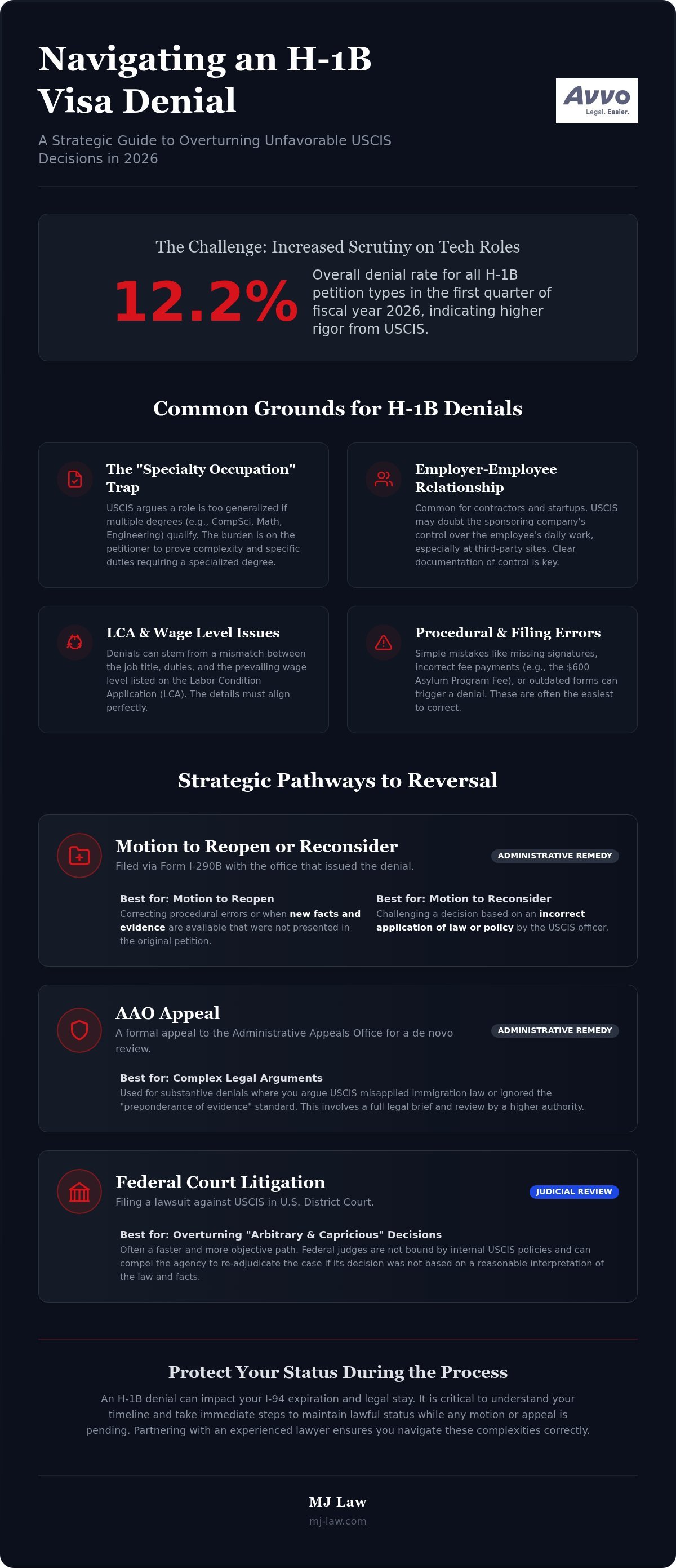
The landscape for the H-1B visa program has shifted significantly. While initial petition approval rates stayed high through early 2026, the overall denial rate for all petition types rose to 12.2% in the first quarter of the fiscal year. This increase indicates that USCIS is applying much higher rigor to technical roles. If you’ve received a denial, your first step is to identify whether the agency’s decision was based on a legitimate legal requirement or if it was an “arbitrary and capricious” interpretation of the facts. An h-1b visa denial appeal lawyer can help you dissect the notice to find these specific errors. Common hurdles include Labor Condition Application (LCA) discrepancies where the job title doesn’t align with the prevailing wage level. Additionally, contractors and startups often face the “Employer-Employee Relationship” challenge, where USCIS doubts the sponsoring company controls the daily work of an employee at a third-party site.
The “Specialty Occupation” Trap for Engineers
In Silicon Valley, many software engineering roles are flagged because USCIS claims the position is too generalized. They argue that because a variety of degrees, such as Computer Science, Math, or Electrical Engineering, can lead to the role, it doesn’t require a specific specialty. You can’t just list standard responsibilities. You must prove complexity. Expert opinion letters from university professors or industry veterans are essential to bridge the gap between your duties and the academic requirement. Emphasize the architectural or algorithmic challenges your role solves to satisfy the specialty occupation requirement.
Procedural Errors vs. Substantive Denials
Sometimes, the issue isn’t your qualifications. It’s a simple administrative oversight. In 2026, new fee structures have created confusion. For example, the Asylum Program Fee ($600 for large employers) or the $215 registration fee must be paid exactly. If USCIS denies a petition based on a missing signature or a fee discrepancy, these are procedural errors that you can often resolve through a Motion to Reopen. These mistakes are frustrating but are usually the easiest to fix with a methodical review of the filing documents.
Substantive denials are more complex. These occur when USCIS misapplies immigration law, like ignoring the preponderance of evidence standard. The “Statement of Facts” in your denial notice serves as the roadmap for your h-1b visa denial appeal lawyer. It lists exactly what evidence the officer reviewed and where they believe you fell short. By identifying where the officer ignored documents or misconstrued the law, you can build a rebuttal that forces an objective review. This detailed analysis is what turns a denial into a successful appeal.
Administrative Remedies: Motions to Reopen vs. AAO Appeals
Receiving a denial doesn’t mean your professional journey in the United States has to end. You have several administrative paths to challenge the decision, but you must act quickly to preserve your rights. Historical data often highlights high rates of H-1B denials, making it essential to understand which legal remedy fits your specific situation. Generally, you can choose between a Motion to Reopen, a Motion to Reconsider, or a formal appeal to the Administrative Appeals Office (AAO). A Motion to Reopen is appropriate when you’ve secured new facts or documentary evidence that wasn’t available during the initial filing. Conversely, a Motion to Reconsider is used to challenge a decision based on an incorrect application of law or immigration policy.
Filing Form I-290B: Requirements and Fees
To initiate any of these remedies, your employer must file Form I-290B. In 2026, USCIS fees have been restructured across several categories, so it’s vital to verify the current filing fee on the agency’s official schedule before submitting your packet. While filing occurs with the office that made the original decision, the AAO handles the actual appellate review for substantive legal challenges. You must submit your request within 30 days of the decision date, but the deadline is strictly 33 days if you received your notice by mail.
Strategic Choice: Should You File a Motion or an Appeal?
Choosing between a motion and an appeal requires a careful analysis of why USCIS rejected the petition. A Motion to Reopen often provides the fastest path to a “Yes” because the local service center can vacate its own decision if your new evidence is compelling. If the local office remains firm, the AAO offers a more detached review by a higher body. Data from the third quarter of fiscal year 2026 shows that the AAO completed 100% of its H-1B appeals within its 180-day goal, providing a clear timeline for resolution.
Many professionals choose to file a combined motion and appeal for maximum legal leverage. This strategy allows the local office to reconsider the case first; if they don’t change their mind, the case automatically moves to the AAO for a full review. An h-1b visa denial appeal lawyer can help you determine if this “belt and suspenders” approach is right for your specific case. If you’re feeling overwhelmed by these procedural choices, you can schedule a strategic review to examine your options with an expert guide.
Federal Court Litigation: The Faster Path to H-1B Approval?
While the USCIS Notice of Appeal or Motion is the standard path for administrative review, many Silicon Valley companies now turn to federal district court for a faster, more objective resolution. Administrative officers are bound by internal agency culture, but federal judges offer a truly independent perspective. When an h-1b visa denial appeal lawyer files a lawsuit under the Administrative Procedure Act (APA), they aren’t just asking for a second look. They’re challenging whether the agency’s decision was “arbitrary and capricious.” This higher level of scrutiny often works in favor of tech firms whose complex roles are frequently misunderstood by USCIS officers who lack industry specific expertise.
One of the most effective aspects of federal litigation is the settlement phenomenon. Once a complaint is filed, the Department of Justice represents the government. These attorneys often prefer to settle and remand the case for approval rather than defending a legally weak denial in open court. For a high growth startup, this can mean the difference between losing a key engineer and securing an approval in a fraction of the time a standard appeal takes.
The Process of Filing a Complaint in District Court
Drafting a federal complaint requires a deep understanding of both immigration law and constitutional due process. Your legal team must document every procedural misstep by the agency to prove they ignored their own precedents. While litigation involves higher upfront costs than a standard motion, the timeline is often superior. While the AAO aims for a 180 day resolution, a federal lawsuit can trigger a government concession within 60 to 90 days. This makes it a powerful tool for companies that can’t afford a half year of uncertainty. If you’re weighing the costs of lost productivity against legal fees, you can request a strategic case evaluation to determine the best path forward.
Success Rates and Case Precedents
Recent trends in 2025 and 2026 demonstrate that courts are increasingly willing to challenge agency overreach. For example, a federal court order on July 24, 2026, vacated agency guidance regarding a proposed $100,000 H-1B fee, proving that litigation is a viable way to halt restrictive policies. Litigation forces a “de novo” review of your specialty occupation status, meaning the judge looks at the evidence fresh without deferring to the previous denial. Federal court forces USCIS to follow its own regulations and ensures they don’t invent new requirements that aren’t found in the law. This objective standard is why many h-1b visa denial appeal lawyer teams recommend litigation for complex technical roles.
Maintaining Legal Status During the Appeal Process
Receiving an H-1B denial notice triggers immediate concerns about your right to remain in the United States. It’s a common misconception that filing an appeal or motion automatically extends your legal status. In reality, while your h-1b visa denial appeal lawyer works to overturn the decision, your previous status may have already expired based on your I-94 date. If your I-94 is still valid, you’re generally safe to stay until that specific date passes. However, if it has already expired, you begin accruing “unlawful presence” the moment the denial is issued. Accruing more than 180 days of unlawful presence can trigger a three year bar from re-entering the country, making it vital to act within the first few weeks of receiving a notice.
The 240-day rule, which allows you to continue working while a timely filed extension is pending, ends immediately upon a denial. To avoid status gaps, many professionals look for “bridging” options. This might involve switching to an H-4 dependent visa, an O-1 for extraordinary ability, or a B-2 visitor visa to provide a short window for departure or litigation. A strategic H-1B Transfer Attorney San Jose: Silicon Valley Job Changes can evaluate if moving to a new employer is a viable path while your current case is in litigation.
Travel Restrictions and Work Authorization
You should generally avoid international travel while an I-290B is pending. Leaving the country often results in the abandonment of your motion or appeal, effectively ending your chance for a reversal. Additionally, your work authorization usually ceases the day the denial is finalized. Employers must be careful here; keeping a staff member on payroll after a denial without a valid “cap-gap” or alternative authorization can lead to significant compliance penalties. We work closely with HR departments to implement legal stay strategies that protect both the company and the individual during this high-stakes period.
Nunc Pro Tunc Petitions: Fixing Status Gaps
If you’ve already fallen out of status due to a denial, a “Nunc Pro Tunc” request might be your best solution. This is a discretionary request asking USCIS to grant a late filing “as if” it were on time. To succeed, you must prove “extraordinary circumstances” beyond your control, such as a severe medical emergency or a clear administrative error. Our firm has spent over 30 years helping Silicon Valley professionals navigate these complex filings to bridge status gaps and secure their future. If you’re worried about your current I-94 expiration, book a status protection consultation to discuss your specific timeline.
How an Experienced San Jose H-1B Lawyer Overturns Denials
Overturning a USCIS decision requires more than just a basic understanding of immigration forms. It demands a sophisticated grasp of how federal regulations intersect with the evolving needs of the technology sector. MJ Law brings over 30 years of experience to this pursuit, acting as a steady hand for professionals who face the sudden uncertainty of a denial. As your h-1b visa denial appeal lawyer, we focus on crafting a rebuttal that addresses the specific legal deficiencies identified by the agency. We don’t just repeat previous arguments. Instead, we reconstruct the case by highlighting the high level of complexity inherent in Silicon Valley roles, ensuring that USCIS cannot easily dismiss the technical requirements of your position.
Our firm leverages an extensive network of industry experts and academic professors across the Bay Area. These partnerships allow us to secure the expert opinion letters necessary to validate specialty occupation claims. By providing a detailed, evidence-based narrative, we force a more objective review of the petition. This collaborative approach transforms a standard appeal into a robust legal challenge that reflects the true value you bring to your employer.
Why Local San Jose Expertise Matters
Proximity to the San Jose and San Francisco USCIS field offices provides a distinct advantage. We understand the specific adjudication trends and local nuances that affect cases in tech hubs like Palo Alto and Mountain View. This localized knowledge is essential when documenting how a role fits within the unique job market dynamics of Northern California. For those preparing for future cycles, our H-1B Visa Attorney San Jose: Your Guide to a Successful 2026 Filing provides additional insights into avoiding common pitfalls before they lead to a denial.
Your Personalized Appeal Strategy
Every denial notice is unique, so every strategy must be tailored to the specific facts at hand. During an initial consultation, we evaluate the strength of your case and determine whether a Motion to Reopen or federal litigation offers the most viable path toward success. Our bilingual legal team is dedicated to supporting diverse global talent, ensuring that communication remains clear and transparent throughout the entire process. We view our clients as partners in a shared mission to protect their professional future. If you’re ready to challenge a recent decision, you can schedule a consultation with our H-1B appeal specialists to begin building your defense. A single denial notice shouldn’t be the final word on your career in the United States; with the right h-1b visa denial appeal lawyer, it’s often just the start of a successful reversal.
Securing Your Professional Future in Silicon Valley
An H-1B denial is a significant hurdle, but it doesn’t have to be the final word on your career in the United States. Whether you choose to pursue an administrative motion or move directly to federal court litigation, the key is acting within the strict 30-day filing window. Understanding how to bridge your status and avoid unlawful presence is equally vital for protecting your long-term eligibility. Our San Jose-based team brings over 30 years of experience to these complex cases, offering the steady guidance needed to navigate high-stakes immigration challenges. We provide bilingual English and Spanish support to ensure every professional feels heard and understood.
Partnering with a dedicated h-1b visa denial appeal lawyer allows you to replace uncertainty with a methodical, results-driven strategy tailored to the Silicon Valley tech landscape. Don’t let a procedural error or a specialty occupation challenge derail your hard-earned progress. You can book a consultation with MJ Law to review your H-1B denial and explore your legal pathways today. Your professional journey is worth the fight, and we’re here to help you move forward with confidence.
Frequently Asked Questions
How long do I have to appeal an H-1B denial in 2026?
You must file your appeal within 30 days of the decision date listed on your denial notice. If you received the notice via mail, the deadline is strictly 33 days. Missing this window usually results in a summary dismissal of your case without a review of the merits. It’s essential to consult with an h-1b visa denial appeal lawyer immediately to ensure Form I-290B is submitted accurately and on time to preserve your legal rights.
Can I stay in the U.S. while my H-1B appeal is pending?
Filing an appeal doesn’t automatically grant you valid legal status or the right to remain in the country. If your I-94 has already expired, you begin accruing unlawful presence the day your petition is denied. To avoid the risk of a multi-year re-entry bar, you should explore alternative status options or bridging strategies. Consult your legal team to determine if a change of status to a B-2 or H-4 visa is necessary to protect your future eligibility.
What is the success rate of H-1B appeals at the AAO?
Success rates vary significantly based on the reason for the initial denial. While the Administrative Appeals Office (AAO) completed 100% of its 51 decided I-129 H-1B appeals within 180 days during the third quarter of 2026, many administrative appeals are dismissed if they lack new, compelling evidence. This is why many professionals choose federal litigation or filing a new, stronger petition over a standard administrative appeal. A detailed case review helps identify the most promising path.
Is it better to file a new H-1B petition or appeal the denial?
Filing a new petition is often faster and more effective than waiting for a lengthy appeal process. A new filing allows you to address the specific concerns raised in the denial notice with fresh evidence and a stronger job description. However, if your status has expired, an appeal might be necessary to maintain a record of continuous lawful presence. An h-1b visa denial appeal lawyer can evaluate which strategy minimizes your professional downtime and maximizes your approval chances.
How much does it cost to file an H-1B appeal?
The current USCIS filing fee for Form I-290B is $800. This fee is required regardless of whether you’re filing a motion to reopen, a motion to reconsider, or an appeal to the AAO. You should also account for additional costs related to gathering new evidence, such as expert opinion letters or academic evaluations. Ensure your employer uses the correct payment method and includes the required Asylum Program Fee if applicable to avoid procedural rejections at the filing stage.
Can my employer file a motion to reconsider on my behalf?
Your sponsoring employer must be the one to file the motion because they are the legal petitioner for the H-1B visa. As the beneficiary, you don’t have independent standing to appeal the decision yourself. Your company’s authorized representative or their legal counsel must sign the necessary forms and submit the required filing fees. This collaborative effort ensures that the rebuttal arguments align with the company’s organizational needs and the specific technical requirements of the role.
What happens if my H-1B appeal is also denied?
If the AAO upholds the initial denial, your next step is typically to file a complaint in Federal District Court. Litigation allows a judge to review the case fresh and determine if USCIS acted in an arbitrary or capricious manner. If you choose not to litigate, you must prepare to depart the United States or change to a different nonimmigrant status immediately. Timely action is critical to avoid long-term immigration consequences that could affect your career.
Does a denial affect my future green card application?
A standard H-1B denial based on a specialty occupation challenge generally doesn’t prevent you from applying for a green card in the future. However, if the denial was based on fraud, willful misrepresentation, or results in significant unlawful presence, it could complicate your path to permanent residency. Maintaining a clean immigration record is essential for long-term success. Working with an experienced legal team helps ensure that your current challenges don’t negatively impact your future goals.