Did you know that as of June 2026, there are over 48,000 pending family green card cases in California? This staggering number represents thousands of families waiting for answers, highlighting how easy it’s for a single mistake to cause a multi-year delay. If you’re a U.S. citizen living in San Jose or San Francisco, the emotional weight of being separated from your aging parents is often compounded by the stress of complex USCIS forms. Consulting with a dedicated parent green card attorney California provides the professional authority needed to navigate this high-stakes environment with confidence.
We understand your fear of a long separation and the confusion surrounding the latest filing fees and financial sponsorship rules. It’s vital to get every detail right the first time to avoid a Request for Evidence (RFE). This guide will walk you through the exact legal steps for 2026, including the current I-130 and I-485 requirements and the mandatory medical exam submission rules. You’ll gain a clear preview of the total costs and a realistic processing timeline. Our goal is to provide a steady hand to help you achieve a successful family reunification in the Bay Area.
Key Takeaways
- Understand why parents are classified as “Immediate Relatives,” allowing them to bypass the long wait times associated with other family preference categories.
- Learn how a parent green card attorney California can help you decide between Adjustment of Status and Consular Processing based on your family’s current location.
- Identify the 2026 income requirements for the I-864 Affidavit of Support to ensure you meet the financial sponsorship criteria in the expensive California market.
- Discover the critical importance of concurrent filing and the updated medical exam submission rules to avoid common delays at the San Jose and San Francisco field offices.
- Gain insights from over 30 years of local immigration experience to navigate the specific procedural quirks of Northern California USCIS locations.
Eligibility for Parent Green Cards in California
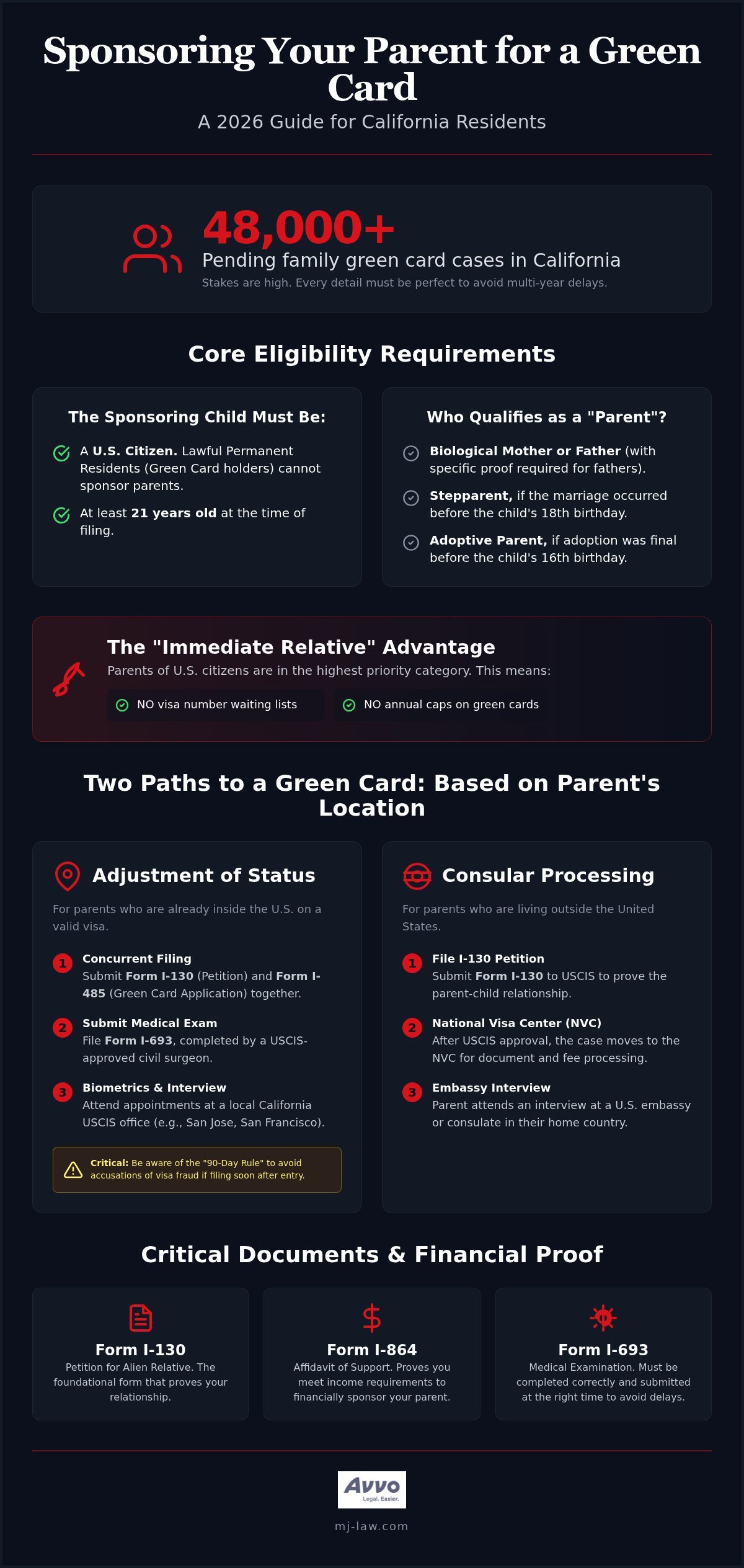
U.S. immigration law reserves the parent sponsorship category exclusively for U.S. citizens who are at least 21 years old. This age requirement is firm; you cannot begin the petition process as a minor or as a Lawful Permanent Resident. If you’re currently a Green Card holder, you’ll need to complete the naturalization process before you can sponsor your parents. A parent green card attorney California can review your specific status to ensure you meet these foundational requirements before you file.
Parents are classified as “Immediate Relatives” (IR) under the law. This classification is the most favorable status available in the family-based immigration system. While other categories, like the brothers and sisters of U.S. citizens, face annual caps and decade-long waiting lists, parents aren’t subject to these quotas. There’s always a visa available for them as soon as the petition is approved. This priority status is designed to keep families together, but the burden of proof remains on the petitioner to document the parental relationship accurately.
Who Qualifies as a “Parent” Under U.S. Immigration Law?
The legal definition of a parent extends beyond biological ties, but each relationship type requires specific evidence. Establishing these connections correctly is vital to avoid a Request for Evidence (RFE) that could stall your case for months. The criteria are as follows:
- Biological Mothers: The relationship is typically established through a birth certificate showing the child’s name and the mother’s name.
- Biological Fathers: You must provide a birth certificate and proof of marriage to the mother, or evidence of legitimation before the child turned 18.
- Stepparents: The marriage creating the step-relationship must have taken place before the child’s 18th birthday.
- Adoptive Parents: The adoption must have been legally finalized before the child reached age 16; additionally, the child must have been in the legal custody of and resided with the adoptive parent for at least two years.
The “Immediate Relative” Advantage
The primary benefit of the Immediate Relative category is the absence of a “Priority Date” waiting line. In most other family categories, applicants must wait for their turn in a queue that moves slowly based on their country of origin. Because parents don’t face these caps, they can often apply for their Green Card immediately if they’re already in the U.S. through a process called Adjustment of Status. This speed is a significant relief for families in Northern California who are eager to bring their aging parents home. Working with a parent green card attorney California helps you capitalize on this priority status by ensuring your initial filing is comprehensive and error-free.
Navigating the Application Process: Step-by-Step
The journey to securing residency for your family begins with Form I-130, Petition for Alien Relative. This form serves as the legal foundation of your petition. It officially establishes the relationship between you and your parent for the federal government. Success depends on more than just filling out a form; it requires a bulletproof evidence package. You’ll need to gather original or certified copies of birth certificates and marriage licenses. If these documents aren’t in English, you must provide certified translations. A parent green card attorney California ensures that every document meets strict USCIS standards, preventing the common clerical errors that cause immediate rejections.
Adjustment of Status (AOS) for Parents Already in the U.S.
If your parents are currently visiting California on a valid non-immigrant visa, they may be eligible to adjust their status without leaving the country. This path is often preferred because it allows for “concurrent filing.” By submitting Form I-130 and Form I-485 (Application to Register Permanent Residence) together, you can often streamline the process. However, timing is critical. You must be mindful of the “90-day rule,” which helps USCIS determine if a visitor had “preconceived intent” to stay permanently when they entered on a temporary visa. Filing too early can lead to accusations of visa fraud. We analyze your parent’s entry date and visa type to determine the safest window for submission.
Consular Processing for Parents Living Abroad
For parents residing in their home country, the process follows the Consular Processing route. Once USCIS approves the initial I-130 petition, the case is transferred to the National Visa Center (NVC). The NVC acts as a middleman, collecting filing fees and the Affidavit of Support before scheduling an interview at the local U.S. Embassy or Consulate. Your parent will also need to complete a medical examination with an embassy-approved physician. While this path involves more international coordination, it’s the standard procedure for families who are currently separated by borders. It’s a methodical process that requires patience and precise documentation at every stage.
The complexity of these two paths highlights why many families choose to partner with an experienced immigration firm to manage the heavy lifting. Even a minor oversight in a civil document or a missed deadline at the NVC can result in months of unnecessary separation. We provide the steady hand needed to keep your case moving forward without avoidable delays.
Meeting Financial Requirements (I-864) in Silicon Valley
The Affidavit of Support, or Form I-864, is a legally binding contract between the sponsor and the U.S. government. By signing this document, you’re assuming a legal obligation to provide financial support for your parents so they don’t rely on public benefits. This responsibility typically lasts until your parent becomes a U.S. citizen or earns 40 quarters of work credit. In the high-cost environment of San Jose and San Francisco, USCIS scrutinizes these financial documents with a high degree of precision. Working with a parent green card attorney California is particularly helpful when your income includes complex components like restricted stock units (RSUs) or performance bonuses common in Northern California tech firms. U.S. citizens in Silicon Valley who are also planning to bring a foreign-born partner to the country should be aware that similar income thresholds apply when working with a fiance visa attorney San Jose to navigate the K-1 visa process.
Proving Sufficient Income and Assets
To qualify as a sponsor, you must demonstrate an income that meets at least 125% of the Federal Poverty Guidelines. The 2026 threshold for a household of two in the contiguous states is approximately $27,050, while a household of four requires roughly $39,000. While tax returns and W-2s serve as the primary evidence, Silicon Valley residents often face unique challenges if their base salary appears lower than their total compensation. If your income falls short of the requirement, you can supplement the gap using personal assets. Eligible assets include:
- Liquid Savings: Funds held in checking or savings accounts.
- Stocks and Bonds: Investments that can be converted to cash within one year.
- Real Estate Equity: The value of property minus any outstanding mortgages or liens.
Keep in mind that assets are generally valued at a fraction of their worth for sponsorship purposes. For parents, you must typically show assets worth five times the income gap, though certain rules may allow for a three-times valuation in specific scenarios. We help you calculate these values accurately to ensure your filing remains robust.
Beyond meeting immediate immigration needs, bringing parents to the U.S. is an ideal time to review your family’s broader legal protections. For those with business or estate interests in Texas, Massingill Attorneys & Counselors at Law offers specialized expertise in business law and probate services to help secure your family’s future across state lines.
The Role of Joint Sponsors
If your individual income and assets don’t meet the threshold, you can include a joint sponsor in your application. A joint sponsor doesn’t need to be a relative; they simply must be a U.S. citizen or permanent resident who meets the income requirements independently. They’ll sign their own I-864 and assume the same legal liabilities as the primary petitioner. This is a common solution for retirees or younger professionals who haven’t yet built a long tax history. We guide families through the process of selecting a joint sponsor who understands the long-term commitment involved, ensuring that the partnership is built on clear communication and trust.
Avoiding Delays: Common Pitfalls and Medical Requirements
Filing the initial paperwork is only the beginning of a process where precision is mandatory. One of the most common reasons for a Request for Evidence (RFE) or a flat rejection is the failure to include the Form I-693, Report of Medical Examination and Vaccination Record, with the initial I-485 package. As of December 2, 2024, this document must be submitted concurrently with the application. If you omit it, USCIS may reject your filing immediately. While the COVID-19 vaccination is no longer a requirement as of January 22, 2025, other standard vaccinations and health screenings remain essential. A parent green card attorney California ensures your medical documents are signed by a designated civil surgeon and sealed correctly before they reach the field office.
Healthcare and the Public Charge Rule
The “Public Charge” rule remains a significant concern for families sponsoring elderly parents in 2026. USCIS evaluates whether an applicant is likely to become primarily dependent on the government for subsistence. For older parents, this assessment heavily weighs their age, health, and financial resources. It’s not enough to show that you meet the income requirements; you should also demonstrate a clear plan for your parent’s healthcare. In California, where medical costs are exceptionally high, providing proof of private health insurance or the ability to pay for long-term care can significantly strengthen the case. While certain benefits like SNAP or emergency Medicaid are generally safe, relying on long-term institutional care at government expense could jeopardize the application.
Documenting the Parent-Child Relationship
Establishing a legal biological or step-relationship can be difficult if your parent’s home country lacks standardized records. When a primary birth certificate is unavailable or contains errors, you must provide secondary evidence. This might include school records, religious documents, or hospital records created shortly after birth. In some cases, USCIS may suggest DNA testing to confirm a biological link. We help you proactively gather these alternative documents to avoid the stress of an RFE later in the process. Additionally, we advise clients on the risks of unauthorized travel. Leaving the U.S. without an approved Advance Parole document while an Adjustment of Status application is pending can result in the case being considered abandoned.
If you’re worried about how these complex rules might affect your family’s future, contact our experienced attorneys today to schedule a consultation and secure your parent’s path to residency.
Why a San Jose Parent Green Card Attorney is Essential
Sponsoring a parent for permanent residency is a deeply personal journey that requires more than just administrative accuracy. It demands a legal partner who understands the specific landscape of Northern California. With over 30 years of experience in family immigration, attorneys Gabriel Jack and Michael Muston provide the professional authority needed to manage complex transitions. Our firm acts as a steady hand, guiding families through the intricate USCIS system with a focus on individual success. When you work with a parent green card attorney California, you aren’t just hiring a service; you’re securing a partnership dedicated to your family’s long-term stability.
Local Expertise in the Silicon Valley Jurisdiction
The San Jose and San Francisco USCIS Field Offices have unique operational rhythms that can impact your case. Local representation is vital because it allows for direct oversight of the interview process. We understand how local officers evaluate documentation and what they expect during in-person appointments. This specialized knowledge helps us prepare you and your parents for the specific questions that often arise in this jurisdiction. Our history of success in Northern California means we can anticipate potential hurdles before they become delays. We prioritize direct communication, ensuring that you receive personalized attention rather than being treated as just another case number in a high-volume system.
A Compassionate Approach to Family Reunification
We recognize the emotional weight that comes with bringing aging parents to a new country. It’s a transition that affects the entire household, and clear communication is the key to reducing stress. To support our diverse community, MJ Law offers bilingual services in English and Spanish. This allows parents to participate fully in consultations, ensuring they feel comfortable and informed throughout the process. We take the time to explain every step, from the initial filing to the final visa issuance, so there are no surprises. Our goal is to provide a composed and reassuring environment where your family feels secure and supported.
The path to residency is complex, but you don’t have to navigate it alone. We invite you to schedule a consultation to review your family’s unique situation and develop a tailored legal strategy. Taking the right first step today can prevent years of frustration and separation. Secure your family’s future with MJ Law in San Jose and experience the difference that local, compassionate expertise makes.
Secure Your Family’s Future in Northern California
Bringing your parents to the United States is a significant milestone that requires meticulous planning and a deep understanding of federal regulations. We’ve explored how the immediate relative status provides a prioritized path, yet success depends on meeting the rigorous 2026 financial and medical standards. Navigating these requirements in high-cost areas like Silicon Valley demands more than just general knowledge. It requires a strategic legal approach that accounts for every detail, from the Affidavit of Support to the timing of your initial filing.
Partnering with a dedicated parent green card attorney California ensures your application is robust from the start. MJ Law brings over 30 years of legal experience to your case, offering bilingual English and Spanish support to keep every family member informed. It’s a priority for us to remain deeply rooted in the San Jose community while helping you navigate the specific nuances of our local field offices. We’re ready to provide the steady hand you need during this transition. Schedule a Consultation with a San Jose Family Immigration Lawyer today and take the first step toward bringing your family home. You’ve worked hard for your success; now it’s time to share it with the people you love most.
Frequently Asked Questions
How long does it take to get a green card for a parent in 2026?
In 2026, the total processing time for a parent’s green card generally ranges from 10 to 18 months. For immediate relatives, the initial I-130 petition usually takes between 10 and 15 months to process. If you file for an adjustment of status concurrently, the I-485 portion often takes an additional 8 to 12 months. Since USCIS workloads fluctuate, consulting a parent green card attorney California helps you set realistic expectations for your specific case.
Can my parents work in the U.S. while their green card application is pending?
Parents can work in the U.S. while their application is pending if they apply for and receive an Employment Authorization Document (EAD). You should file Form I-765 alongside the I-485 adjustment of status application to secure this benefit. Once the EAD is approved, your parent receives a work permit card. This allows them to seek employment legally while they wait for their final green card interview and adjudication.
What is the minimum income required to sponsor a parent for a green card?
Sponsors must demonstrate an income of at least 125% of the Federal Poverty Guidelines for their household size. For 2026, the threshold for a household of two in California is approximately $27,050, while a household of four requires roughly $39,000. These figures are updated annually by the government. If your individual income doesn’t meet these requirements, you may use personal assets or a joint sponsor to fulfill the legal obligations of the Affidavit of Support.
Can I sponsor my parents if they entered the U.S. without a visa?
Sponsoring a parent who entered without a visa is a complex legal challenge that typically prevents them from adjusting status within the U.S. They’ll likely need to return to their home country for consular processing. This situation often triggers a bar on re-entry, requiring a provisional waiver to excuse the unlawful presence. Because the stakes are high, you should review the specific details of their entry with an attorney before filing any paperwork.
Do my parents need a medical exam for the green card process?
Yes, a medical examination is a mandatory requirement for all parent green card applicants. As of late 2024, USCIS requires you to submit Form I-693, signed by a designated civil surgeon, with your initial application package. This exam ensures your parent meets health-related standards for admissibility. Failure to include the sealed medical results with your filing can lead to an immediate rejection or a significant delay in processing your family’s case.
Can I include my siblings on my parent’s green card petition?
You cannot include siblings as derivative beneficiaries on a parent’s green card petition. Because parents are classified as immediate relatives, each individual must have their own separate I-130 petition. If you have siblings who also need residency, you’ll need to file separate petitions for them under the appropriate family preference category. This often results in different waiting periods and priority dates compared to the expedited path available to your parents.
What happens if my parent’s green card application is denied?
If an application is denied, you’ll receive a notice explaining the specific legal reasons for the decision. Depending on the cause, you may have the option to file a motion to reopen or reconsider the case. In other instances, it’s more effective to address the underlying issues and refile the petition entirely. A parent green card attorney California can analyze the denial notice to determine the most strategic path forward for your family.
Is there an age limit for parents to receive a green card?
There is no upper age limit for a parent to receive a green card. As long as the petitioner is a U.S. citizen at least 21 years old and the parent meets all other health and security requirements, they’re eligible for residency. While older parents may face closer scrutiny regarding the public charge rule, their age itself isn’t a barrier to approval. We focus on building a strong financial case to support parents of any age.