
Signing the affidavit of support form i 864 isn’t just a procedural hurdle; it’s a significant financial contract with the U.S. government that can last for over a decade. Most sponsors feel an immediate sense of pressure when they realize the long-term liability involved. You’re likely worried about calculating your household size correctly or facing a stressful Request for Evidence (RFE) that could delay your family’s green card for months. It’s a complex process, and the fear of making a single documentation error is completely understandable.
This guide will help you master the financial requirements and legal obligations of the affidavit of support form i 864 to ensure your family’s success without the stress. You’ll learn how to meet the 2026 income thresholds, such as the $34,150 requirement for a household of three in most states, and how to use assets to bolster your application. We’ll walk through the current 10/17/24 edition rules and the specific evidence USCIS demands today. By the end of this article, you’ll have a clear roadmap to navigate these obligations and protect your family’s future with professional precision.
Key Takeaways
- Learn why the affidavit of support form i 864 is a legally binding contract designed to prevent immigrants from relying on means-tested public benefits.
- Master the math behind the 2026 Federal Poverty Guidelines to determine exactly how your income and household size impact your eligibility.
- Discover the strategic role of a joint sponsor and when it’s necessary to bring in a second financial anchor to ensure application approval.
- Identify the specific documentation requirements, such as tax transcripts and asset valuations, that prevent costly Requests for Evidence (RFEs).
- Gain peace of mind by partnering with a seasoned San Jose firm that offers bilingual support and 30+ years of experience in complex family immigration cases.
What is the I-864 Affidavit of Support and Why is it Mandatory?
The affidavit of support form i 864 is a legally binding contract between a sponsor and the U.S. government. It’s much more than a simple piece of paperwork; it’s a formal promise that you will provide financial assistance to the intending immigrant to ensure they don’t rely on government assistance. This requirement stems from the “public charge” rule, a policy designed to protect public resources by shifting the financial responsibility of an immigrant’s well-being to their family members. USCIS mandates this for almost all family-based green card petitions to verify that the new resident has a reliable financial safety net from day one.
The Legal Reality of the I-864 Contract
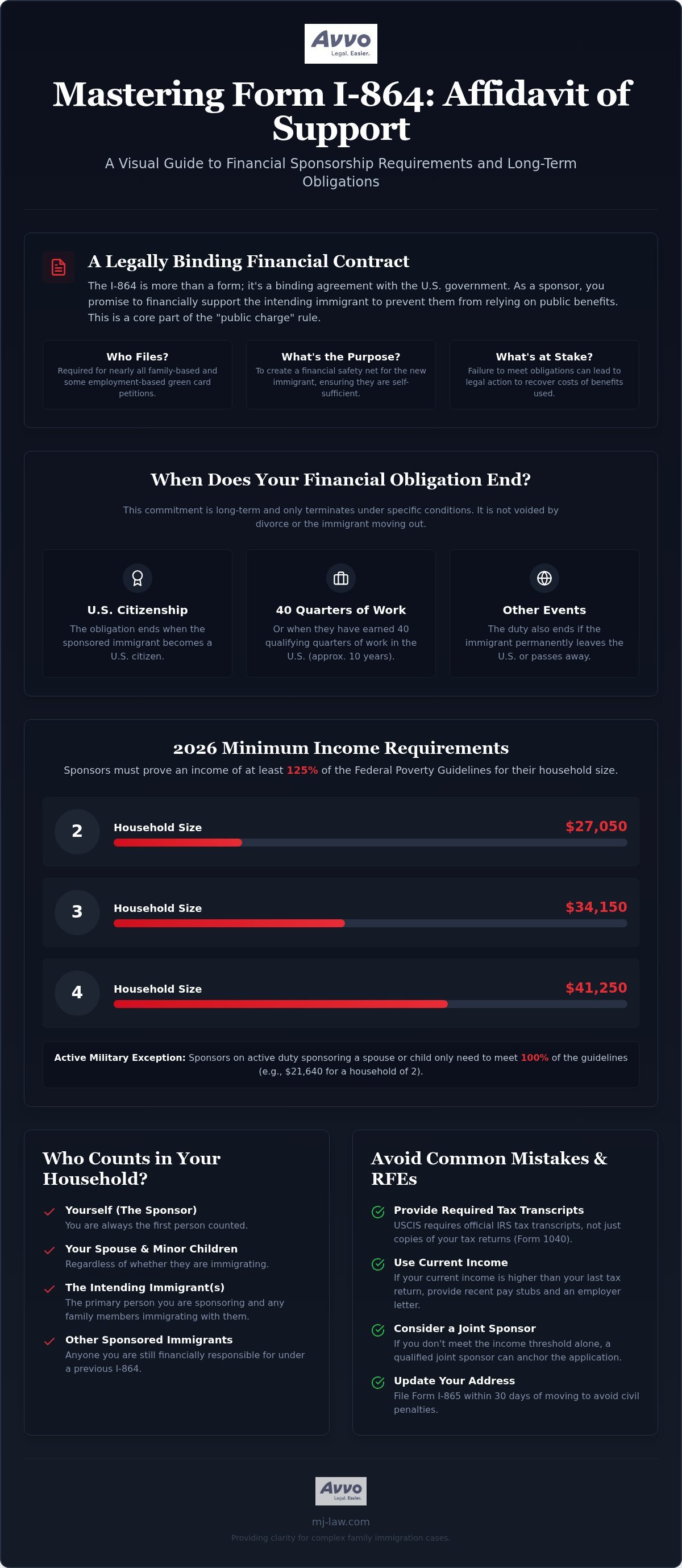
Your obligations under this contract are significant and don’t end easily. Many sponsors mistakenly believe a divorce or a change in family dynamics terminates the agreement, but that’s not the case. The responsibility typically remains in force until the sponsored individual becomes a U.S. citizen, passes away, or leaves the country permanently. Another common milestone for termination is when the immigrant earns 40 qualifying quarters of work, which usually takes about 10 years of employment in the United States.
If the sponsored relative receives means-tested public benefits, the providing agency can sue you to recover those costs. To manage this partnership with the government, you’re also required to report any change of address using Form I-865 within 30 days of moving. This ensures the government can always reach the person holding the financial anchor for the new resident. Failing to update your address can lead to civil fines, highlighting the serious nature of this long-term commitment. Just as you must protect yourself against immigration-related liability, it is equally important to have trusted representation for other legal challenges; for instance, Oberg Law Office provides dedicated advocacy for those navigating the complexities of personal injury claims.
Who Must File Form I-864?
Most family-based immigration paths require the petitioner to submit an affidavit of support form i 864. USCIS applies this requirement to several specific groups to ensure broad financial coverage:
- Immediate Relatives: This includes spouses of U.S. citizens, unmarried children under 21, and parents of citizens who are at least 21 years old.
- Family Preference Categories: This covers adult children (married or unmarried) and siblings of U.S. citizens, as well as the spouses and children of permanent residents.
- Employment-Based Exceptions: If a relative filed the underlying petition or owns a 5% or greater interest in the business that filed the petition, they must act as a sponsor.
Our firm has seen how these requirements impact diverse Silicon Valley families since 1985. We provide the steady hand needed to navigate these technical definitions with confidence, ensuring your family’s petition rests on a solid legal foundation. Understanding these categories is the first step in avoiding the confusion that often leads to processing delays. U.S. citizens sponsoring their parents should also review our detailed guide on how to help your parents get a green card with a California attorney’s guidance to understand the full scope of the petition process.
Meeting the 2026 Income Requirements and Poverty Guidelines
The financial heart of the Form I-864 Affidavit of Support involves proving you earn enough to support your entire household at a level well above the poverty line. For 2026, most sponsors must demonstrate a sustained income of at least 125% of the Federal Poverty Guidelines. In the 48 contiguous states, this means a household of two requires an income of $27,050. For a family of three, the requirement rises to $34,150, and for four, it reaches $41,250. If you’re on active duty in the U.S. Armed Forces and sponsoring a spouse or child, the threshold is lower, requiring only 100% of the guidelines, which is $21,640 for a household of two.
A common source of stress for sponsors is the distinction between “current income” and “tax return income.” USCIS looks at your most recent federal tax transcript to establish a history of earnings, but they make their final decision based on what you’re earning at the moment you file the affidavit of support form i 864. If you’ve recently started a higher-paying job in San Jose, your current pay stubs and an employer letter can often overcome a lower income figure from the previous tax year. This flexibility is vital for families who have seen their financial situation improve since their last tax filing.
Determining Your Household Size Correctly
Calculating your household size is a precise exercise that goes beyond just the people living under your roof. You must include yourself, your spouse, and any unmarried children under the age of 21. You also have to count the intending immigrant and every family member who is immigrating with them. If you’ve previously sponsored someone who is now a permanent resident and still covered by an active I-864, they must be included in your count as well. In Silicon Valley’s multi-generational homes, you may also choose to include other relatives as household members to combine incomes, provided they’ve lived with you for the last six months and are willing to sign Form I-864A.
Silicon Valley Assets: Using RSUs and Stock Options
In our local tech economy, base salary doesn’t always tell the whole story. If your annual income falls short of the 125% threshold, you can use the value of your assets to make up the difference. For a spouse or child, you must show assets worth three times the income gap. For most other relatives, that ratio increases to five times the gap. Vested Restricted Stock Units (RSUs) can be used as significant assets in 2026 as long as they are liquid and can be converted to cash within one year without harming the sponsor’s financial stability. Since 1985, MJ Law has helped sponsors navigate these high-stakes financial calculations to ensure their equity and investments are properly credited by USCIS. We’ve seen how a steady, expert hand can turn a complex financial portfolio into a winning green card application.
Sponsors, Joint Sponsors, and Household Members
Every family-based green card petition requires a primary sponsor. This is always the person filing the initial immigrant petition, and they must submit the USCIS Form I-864 regardless of their personal income level. If the primary sponsor’s individual earnings don’t meet the 125% threshold we detailed in the previous section, the application isn’t automatically denied. Instead, the sponsor can bring in additional financial support to bridge the gap. This collaborative approach ensures that family unity remains the priority, even when one person’s current income falls short of the federal guidelines.
The Role and Risk of a Joint Sponsor
A joint sponsor acts as a secondary financial anchor for the intending immigrant. Many people believe a joint sponsor must be a relative, but that’s a common misconception. Any U.S. citizen or permanent resident who is at least 18 years old and lives in the United States can serve in this role. While an immigrant can have up to two joint sponsors in specific family-group scenarios, most cases rely on one strong joint sponsor to meet the requirements. It’s vital to remember that a joint sponsor accepts the same shared liability as the primary sponsor. They’re legally responsible for the immigrant’s financial well-being until the obligation ends, making this a significant request to ask of a friend or extended family member.
Using Form I-864A for Household Income
If you live with other working adults, you may be able to combine your incomes to meet the government’s standards. This is accomplished using Form I-864A, which is a contract between the primary sponsor and a household member. This option is frequently used by spouses, adult children, or parents who reside in the same San Jose home. To qualify, you must provide clear documentation of your relationship and shared residency, such as marriage certificates or shared lease agreements. By signing the I-864A, the household member agrees to make their income and assets available to support the immigrant, creating a joint liability that strengthens the overall affidavit of support form i 864 filing.
In rare and tragic circumstances where a petitioner passes away while the application is pending, a “substitute sponsor” can step in. This allows a close relative to take over the financial duties of the affidavit of support form i 864 to keep the petition alive. Since 1985, MJ Law has provided a steady hand to families navigating these sensitive transitions. We offer bilingual support in English and Spanish to ensure every sponsor and joint sponsor fully understands the long-standing commitment they’re making to their loved ones.
How to Avoid Common I-864 Mistakes and RFEs
Filing the affidavit of support form i 864 requires a level of precision that many sponsors find overwhelming. A single missing signature or an outdated form version can trigger a Request for Evidence (RFE), which stalls your family’s immigration journey. To ensure a smooth process, follow these critical steps:
- Use the correct edition: Verify your form has the 10/17/24 edition date. USCIS has strictly required this version since February 10, 2025.
- Prioritize tax transcripts: Always provide official IRS tax transcripts rather than just copies of your Form 1040. Transcripts are the gold standard for USCIS because they confirm the IRS has already processed and verified your data.
- Complete every field: Never leave a space blank. If a question doesn’t apply, type “N/A” or “None” to show you haven’t simply overlooked the section.
- Verify signature requirements: While USCIS has modernized some procedures, many officers still prefer a “wet” ink signature. Check the latest filing instructions to ensure your signature isn’t rejected as a “copy.”
- Prove sponsor status: Include a clear copy of your U.S. passport, birth certificate, or Green Card to establish your legal standing to act as a sponsor.
Documentation Checklist for a Strong Filing
A successful filing relies on the quality of your evidence. Beyond tax transcripts, you should include an employment verification letter on company letterhead and your six most recent pay stubs. These documents prove that your current income matches what you’ve reported on the form. If you’re using assets to meet the 125% threshold, provide current bank statements dated within the last 12 months. For real estate assets, USCIS requires a formal appraisal from a licensed professional; online estimates from sites like Zillow are generally not accepted as valid proof of value.
The Consequences of a “Request for Evidence” (RFE)
An RFE isn’t a denial, but it acts as a significant roadblock. In the San Francisco field office, an RFE can delay a green card approval by three to six months as your file is moved out of the active processing queue. Common triggers for these notices include mismatched household sizes or failing to include the income documentation for a joint sponsor. Professional legal review prevents RFE-related delays by identifying these technical inconsistencies before your packet ever reaches a government desk. If you want to avoid these costly setbacks, contact our San Jose immigration experts to ensure your filing is audit-ready from day one.
Why Consult an Immigration Lawyer in San Jose for Your I-864?
The financial and legal implications of the affidavit of support form i 864 are too significant to leave to chance. While online guides provide a basic overview, they often fail to account for the unique economic environment of Silicon Valley or the specific scrutiny applied by local USCIS field offices. Partnering with a seasoned legal team ensures that your financial strategy is not only compliant but optimized for success. This is particularly vital for high-asset professionals whose income includes complex elements like the RSUs we explored in previous sections. For U.S. citizens sponsoring aging parents, working with a dedicated parent green card attorney in California ensures that both the I-130 petition and the financial sponsorship requirements are handled correctly from the start.
Our firm provides the comprehensive support necessary to navigate these high-stakes petitions. We offer bilingual services in English and Spanish, ensuring that every family member involved in the sponsorship process understands their rights and responsibilities. This personal touch, combined with our professional precision, transforms a stressful bureaucratic requirement into a manageable step toward family unity. You shouldn’t have to guess whether your documentation will satisfy a government officer’s requirements.
MJ Law: Your Steady Hand in Silicon Valley
Since 1985, MJ Law has served as a reliable anchor for families in the San Jose area. Our 30+ years of experience allow us to anticipate the specific questions that arise during interviews at the San Francisco and San Jose field offices. We understand how local officers interpret “Public Charge” rules and what specific evidence they look for when reviewing a affidavit of support form i 864. This local expertise is a critical advantage that national firms or automated services simply cannot provide.
If your case involves high-net-worth individuals or complex household structures, a local attorney provides a distinct advantage. We don’t just file forms; we craft a narrative of financial stability that protects your family from unnecessary delays. Our deep roots in the community mean we’ve successfully navigated countless scenarios, from straightforward petitions to those requiring substitute sponsors or complex asset valuations. We position ourselves as your partner, ensuring your legal strategy is as robust as your financial one.
Ready to Bring Your Family Home?
The journey toward a successful family green card petition begins with a clear understanding of your obligations. We help you gather the right documentation, calculate household sizes accurately, and address potential red flags before they become RFEs. Our goal is to provide the peace of mind that comes from knowing your contract with the government is legally sound and your family’s future is secure.
Taking the first step is simple. We invite you to schedule a consultation with our experienced legal team to discuss your specific situation. We’ll review your financial documents, explain the long-term commitments involved, and develop a customized plan for your petition. Contact MJ Law today for a family immigration consultation. We look forward to helping you build a bridge for your family’s success in the United States.
Secure Your Family’s Path to Permanent Residency
Navigating the affidavit of support form i 864 requires more than just filling out a document; it’s about building a solid financial foundation for your family’s future in the United States. You now understand that meeting the 2026 income guidelines and providing meticulous documentation are critical steps to avoiding the delays caused by Requests for Evidence. Whether you’re calculating complex Silicon Valley assets or coordinating with a joint sponsor, precision is your best defense against processing setbacks.
With over three decades of immigration expertise, MJ Law serves as a steady hand for families throughout San Jose and the Silicon Valley tech hubs. Our bilingual English and Spanish staff provides the compassionate, high-level guidance you need to handle these intricate legal obligations with confidence. We’ve been helping families reunite since 1985, and we’re ready to apply that same dedication to your success story. Don’t let paperwork errors stand in the way of your loved ones’ green card approval. Schedule Your Consultation with MJ Law Today to ensure your petition is handled with the care and authority it deserves. Your family’s journey is our priority.
Frequently Asked Questions
Is the I-864 Affidavit of Support legally binding forever?
The obligation ends only upon specific milestones rather than a set expiration date. These include the immigrant becoming a U.S. citizen, earning 40 quarters of work credit, permanently departing the country, or passing away. It’s a long-term commitment that doesn’t expire simply because time passes. Sponsors should understand that this contract remains active even if the family relationship changes or the sponsor’s financial situation fluctuates significantly over the years.
Can I use my house as an asset to meet the I-864 requirements?
You can include the net value of your home as an asset if you’re the primary owner. To do this, you must provide a current-year appraisal from a licensed appraiser rather than a digital estimate from a real estate website. The value used is the appraised price minus all mortgages or liens. Since the house must be convertible to cash within one year, proving equity is essential for this asset to count toward the 125% threshold.
What happens to the I-864 if we get a divorce?
Divorce does not terminate your financial obligations under the affidavit of support form i 864. The contract is between you and the U.S. government, not between you and your spouse. Even after a legal separation or divorce, the sponsor remains liable for supporting the immigrant and reimbursing the government for any means-tested benefits they might receive. This remains true until one of the five legal termination events occurs, such as citizenship or work credits. To learn more about how family law issues can affect your immigration standing, it is helpful to consult with a firm that understands both practice areas.
Do I need an I-864 if my spouse is already working in the U.S.?
The petitioner must file an affidavit of support form i 864 regardless of the immigrant’s current employment status. However, if your spouse is working legally in the U.S., their income can be pooled with yours to meet the 125% requirement. This usually requires filing Form I-864A as a household member. You’ll need to prove they’ve lived in your household for at least six months and that their income will continue from the same source after they get their green card.
Can a retired person be a sponsor for Form I-864?
Retired individuals can absolutely serve as sponsors as long as their total income meets the poverty guidelines. USCIS accepts Social Security benefits, pension payments, and regular 401(k) or IRA distributions as valid income. If these fixed payments aren’t enough, retirees often use the value of their savings accounts or investments as assets to bridge the gap. We’ve helped many Silicon Valley retirees successfully sponsor family members using these combined financial strategies.
What is the difference between Form I-864 and Form I-134?
Form I-864 is a permanent, legally enforceable contract used for green card applications. Form I-134 is a shorter document used primarily for non-immigrant visas, such as K-1 fiancé visas or humanitarian parole. While I-134 is a declaration of financial support, it doesn’t carry the same long-term reimbursement liabilities as the I-864. Once a K-1 holder applies for a green card, the sponsor must transition to the more robust I-864 to satisfy USCIS requirements.
How much does it cost to file Form I-864 in 2026?
There is no filing fee when you submit the form directly to USCIS as part of an adjustment of status packet. However, if you’re processing the application through the National Visa Center (NVC) for an immigrant outside the U.S., a $120 review fee usually applies. It’s important to verify these costs with the Department of State, as they’re separate from the $1,440 I-485 filing fee often paid by adults in 2026.
Can a joint sponsor be someone who doesn’t live in California?
A joint sponsor can reside in any of the 50 U.S. states or territories. They don’t need to live in San Jose or even in California to qualify. As long as they’re a U.S. citizen or permanent resident, at least 18 years old, and meet the income requirements for their own household size, their location doesn’t disqualify them. They simply need to provide proof of their U.S. domicile and their complete financial documentation.