Imagine sitting down for dinner in San Jose, looking at an empty chair, and realizing that your brother’s visa application might take over twenty years to process. For many families, this isn’t just a fear; it’s the reality of the F4 visa category in 2026, where applicants from countries like Mexico are currently seeing priority dates from April 2001. If you’re feeling overwhelmed by the backlog or worried about making a mistake that costs you years of progress, you aren’t alone. Partnering with an experienced sibling immigration lawyer California families trust can make the difference between a successful filing and a devastating denial.
We understand that waiting decades for a family reunion is an emotional marathon that requires precision from day one. You’ve worked hard to build a life here, and you want to ensure your siblings and their children are protected throughout this journey. This guide provides the exact legal requirements, current 2026 timelines, and strategic steps needed to secure a priority date and manage the complexities of derivative beneficiaries. We’ll walk through the F4 category details, explain how the Child Status Protection Act might apply to your nieces and nephews, and show you how to build a rock-solid petition that stands the test of time.
Key Takeaways
- Learn why only U.S. citizens aged 21 or older can initiate a sibling petition and why green card holders must naturalize before they’re eligible to sponsor.
- Understand how to navigate the F4 visa backlog and why consulting a sibling immigration lawyer California families trust is essential for tracking priority dates over several decades.
- Discover how to include your sibling’s spouse and children as derivative beneficiaries while using strategic planning to prevent children from “aging out” of eligibility.
- Get a clear breakdown of the two-phase application process, beginning with the I-130 petition to establish your family’s priority date as early as possible.
- See how consistent legal oversight ensures your file remains accurate and updated throughout the 15 to 20 year waiting period common for many countries.
Eligibility Requirements for Sponsoring a Brother or Sister
Establishing the foundation for a sibling petition starts with two non-negotiable facts. You must be a U.S. citizen, and you must be at least 21 years old. These rules are absolute. Green card holders don’t have the legal standing to sponsor a brother or sister until they complete the naturalization process. Because the wait times for these visas are historically long, every month you wait to file can add years to the final arrival date. A sibling immigration lawyer California expert can help you verify your eligibility today so you don’t waste time on a petition that USCIS will eventually reject.
Proving your biological or legal relationship is the next critical step. You’ll need to provide primary evidence, which usually consists of birth certificates showing you share at least one common parent. If primary documents are unavailable or missing, you may need to submit secondary evidence like baptismal records, school transcripts, or medical records. You must also demonstrate the financial ability to support your sibling. By filing Form I-864, the Affidavit of Support, you agree to maintain your sibling at 125% of the Federal Poverty Guidelines. If your personal income doesn’t meet this threshold, you can often use a joint sponsor to fulfill this requirement.
Who Qualifies as a Sibling Under U.S. Law?
U.S. immigration law recognizes several types of sibling bonds beyond biological brothers and sisters. Whole siblings share both parents, while half-siblings share only one. Step-siblings can qualify if the marriage that created the relationship happened before both children turned 18. Adopted siblings are also eligible if the adoption was finalized before the child reached age 16. Managing these non-traditional family structures requires precise documentation to satisfy USCIS officers who scrutinize family-based immigration petitions for any signs of fraud or inconsistency.
The U.S. Citizen Requirement
The requirement for U.S. citizenship is a common hurdle for many Bay Area residents. Since Lawful Permanent Residents cannot sponsor siblings, naturalization is often the first legal hurdle to clear. MJ Law frequently assists clients with their citizenship applications specifically to pave the way for a sibling petition. It’s a strategic move that requires a sibling immigration lawyer California specialist to ensure your naturalization is handled correctly. Once you take your oath, you can immediately file the I-130 petition to secure your sibling’s place in line. For family members who may be pursuing other immigration pathways simultaneously, understanding the full range of visa options — including working with a fiance visa attorney San Jose families rely on for K-1 petitions — can help coordinate the most effective strategy for your household.
Navigating the F4 Visa Backlog and Priority Dates
Sponsoring a sibling falls under the F4 preference category. This is often the most challenging path in the family preference system due to the sheer volume of applicants. Your Priority Date is the most important piece of information you’ll receive from USCIS. It represents your official place in the queue for a green card. Because this category is subject to strict annual limits, filing your I-130 petition as soon as you’re eligible is the only way to minimize the total wait time. Waiting even six months to file can push your sibling’s arrival back by years if a sudden backlog occurs.
A sibling immigration lawyer California families rely on can help you interpret the complex nuances of the monthly Visa Bulletin. This document tracks two different timelines: the “Final Action Date” and the “Date for Filing.” The latter often allows you to begin administrative work with the National Visa Center (NVC) before a visa is technically available. Understanding these charts is vital for planning your family’s future and ensuring you’re ready to act the moment your window opens.
Understanding Country-Specific Wait Times
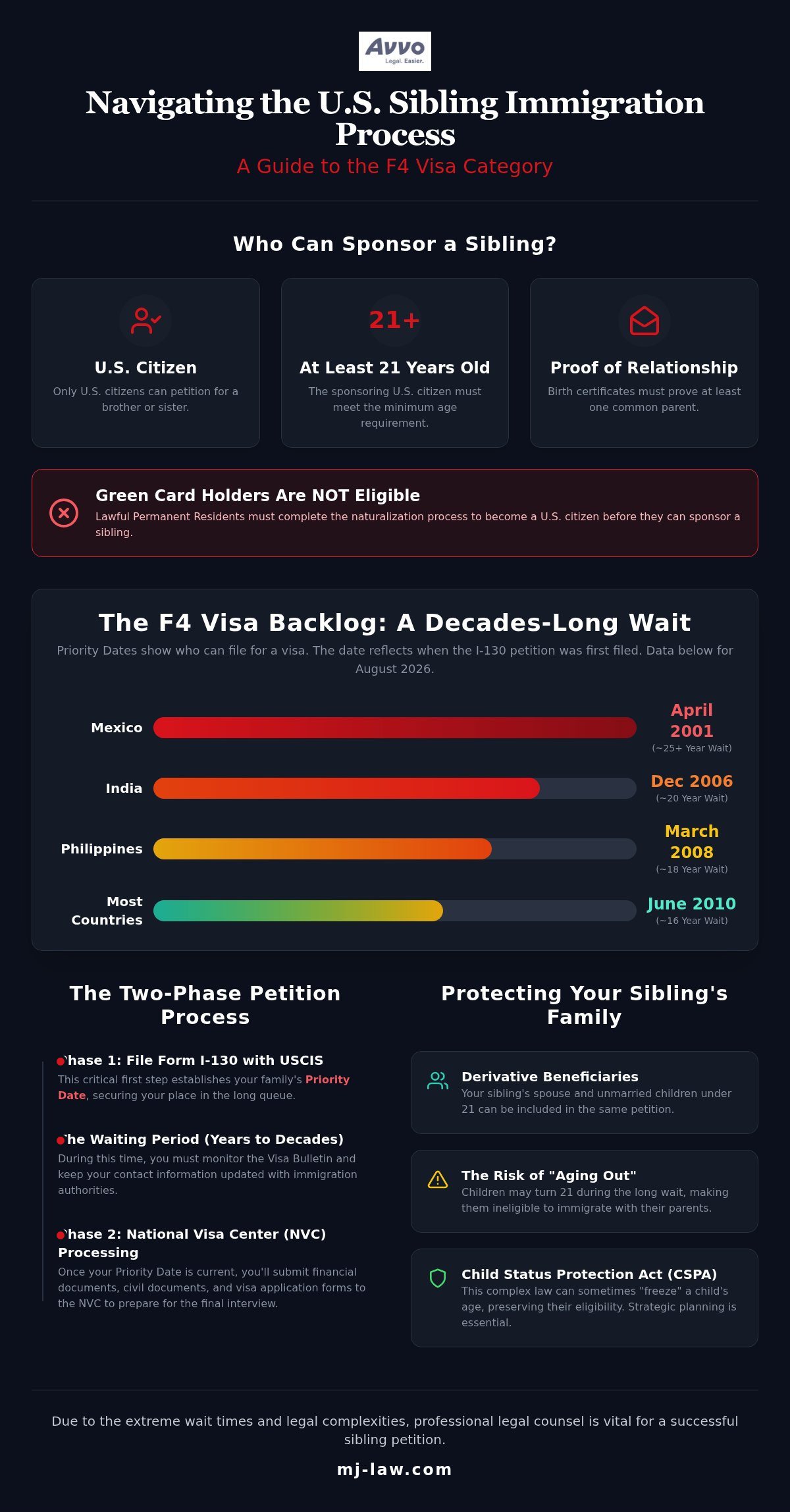
Wait times vary significantly based on your sibling’s country of birth. As of August 2026, the Dates for Filing for most countries sit at June 22, 2010. However, high-demand regions face much longer delays. Applicants from India are currently looking at a date of December 15, 2006, while those from the Philippines are at March 22, 2008. The backlog for Mexico remains the most severe, with a filing date of April 30, 2001. Per-country caps limit any single nation to 7% of the total available visas each year, which creates these disparate wait times for high-demand regions.
Tracking Your Priority Date Over Time
Managing a case that spans two decades requires meticulous organization. You must monitor the Visa Bulletin every month to see if your Priority Date has become current. If your date passes and you don’t take action within one year of notification, you risk losing the petition entirely. Keeping your contact information current with the NVC is a responsibility that lasts for years. If you move or change email addresses, you must update the government immediately to ensure you receive the “Welcome Letter” when the time finally arrives. A sibling immigration lawyer California specialist can ensure your documentation remains compliant with evolving USCIS standards while you wait. Having a steady hand to manage your file over these decades provides the security that your family’s dream won’t be lost to a simple administrative error.
Strategic Planning for Long-Term Wait Times (CSPA and Derivatives)
One of the most significant advantages of the F4 sibling petition is that it functions as a comprehensive family strategy. When you sponsor your brother or sister, their spouse and unmarried children under age 21 are automatically included as derivative beneficiaries. You don’t have to file separate petitions or pay additional filing fees for these family members during the initial I-130 stage. However, the multi-decade wait times we analyzed in previous sections create a major concern for parents: the risk of children “aging out” of the process before a visa becomes available.
Many families hesitate to start the process, asking if it’s worth it if a nephew or niece will be 30 years old by the time the priority date is current. This is a valid concern, but it’s often based on a misunderstanding of how the law protects families. Because of specific legal safeguards, many children who turn 21 during the wait can still immigrate with their parents. A sibling immigration lawyer California expert can help you monitor these timelines and apply the necessary protections to keep your family together. MJ Law’s three decades of experience provides the continuity required to track a child’s eligibility from their toddler years through early adulthood.
The Child Status Protection Act (CSPA) Explained
The Child Status Protection Act offers a lifeline to families worried about the “aging out” process. To determine if a child still qualifies as a derivative, the government uses a specific mathematical formula: you take the child’s biological age on the date the visa becomes available and subtract the total number of days the I-130 petition was pending with USCIS. If the resulting “CSPA age” is under 21, the child may still be eligible to immigrate. The Child Status Protection Act effectively freezes a child’s age for immigration purposes by subtracting the time the initial petition sat pending with USCIS from their biological age on the date a visa becomes available. To lock in this protection, the beneficiary must meet the “seeking to acquire” requirement by taking specific legal steps within one year of the visa becoming available.
Managing Family Changes Over Two Decades
Life doesn’t stand still while you wait for a priority date. Over twenty years, your sibling might marry, have more children, or face a divorce. Each of these life events changes the composition of the petition. New spouses and children born after the initial filing can usually be added to the case as long as the principal relationship remains valid. If a petitioner passes away during the long wait, the case doesn’t necessarily die with them; we can often pursue humanitarian reinstatement to honor the original priority date. This level of long-term file management is where a sibling immigration lawyer California specialist becomes an essential partner, ensuring that every family milestone is documented and every legal protection is utilized.
The Step-by-Step Sibling Petition Process
The journey to bringing a brother or sister to the United States is an administrative marathon divided into distinct phases. It’s a process that moves from the domestic oversight of USCIS to the international coordination of the Department of State. Because this process spans decades, each step must be executed with high-level precision to avoid rejections that could set your timeline back even further. Working with a sibling immigration lawyer California families trust ensures that your file remains compliant with regulations that may change several times before your sibling ever sets foot in an embassy.
The process generally follows three main phases: establishing the legal relationship, waiting for visa availability, and finally, the immigrant visa application. While the middle phase is mostly a period of monitoring the Visa Bulletin, the first and third phases require intense documentation and legal strategy. A mistake in the initial filing can lead to a Request for Evidence (RFE) that delays your priority date, while a mistake in the final phase can lead to a visa denial at the very end of your twenty-year wait.
Phase 1: The I-130 Petition
The process begins when you file Form I-130, Petition for Alien Relative. As of August 2026, the filing fee is $625 for online submissions and $675 for paper filings. You must use the current 04/01/24 edition of the form to avoid immediate rejection. During this phase, you are proving two things: your own U.S. citizenship and your valid sibling relationship. Common RFEs often stem from poorly translated foreign birth certificates or insufficient evidence of a common parent in cases involving half-siblings or adoptions. Once USCIS issues an I-797 Notice of Action (Approval), it confirms the relationship is recognized. However, it’s important to remember that this approval does not grant your sibling any right to live or work in the U.S.; it simply secures their place in the long queue. Premium processing is currently not available for sibling I-130 petitions, so patience is required from the very start.
Phase 3: The National Visa Center (NVC) and Consular Processing
Once your priority date finally becomes current, the case moves to the National Visa Center. This is the “documentary qualification” stage. Your sibling must provide police certificates from every country they’ve lived in, undergo a medical examination by a designated physician, and submit various financial forms. If your sibling is abroad, they’ll undergo consular processing, culminating in an interview at the U.S. Embassy or Consulate in their home country. If they are already in the U.S. in a valid non-immigrant status, they might be eligible for an Adjustment of Status using Form I-485. Preparing your sibling for the final interview is a vital service we provide, ensuring they can confidently answer questions about their history and your relationship. To ensure your family’s paperwork is handled with the care it deserves after such a long wait, you should consult with MJ Law to manage the final transition.
A sibling immigration lawyer California specialist can guide you through the civil surgeon locator tools and ensure all medical and security clearances are current. When the consular officer approves the visa, your sibling will receive an immigrant visa in their passport, allowing them to enter the United States as a Lawful Permanent Resident.
Why Professional Legal Counsel is Vital for Sibling Petitions
Sponsoring a sibling is a generational commitment. This legal journey often lasts longer than most business partnerships or even some marriages. Because the F4 visa category frequently involves wait times of 15 to 20 years, you need a legal partner with the longevity to see the case through to the end. MJ Law has served the Silicon Valley community for over three decades. This history is vital. It means we’ve successfully guided families from their initial I-130 filing in the early 2000s to their final green card interviews today. Choosing a sibling immigration lawyer California families trust ensures that your family’s future isn’t left to a firm that might not exist when your priority date finally becomes current.
The technical complexity of these cases increases as time passes. As we discussed earlier, issues like the Child Status Protection Act require a deep understanding of evolving mathematical formulas and filing requirements. A generic document preparation service can’t provide the strategic oversight needed to prevent a child from aging out of the system. Our team offers bilingual support in English and Spanish, ensuring that every family member understands their rights and responsibilities. Having a local San Jose office allows for face-to-face consultations throughout the decades, providing a steady hand as immigration laws and USCIS procedures shift over time. Families navigating multiple immigration matters simultaneously — such as a sibling petition alongside a San Jose fiancé visa attorney engagement for a K-1 petition — benefit greatly from having a single experienced firm coordinate all aspects of their family’s immigration strategy.
The Benefit of Continuity in Your Legal Team
Continuity is the greatest asset in a multi-decade immigration case. When a firm maintains meticulous records over twenty years, they can easily respond to government inquiries about documents filed half a lifetime ago. We don’t just file your paperwork and walk away. We provide ongoing case monitoring, tracking the Visa Bulletin and keeping your file “documentarily ready” for the National Visa Center. This level of professional oversight offers peace of mind. It ensures that a simple address change or a missed notification doesn’t result in the termination of a petition you’ve waited nearly half your life to complete. Our sibling immigration lawyer California experts act as a reliable anchor in a specialized and often intimidating field.
Get Started with MJ Law in San Jose
The best time to establish your priority date was years ago; the second best time is today. To begin this journey, you can schedule an initial consultation with Gabriel Jack or Michael Muston at our San Jose office. During this meeting, we’ll review your proof of citizenship and your sibling’s birth records to ensure a solid foundation for your I-130 petition. Please bring any existing immigration documents, marriage certificates for your sibling, and birth certificates for any nieces or nephews you wish to include as derivatives. We’ll provide a clear roadmap and a realistic assessment of the timeline ahead. Contact MJ Law today to begin your family’s journey.
Securing Your Family’s Future in the United States
Sponsoring a sibling is a marathon that requires immediate action to lock in a priority date. Successful navigation of the F4 category depends on understanding eligibility, managing the multi-decade wait, and protecting derivative children through the Child Status Protection Act. Because this process often spans twenty years, the stability of your legal partner matters just as much as the initial filing. MJ Law brings over 30 years of experience to the Silicon Valley community, offering the steady hand needed for these complex family goals.
Our San Jose-based team provides bilingual services in English and Spanish, ensuring every family member feels supported from the first I-130 petition to the final consular interview. Partnering with a dedicated sibling immigration lawyer California families trust provides the security that your paperwork is handled with precision at every stage. Don’t let administrative errors jeopardize your family’s reunion after years of patient waiting. Schedule a consultation with MJ Law to discuss your sibling petition and take the first step toward bringing your loved ones home. We’re here to guide you through every milestone of this journey.
Frequently Asked Questions
Can I sponsor my sibling if I only have a Green Card?
No, you cannot sponsor a sibling as a Lawful Permanent Resident. Only U.S. citizens who are at least 21 years old are eligible to file Form I-130 for a brother or sister. If you currently hold a green card, your first step should be naturalization. A sibling immigration lawyer California families trust can help you navigate the citizenship process to ensure you can begin the sibling petition as soon as possible.
How much income do I need to sponsor my brother or sister?
You must demonstrate an income that meets at least 125% of the Federal Poverty Guidelines for your household size. This requirement is verified through the I-864 Affidavit of Support when the visa becomes available. If your income is insufficient, you may use a joint sponsor to meet the financial threshold. This ensures the sponsored sibling won’t become a public charge upon their arrival in the United States.
What happens to the petition if the U.S. Citizen sponsor moves to a different state?
Moving to a different state doesn’t invalidate your petition. You must update your address with USCIS or the National Visa Center (NVC) within ten days of your move. While the legal requirements remain the same nationwide, keeping your local San Jose attorney informed ensures that all correspondence reaches the correct office. The priority date established at the time of your initial filing remains your permanent place in the queue.
Can my siblings children come to the U.S. with them?
Yes, your sibling’s unmarried children under age 21 can generally immigrate as derivative beneficiaries. They are included in the same petition as their parent. If a child turns 21 during the long waiting period, they may still be eligible under the Child Status Protection Act (CSPA). This act allows for a mathematical age reduction based on the time the initial petition was pending, helping families stay together despite lengthy backlogs.
Is there a way to speed up a sibling immigration petition?
There is currently no premium processing or legal method to speed up the F4 visa category. The wait times are dictated by annual limits and per-country caps established by Congress. The most effective strategy is to file the initial petition as early as possible to secure the earliest possible priority date. Working with a sibling immigration lawyer California expert ensures your application is error-free, preventing unnecessary delays caused by government requests for evidence.
What is the “Priority Date” and where can I find mine?
The Priority Date is your official place in the immigration line, established the day USCIS receives your I-130 petition. You can find this date on the I-797 Notice of Action you received after filing. To see when a visa might be available, you must compare your priority date to the dates listed in the Department of State’s monthly Visa Bulletin. Tracking this accurately is vital for preparing the final application steps.
Does my sibling need to be in the U.S. while the petition is pending?
No, your sibling doesn’t need to be in the United States while the petition is pending. In fact, most beneficiaries remain in their home countries during the 15 to 20 year wait. If they choose to visit the U.S. on a temporary visa like a B1/B2, they must still demonstrate non-immigrant intent. A pending I-130 can sometimes complicate tourist visa applications, so it’s wise to consult with legal counsel before they travel.
What happens if the U.S. Citizen sponsor passes away before the visa is ready?
If the petitioner passes away, the petition is technically revoked, but you can request humanitarian reinstatement. This allows the sibling to continue the process if a qualifying relative acts as a substitute financial sponsor. You must demonstrate that the revocation would cause undue hardship to the family. This is a complex legal area where the steady hand of an experienced firm is essential to preserve a priority date that took decades to reach.